

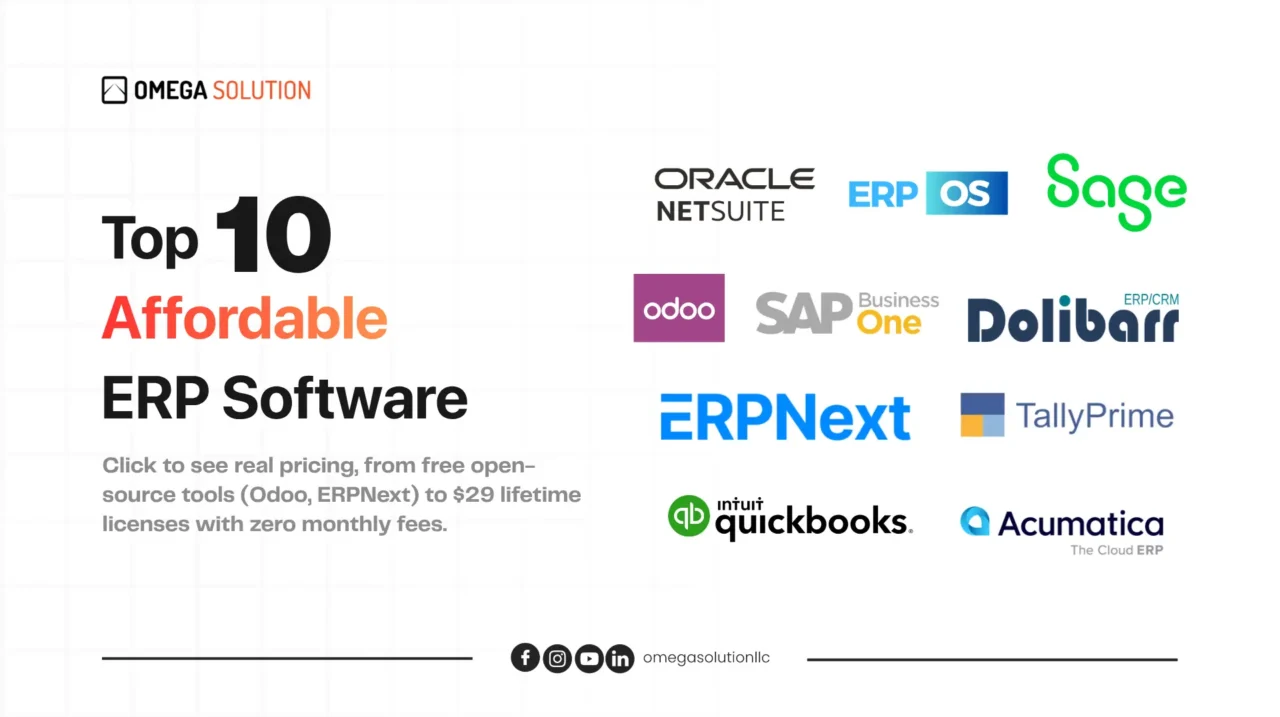
2026 Top 10 Affordable ERP Software | 29$ Only
 By Hamim Mahamud
Imagine you own a thriving retail shop in a busy town, and everything is running smoothly, until one day; you realize you’ve oversold a product, your inventory records don’t match, and an important invoice is missing. Customers are frustrated, and so are you. Now, think about this: What if all these operations could be automated and unified in one system, reducing errors and boosting efficiency? This is exactly what Enterprise Resource Planning (ERP) software does for businesses.
In 2026, ERP systems are no longer a luxury; they’re a necessity. Whether you’re a small business owner, a growing startup, or a mid-sized enterprise, choosing a cost-effective ERP solution saves time, minimizes human errors, and protects your profit margins. But the big question is: Which ERP software is the cheapest and most affordable for your business?
ERP Software Meaning & Quick Pricing Comparison (2026)
ERP software integrates core business processes, accounting, inventory, CRM, billing, and human resources into a single database. Businesses often ask, What is the best budget ERP software for small businesses and growing teams? To answer that immediately, here is a side-by-side pricing and licensing comparison of the top 10 cheapest ERP software systems in 2026, covering free open-source, one-time lifetime licenses, and monthly cloud subscriptions. Learn More About How ERP Works
| ERP Software | Best For | Licensing Model | 2026 Pricing | Core Modules Included |
|---|---|---|---|---|
| ERP OS | Small & Multi-Store Businesses (Best Value) | One-Time Lifetime License (Unlimited Users) | $29 once (Single Store) / $39 once (Multi-Store) | Accounting, Inventory, POS, Billing, CRM |
| ERPNext | Businesses with In-House IT Staff | Open-Source / Cloud Subscription | Free (Self-Hosted) / From $50/mo (Cloud) | Accounting, Inventory, HR, CRM, Manufacturing |
| Odoo ERP | Growing Teams Needing Modular Apps | Free Single App / Per-User Cloud SaaS | Free (Community) / From $19.90/user/mo | Sales, Invoicing, CRM, Inventory, HR |
| Dolibarr | Micro Businesses & Freelancers | Open-Source / Cloud Subscription | Free (Self-Hosted) / From $10/mo (Cloud) | CRM, Quotes, Invoicing, Stock, HR |
| TallyPrime | Bookkeeping & Tax-Focused Shops | Monthly Rental or Perpetual License | From $21/mo (or ~$225 One-Time Silver) | Accounting, Financial Reports, Inventory, GST |
| QuickBooks Enterprise | Small Businesses Needing Advanced Accounting | Annual Subscription | Starts around $160/mo (Billed Annually) | Advanced Accounting, Order Management, Payroll |
| Sage 300 ERP | Multi-Currency & Distribution Operations | Per-User Subscription | Starts around $85–$100/user/mo (Custom Quote) | Financials, Inventory, Order Entry, Project Tracking |
| SAP Business One | Mid-Sized to Large Enterprises | Per-User Subscription or Perpetual | Starts around $110–$150/user/mo (Custom Quote) | Finance, Purchasing, Inventory, Supply Chain |
| Acumatica ERP | Mid-Market Companies Scaling Operations | Consumption-Based Cloud License | Custom Quote (Typically $1,000–$1,800+/mo) | Financials, Distribution, Manufacturing, CRM |
| NetSuite ERP | Fast-Growing Mid-Market Enterprises | Annual Cloud Subscription + Per-User Fee | Custom Quote (~$999/mo base + $99/user/mo) | Global Financials, Inventory Control, ERP, CRM |
Top 10 Affordable & Low-Cost ERP Software
1. ERPNext (Free & Open-Source ERP)
- Pricing: Free (Self-hosted open-source version); Managed Cloud plans start around $50/month
- Best for: Businesses with dedicated IT expertise
- Features: Accounting, inventory, HR, CRM, and manufacturing
ERPNext is a comprehensive open-source ERP system that allows businesses to download and customize its code at no licensing cost. However, self-hosting requires Linux server management and technical knowledge to install, maintain, and update, making it unsuitable for store owners who want a ready-to-use system out of the box.
2. Odoo ERP (Free Single-App & Paid Cloud Plans)
- Pricing: Free (Community Edition or One App Free); Paid plans start around $19.90 to $24.90/user/month
- Best for: Growing businesses looking for modular apps
- Features: Sales, invoicing, HR, inventory, and CRM
Odoo offers a free version for basic single-app functionalities, but once you combine accounting, inventory, and POS, businesses must upgrade to per-user paid plans. As your team grows from 2 users to 15 users, monthly subscription and implementation costs increase significantly.
3. Dolibarr (Lightweight Open-Source ERP)
- Pricing: Free (Self-hosted); Cloud-hosted versions start around $10–$14/month
- Best for: Small businesses and freelancers with technical expertise
- Features: CRM, invoicing, HR, and basic inventory management
Dolibarr is an open-source ERP and CRM package that lets small businesses manage operations for free if hosted on their own web server. However, automated cloud hosting and specialist modules require paid subscriptions or marketplace add-ons.
4. ERP OS | Budget ERP for SME Businesses
- Pricing:
– ERP OS (Single Store): $29 one-time payment (Lifetime license, unlimited users) Buy now
– ERP MS (Multi-Store): $39 one-time payment (Lifetime license, unlimited users) Buy now - Best for: Small to medium-sized businesses seeking a low-cost, ready-to-use ERP with zero monthly fees
- Features: Accounting, real-time inventory tracking, invoice management, POS integration, CRM, and a clean dashboard
Unlike free open-source ERP software that demands complex server configuration—or cloud ERPs that charge per user every month—ERP OS delivers a complete, ready-to-use system for a single $29 payment. Businesses can purchase the standard license with full source code directly or via CodeCanyon. For businesses operating multiple branches or warehouses, ERP MS provides centralized multi-store management for only $39 once. Try the Live Demo Now
5. TallyPrime
- Pricing: Rental plans start at $21/month (Perpetual Silver license starts around $225)
- Best for: Accounting-focused retail and distribution businesses
- Features: Financial reports, voucher entry, inventory tracking, and tax/GST compliance
TallyPrime is widely trusted for bookkeeping and billing, though it focuses primarily on traditional accounting and stock ledgers rather than modern web-based POS and CRM workflows.
6. SAP Business One
- Pricing: Custom quote (Typically starts around $110–$150/user/month plus implementation fees)
- Best for: Large enterprises and complex manufacturing
- Features: Advanced ERP modules for finance, purchasing, HR, and supply chain management
SAP Business One is one of the most established enterprise systems globally, but its per-user licensing and multi-thousand-dollar setup costs put it far outside the budget of small businesses compared to lifetime alternatives like ERP OS.
7. NetSuite ERP
- Pricing: Custom quote (Base platform starts around $999/month + ~$99/user/month)
- Best for: Funded mid-market and multi-subsidiary companies
- Features: Multi-currency financial management, automated inventory control, and enterprise CRM
Oracle NetSuite is built for mid-sized enterprises scaling internationally, but with annual contracts routinely exceeding $12,000 to $25,000+ per year, small businesses can achieve the core inventory, invoicing, and accounting workflows they need at a fraction of the price with a budget ERP.
8. Acumatica ERP
- Pricing: Custom quote based on transaction volume (Typically starts around $1,000–$1,800+/month)
- Best for: Mid-sized wholesale, construction, and manufacturing firms
- Features: Financials, distribution, inventory, and project accounting
While Acumatica doesn’t charge strictly per seat, its high minimum annual contract cost makes it an enterprise-tier investment. Small teams looking for unlimited users without enterprise overhead can use ERP OS for a one-time $29 cost.
9. QuickBooks Desktop Enterprise
- Pricing: Starts around $160/month (billed annually at ~$1,922/year for 1 user)
- Best for: Small businesses already using QuickBooks that need deeper inventory rules
- Features: Advanced financial reporting, order management, payroll, and inventory tracking
QuickBooks Enterprise is heavily accounting-centered, and adding multiple users or point-of-sale hardware quickly drives up annual subscription expenses.
10. Sage 300 ERP
- Pricing: Custom quote (Starts around $85–$100/user/month)
- Best for: Mid-sized businesses managing multi-location financials
- Features: Inventory, financials, order entry, payroll, and invoicing
Sage 300 ERP handles complex accounting structures well, but its recurring per-user subscription model requires continuous monthly payments. In contrast, ERP OS eliminates recurring SaaS bills entirely with its lifetime license.
Frequently Asked Questions
1. What is the most affordable ERP software for growing teams?
2. Which cheap ERP software has accounting, inventory, and CRM included?
• ERP OS ($29 Lifetime): Includes invoicing, accounting ledgers, barcode inventory, POS, and customer management out of the box.
• ERPNext (Free Self-Hosted): Includes full accounting, stock, and CRM, provided you have the technical skill to manage your own Linux server.
• Dolibarr (Free Self-Hosted / $10/mo Cloud): Bundles basic CRM, quotes, billing, and product stock tracking for micro-businesses.
3. What are the most affordable ERP licensing options for a small business under a tight budget?
• One-Time Lifetime License (Lowest 3-Year Cost): Solutions like ERP OS ($29–$39) give you full source code and lifetime usage with zero monthly subscription fees.
• Self-Hosted Open-Source: Platforms like ERPNext and Dolibarr charge $0 for the license, though you will pay $10–$30/month for cloud VPS hosting and handle your own maintenance.
• Monthly Cloud Subscription (SaaS): Tools like Odoo and TallyPrime let you start around $20/month with hosting included, but costs compound every year as you add users.
4. Which is the best cloud-based ERP software for small businesses?
Final Thoughts: Choosing the Right Cost-Effective ERP for Your Business
Selecting the best budget ERP system comes down to your team size, technical comfort, and whether you prefer monthly bills or a one-time purchase. While enterprise tools like NetSuite, SAP Business One, and Acumatica charge $1,000+ per month, small and mid-sized businesses can automate their entire operation, billing, POS, inventory, and accounting, for a single $29 lifetime payment with ERP OS.
Ready to automate your store and eliminate monthly software bills? Get ERP OS Today ($29 Lifetime License) or Test the Live Multi-Store Demo!
Related Guides: What is HRM Software? | Top 10 ERP Software in Bangladesh


 Aug 26, 2025


 Dhaka, Bangladesh


