

Top 20 Software Companies in the Gulf (2027 Guide)
 By Ashiqur Rahman
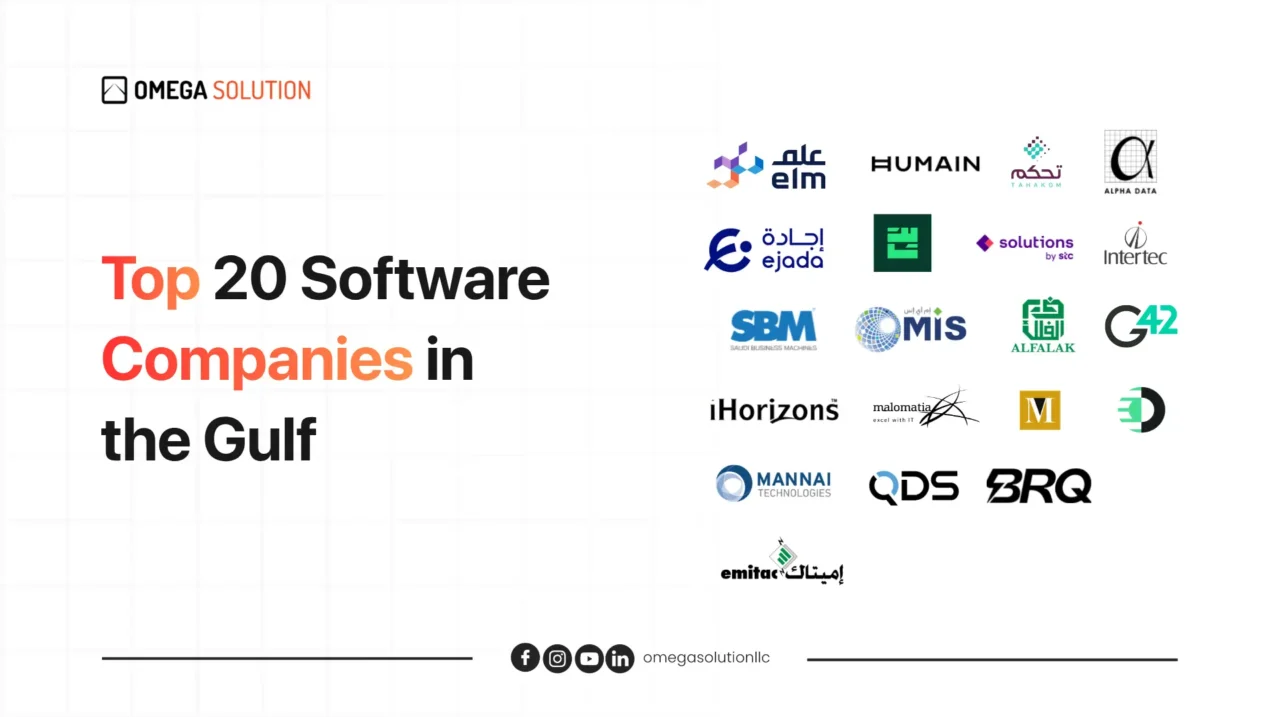
The Gulf’s software market is not one market. Saudi Arabia is dominated by large sovereign-backed firms running national platforms. Qatar’s sector is smaller and built around systems integrators serving the government. The UAE splits between listed integrators with decades of history and newly capitalized AI groups. A vendor that fits one of those three will often be wrong for the other two.
This guide covers twenty companies headquartered in the region, grouped by country. Each entry says what the company builds, how big it is, and the kind of buyer it suits. Sizes and founding dates come from the companies themselves or from named sources, and where a figure is a company’s own claim, the text says so.
If you are comparing a Riyadh firm against a Doha firm for the first time, start with the table. If you already know the country you are buying in, skip to that section.
Key Takeaways
Six points worth having before you read twenty company profiles. They are the shape of the market rather than a summary of the list, because the single most useful thing to know here is that the three countries behave differently and a firm that suits one often will not suit another.
- Saudi Arabia’s largest IT firms are mostly state-linked. Tahakom and SITE sit under the Public Investment Fund; HUMAIN was launched under it in May 2025, and solutions by stc belongs to the stc group.
- Qatar’s market is integrator-led. Of the six Qatari firms here, two describe custom software work and the rest lead with infrastructure, managed services or colocation.
- The UAE has the region’s only listed pure-play integrator in this set, Alpha Data, which reports AED 2.3 billion in 2024 revenue and more than 1,500 staff.
- Size varies by two orders of magnitude, from five in-house developers at BRQ Qatar to 23,000 people across the G42 group.
- Most of these firms are integrators rather than software developers. Only five describe building custom applications as a core service.
- Kuwait, Bahrain and Oman are not represented, and the reason is explained below.
What Does a Gulf Software Company Actually Do?
Most of them integrate rather than build. The regional norm is a firm that deploys, configures and runs software made by Microsoft, IBM, Oracle or SAP, wraps it in managed services, and takes responsibility for uptime. Firms that write custom applications from scratch are the minority in this set.
The four kinds of firm you will meet
Systems integrators deploy and run other people’s platforms, which covers most of this list. Custom software houses write applications to your requirements, and there are five here. Sovereign technology companies build and operate national platforms, which is a Saudi speciality. Infrastructure and cloud operators sell capacity and managed hosting rather than software.
Why the distinction decides your shortlist
An integrator is the right call when you are rolling out an ERP, a security stack or a cloud migration, because that is the work they do every week. A custom house is the right call when the thing you need does not exist as a product. Asking an integrator to build from scratch, or a five-person studio to run a national rollout, is the most common mismatch in this market.
Where the big budgets go
Government and quasi-government work dominates. Tahakom runs traffic and public-safety systems, SITE serves government bodies and national entities, malomatia’s client base is public sector, and Alpha Data’s named customers include ADNOC, DP World and Dubai Airports. A private mid-market buyer is not the typical client for the largest firms here.
How Was This List Built?
Seven published lists of Gulf and Saudi technology companies were read in full, every company named in them was recorded, and the set was then narrowed to firms headquartered in a Gulf Cooperation Council state that sell software or IT services to other organizations. Companies that published nothing checkable were dropped rather than padded out.
What was excluded
Telecom operators, because Ooredoo and Vodafone Qatar sell connectivity rather than software projects. Product-only vendors such as Foodics. Research bodies. And the publishers of the lists used to build the set, because six of those seven publishers placed themselves in their own rankings and four put themselves first.
How the facts were checked
Each company’s own website was read on 19 and 20 November 2026. Where a company’s site does not publish a founding date or a headcount, the figure comes from a named third party, and the text says which. Employee counts drawn from the Tamtam dataset are described by that source as derived from LinkedIn, so treat them as indicative.
The 20 at a Glance
Grouped by country, not ranked, because the firms here are not substitutes for one another. Founding years and sizes are as published by the company or by the named source beside them in the entries below. Read the last column first if you are shortlisting.
| Company | Country | Founded | Size | Known for | Best suited to |
|---|---|---|---|---|---|
| Elm | Saudi Arabia | timeline opens 1988 | 700,000+ clients claimed | National digital platforms including Yakeen and Muqeem | Government and large enterprise digital services |
| HUMAIN | Saudi Arabia | launched May 2025 | not published | The full AI stack, from data centers to models | AI infrastructure and large-scale AI programs |
| Tahakom | Saudi Arabia | 2015 | about 4,580 | Traffic, public safety and smart mobility systems | Public-sector mobility and surveillance projects |
| SITE | Saudi Arabia | 2017 | about 1,590 | Cybersecurity, cloud and five named platforms | Regulated and government cybersecurity work |
| Ejada | Saudi Arabia | 2005 | about 3,420 | Enterprise IT services across the Middle East | Banking and large enterprise system delivery |
| solutions by stc | Saudi Arabia | not published | about 4,010 | End-to-end IT services for large Saudi firms | Enterprise-scale managed IT |
| Saudi Business Machines | Saudi Arabia | 1981 | about 1,600 | IBM’s long-standing Saudi representative | IBM estates and enterprise integration |
| Al Moammar Information Systems | Saudi Arabia | 1979 | about 850 | Systems integration over four decades | Cloud, cybersecurity and enterprise applications |
| ALFalak | Saudi Arabia | 1981 | about 1,130 | IT distribution, integration and outsourcing | Hardware-led rollouts and managed manpower |
| iHorizons | Qatar | 1996 | 250+ Technologists | Custom software engineering for data-heavy systems | Custom builds in Qatar and the wider MENA region |
| malomatia | Qatar | 2008 | 1,100+ professionals | Application development and modernization | Qatari government and enterprise programs |
| Mannai Technologies | Qatar | more than 30 years | not published | Infrastructure, managed services and integration | Large Qatari IT estates |
| MEEZA | Qatar | not published | not published | Colocation, cloud and managed IT | Data center capacity and hosted infrastructure |
| QDS | Qatar | over 40 years | 150+ professionals | Microsoft business solutions and infrastructure | Mid-sized Qatari integration projects |
| BRQ Qatar | Qatar | not published | 5 + developers | Custom software, ecommerce and ERP work | Smaller custom builds and platform implementations |
| Alpha Data | UAE | 1981 | 1,500+ employees | Digital transformation and integration at scale | Large UAE enterprise and government estates |
| Intertec Systems | UAE | 1991 | 800+ employees | Services plus its own government platforms | Multi-country Gulf rollouts |
| G42 | UAE | not published | 23,000+ people | An AI and cloud group of ten companies | National-scale AI and cloud programs |
| Core42 | UAE | not published | 800+ engineers claimed | Sovereign cloud and AI infrastructure | Regulated workloads needing in-country hosting |
| Emitac Group | UAE | 1976 | not published | Integration, managed services and healthcare IT | Long-horizon UAE enterprise relationships |
Saudi Arabia: Nine Companies
Saudi Arabia has the region’s largest and most state-linked software sector. Three of the nine below sit under the Public Investment Fund or the stc group, and several run platforms that citizens and residents use daily. For a private buyer this means capability is deep and attention is competitive.
Elm
Elm builds and runs national digital services, and its best-known products are the identity-verification platform Yakeen and the residency platform Muqeem. Its own description is We innovate applications and digital products, across four lines: digital products, solutions, business outsourcing and consultancy. Its contact address is in Riyadh, and its company timeline records entering the Saudi stock market in 2022.
Best for government and large-enterprise digital service delivery. Its homepage claims more than 700,000 clients and over three billion transactions, which are its own figures and reflect platform usage rather than project count.
HUMAIN
The newest company on this list and the most heavily capitalized. The Public Investment Fund says HUMAIN was strategically launched in May 2025 under the Public Investment Fund (PIF) and is chaired by HRH Crown Prince Mohammed bin Salman, with a mandate to build the entire AI stack: data centers, cloud infrastructure, models, and applications. Its named partners include NVIDIA, Microsoft, AMD, Qualcomm, AWS, Google Cloud and grow, and it co-developed the ALLAM Arabic model with SDAIA.
Best for large AI infrastructure programs rather than application projects. In November 2026 it acquired the Riyadh cloud and AI firm CNTXT, which added cloud transformation, data and cybersecurity services to its portfolio.
Tahakom
The Saudi Technology and Security Comprehensive Control Company, established in 2015 and based in Riyadh. Saudipedia, published by the Saudi Ministry of Media, describes it as affiliated with Tahakom Investments Company, a Public Investment Fund subsidiary, and lists its two fields as public safety and smart mobility. Its work includes crowd management, vehicle identification and authentication, anomaly detection, traffic management, smart parking and connected-vehicle systems, running on an AI camera network across the Kingdom’s roads.
Best for public-sector mobility, traffic and surveillance projects. The Tamtam dataset puts its headcount at about 4,580, which makes it one of the largest IT employers in the country.
SITE
The Saudi Information Technology Company, established in 2017, with the Public Investment Fund named as its responsible entity. It works in cybersecurity, cloud and data science, and it publishes five platforms of its own: SITE Postal, SITE Inform, SITE Inspect, SITE Detect and SITE Guard. Saudipedia credits it with providing over 750 services to 250 beneficiaries, and with work on Hajj seasons, the Future Investment Initiative and the Kingdom’s G20 presidency.
Best for regulated and government cybersecurity programs. It holds PCI DSS v4.0, SOC 2 and CSA Trusted Cloud certifications, and in April 2024 it took a ten percent stake in the South Korean security firm AhnLab through its subsidiary SITE Enterprises.
Ejada
The most frequently recommended Saudi IT firm across the lists read for this guide, appearing on three of seven. Its IBM partner profile describes it as a Leading IT Solutions and Services company serving enterprises in the Middle East, and it holds IBM’s Platinum partner tier while operating as an ISV, systems integrator, managed service provider and reseller.
Best for banking and large enterprise delivery, which is where its reseller authorizations point. Founded in 2005 with a headcount reported at about 3,420 by Tamtam, though published figures differ between sources, with two other lists putting it above 3,500.
solutions by stc
Writes its own name in lowercase and belongs to the stock group. It calls itself an IT Services Provider to Saudi Arabia’s leading companies, offering end-to-end IT services across the entire digital value chain, and its scale is the point: Tamtam reports about 4,010 employees, making it one of the largest in the set.
Best for enterprise-scale managed IT where telecom and network services sit alongside the software. It does not publish a founding year or describe custom development, so ask for specific build references if that is what you need.
Saudi Business Machines
Established in 1981 by E.A. Juffali & Bros and the longest-standing IBM representative in the Kingdom. It describes itself as a provider of end-to-end enterprise information technology and telecommunications solutions, covering networking, systems integration, consultation, implementation and maintenance, with offices in Riyadh, Jeddah, Khobar and Jubail.
Best for IBM estates and enterprise integration programs. It does not describe custom software development, so treat it as an integration and support partner rather than a build partner.
Al Moammar Information Systems
Known as MIS, established in 1979, with a head office in Riyadh and a claim to being the first Saudi public listed company in the IT field. Four decades as a systems integrator sit behind a current service line covering managed services, consultancy, data and AI, cybersecurity, cloud and enterprise applications.
Best for cloud, security and enterprise application work where a listed local supplier matters for procurement. Tamtam reports about 850 employees, which makes it mid-sized by Saudi standards and more accessible than the sovereign-backed firms.
ALFalak
Founded in 1981 with a head office in Al-Khobar, and described on its own site as a Closed-Stock Saudi Arabian company within the ALFalak ALKhaleej group. Its business spans IT and communication services, end-to-end solutions, stocking and distribution, ecommerce and serviced manpower outsourcing.
Best for hardware-led rollouts and outsourced technical staffing. It is a distributor and integrator rather than a software developer, and nothing on its site describes custom application work.
Qatar: Six Companies
Qatar’s sector is smaller than Saudi Arabia’s and more concentrated on integration and managed services for the government. Two of the six write custom software as a core service. The rest lead with infrastructure, which matters if your project is a build rather than a deployment.
iHorizons
The best-documented software firm in this guide and the clearest custom-build option in Qatar. It states that it is Headquartered in Doha, Qatar, has been Qatar-headquartered since 1996, employs 250+ Technologists, and offers Custom software engineering for transactional and data-intensive systems alongside enterprise solutions, cloud, AI and managed cloud operations.
Best for custom builds where the system has to handle volume, and for buyers who want a Qatari partner with regional reach across MENA.
malomatia
Describes itself as a Qatar-born technology company founded in 2008 and reports 1,100+ under skilled professionals. Its service lines include Applications Development & Modernisation, data and AI, enterprise applications, cybersecurity, cloud services, IT managed services and contact center operations, and its orientation is firmly toward government and large enterprise.
Best for Qatari public-sector programs that mix application work with managed services. It publishes no street address, so confirm the contracting entity early.
Mannai Technologies
The ICT division of Mannai Corporation, operating from Doha and serving, by its own account, more than 5,000 customer entities since its foundation more than thirty years ago. Its coverage runs across IT infrastructure, enterprise applications, managed services and outsourcing, cybersecurity, data center and cloud services, and its InfoTech unit offers bespoke Application Development.
Best for large Qatari IT estates where one supplier handles hardware, software and support. Note that its footer names a separate legal entity, Mannai Trading Co. WLL, so establish which company signs.
MEEZA
A Qatari provider listed on the Qatar Stock Exchange, built around data centers rather than software. Its services begin with Premium Colocation and Data Suites and extend into cloud, managed IT, security and workplace services, with Tier III and ISO 27001 certification. Lumitech reports first-quarter 2026 revenue of QAR 104.7 million, up 22 percent year on year.
Best for hosting, colocation and managed infrastructure. It is not a software development partner and does not present itself as one.
QDS
It calls itself a Leading IT System Integrator in Qatar, operating from Al Sadd in Doha with over forty years behind it and more than 2,000 completed projects by its own count. Its units cover Microsoft business solutions, IT automation, servers and hybrid cloud, security and audiovisual systems, and a managed services arm with a round-the-clock network operations center.
Best for mid-sized Qatari integration work, particularly Microsoft-centred business applications. Custom application development is not among its named services.
BRQ Qatar
The smallest firm in this guide and one of the few in Qatar that leads with Custom Software Development, alongside product engineering, ecommerce builds on Shopify, Adobe Commerce and Magento, ERP and CRM implementation, and AI work. It reports 5 + certified in-house developers.
Best for smaller custom builds and ecommerce implementations where a five-person team is the right size. For anything requiring surge capacity, ask how subcontracting is handled.
The UAE: Five Companies
The UAE divides between integrators with forty years of history and AI groups capitalized in the last few years. It is also the only country in this set with a listed pure-play integrator, which means one firm here publishes audited revenue.
Alpha Data
The most transparent company in this guide on commercial facts, because it is listed on the Abu Dhabi Securities Exchange. It describes itself as one of the leading digital transformation providers & system integrators in the UAE, has operated since 1981, and reports 1,500+ employees across the UAE, Saudi Arabia and Qatar with AED 2.3 billion of 2024 revenue. Named customers include DP World, ADNOC, Emirates Airlines, Dubai Airports and the Mohammed Bin Rashid Space Centre.
Best for large UAE enterprise and government estates, in energy, banking, education, healthcare and the public sector. Its partner list runs through Microsoft, AWS, Cisco, IBM, Fortinet and Palo Alto.
Intertec Systems
States Group Headquarters in Dubai, was Established in 1991, and reports 800+ employees with software development centers in India and offices across the UAE, India, Saudi Arabia, Oman and Bahrain. Beyond services in digital, data and AI, cloud, cybersecurity and managed IT, it sells its own products, including a digital government platform and a field-inspection tool.
Best for rollouts spanning more than one Gulf country, where a single supplier needs local presence in several markets.
G42
An Abu Dhabi AI and cloud group rather than a single firm. It reports 23,000+ people across 10 COMPANIES and 30 COUNTRIES, names Mubadala, SilverLake and Microsoft among its investors, and covers cybersecurity, data centers and cloud computing.
Best for national-scale AI and cloud programs. Because it is a group, establish which subsidiary holds the capability and will hold the contract before the headline headcount influences a decision.
Core42
Part of the G42 group, and focused on sovereign cloud, AI infrastructure, and services. Its offer covers a GPU-backed sovereign AI cloud, a sovereign public cloud built on Microsoft Azure, and a private cloud run from in-country data centers. It reports more than 800 engineers on its homepage, though a second page on the same site gives a higher figure, so treat the number as indicative.
Best for regulated workloads where data has to stay in the UAE. Like its parent, it is an infrastructure provider rather than an application developer.
Emitac Group
Established in 1976 and, by its own account, jointly owned by the well-known Bukhatir and Ghobash Group, which makes it one of the oldest technology businesses in the UAE. Its systems integration arm is described on the group site as providing a wide range of IT solutions spanning managed services, cloud, security and outsourcing, and the group also sells healthcare technology.
Best for long-horizon UAE enterprise relationships where continuity matters. The group does not publish an entity-level headcount or founding date for its integration arm, so confirm which Emitac company you are contracting with.
How Can You Spot a Padded Gulf List?
Three checks take a few minutes each and will disqualify a surprising share of what ranks for this subject. None of them needs any knowledge of the Gulf market, only a careful read of the page already in front of you.
Check the stated locations against the title
One widely cited page titled for Saudi Arabia lists twenty companies, and its own location lines place six of them in India, the United States, Vietnam, Bangladesh, the United Kingdom and Pakistan. The page is not concealing this. It simply assumes nobody reads the location line. Two other lists carry milder versions, including a Jordanian firm on a Middle East list and a Miami-headquartered firm on a Qatar list.
Check who published it and where they placed themselves
Six of the seven lists read for this guide include their own publisher, and four of those put themselves in first place. The disclosure varies widely. One states it in the opening line and deliberately keeps itself out of the top slot. Another ranks itself first and says nothing at all.
Check whether the numbers agree
Where two lists cover the same company, compare the figures. Ejada’s headcount is published as about 3,420 by one source and above 3,500 by two others. One list contradicts itself inside a single page, giving a company one founding year in its entry and a different year in its own comparison table, and another prints a team size in a header that the body of the same entry contradicts.
Which Gulf Countries Are Missing?
Three of the six Gulf Cooperation Council states have no entry here: Kuwait, Bahrain and Oman. The distribution across the twenty is nine Saudi firms, six Qatari and five Emirati. That reflects where published coverage of this market exists rather than where capability exists, and the distinction matters if one of those three countries is where you are buying.
No source list covered them
Of the seven lists read, four focused on Saudi Arabia, one on Dubai, one on Qatar and one on the wider Middle East. None covered Kuwait, Bahrain or Oman as a market. Including firms from those countries would have meant naming companies with nothing in the research supported.
What to do if you need those markets
Start with the local chamber of commerce and the relevant ministry’s approved-supplier lists, which exist in all three countries and are more reliable than a listicle that has not covered them. Several firms in this guide also operate there: Intertec reports offices in Oman and Bahrain, and Alpha Data operates across three Gulf countries.
How Should You Shortlist a Gulf Software Partner?
Four questions, asked by email before any call, will tell you more than any ranking. Each one exists because the research behind this guide found it unanswered on most company websites, which means asking is doing work the market has left undone.
Ask the four questions most sites do not answer
- What year were you founded, and which legal entity signs the contract?
- How many engineers do you employ directly, rather than subcontract?
- Where is that entity registered, and where will the work actually be done?
- Name two clients in my sector, with the year each project went live.
Separate the integrators from the builders
Most firms here deploy and run other people’s software. Only iHorizons, malomatia, BRQ Qatar, Mannai’s InfoTech unit and Intertec describe building applications as a core service. That is the right distinction to apply first, because it eliminates most of a twenty-company list in one pass.
Treat a group as a group
G42 reports 23,000 people across ten companies, and Core42 is one of them. Emitac is a group with several brands. You cannot contract with a group, so establish the operating entity, its own size, and its own track record before the parent’s figures carry any weight.
What About Building From Outside the Gulf?
Omega Solution is not one of the twenty above, and that is deliberate. It is headquartered in Dhaka and Albuquerque rather than in a Gulf state, so it does not meet this guide’s first condition. This section is labeled separately for that reason.
The one Gulf engagement on the record
There is a single relevant project, and the reason it was built rather than bought is the useful part. The client needed cost centres mapped to projects, budget tracked against actual spend, and approvals routed through several levels, all tied back to attendance and payroll. No subscription covered that combination.
That work is published as Alotbi, for a client in the United Arab Emirates. On duration, its project page says only Time Taken: 4 Months. Under the heading Team Structure, it lists 1 FrontEnd 1 BackEnd 1 DevOps Engineer, and 1 Project Manager, so four people. Three of the modules it names are:
- Multi-Level Approval Workflows
- Budget vs Actual Cost Analysis
- Cost Centre & Project Mapping
When an offshore partner is the wrong answer
When the contract must be held by a locally registered entity, when data residency rules require the work and the hosting to stay in-country, when the project needs daily on-site presence, or when a government tender carries a local-content requirement. In all four cases, a Gulf-headquartered firm from the list above is the correct choice.
The relevant services
For a new build, there is custom software development. For a first version to test an idea, there is MVP development. For deciding between a local firm, an offshore team and an off-the-shelf platform, there is IT consultation. Omega Solution does not provide Gulf-based delivery, local entity setup or on-site staffing.
Common Mistakes When Hiring in the Gulf
The same four errors turn up again and again in this market, and not one of them is a delivery problem. Each is committed while the shortlist is still being drawn up, which is why a project can be in trouble before anyone has signed anything. They appear below in the order buyers usually make them.
Mistake 1: Reading a ranking without checking its location lines
The worst example found for this guide puts six non-Saudi firms on a Saudi list, with each location stated on the page itself. Read the location line for every entry before you trust the title.
Mistake 2: Taking a headcount from a comparison article
Three lists publish three different headcounts for the same company. A figure that does not come from the company, its auditor or its exchange filing is an estimate. Ask for it in writing.
Mistake 3: Mistaking an integrator for a developer
Several of the largest Gulf IT firms resell and deploy other people’s software. That is a real and valuable business, and it is not the same as building yours. The distinction rarely survives a listicle’s phrasing.
Mistake 4: Contracting with a brand rather than an entity
Group names, division names and trading names differ across these companies’ own pages, and in at least one case the footer names a different legal entity from the contact page. Establish which entity signs, and in which jurisdiction, before the first invoice.
Frequently Asked Questions
Which countries count as the Gulf?
The six Gulf Cooperation Council states: Saudi Arabia, the United Arab Emirates, Qatar, Kuwait, Bahrain and Oman. The wider Middle East reaches further, into Jordan, Egypt and Turkey, which is why a Middle East ranking and a Gulf ranking are not the same list.
Who are the largest software companies in the Gulf?
By reported headcount, the G42 group in Abu Dhabi is the largest at more than 23,000 people across ten companies. Among single firms, Tahakom and Solutions by stc in Saudi Arabia both report around 4,000 to 4,600 staff, followed by Ejada at roughly 3,420.
Which Gulf companies actually build custom software?
Five describe it as a core service: iHorizons and BRQ Qatar in Doha, malomatia through its application development and modernization line, Mannai Technologies through its InfoTech unit, and Intertec Systems in Dubai. The other fifteen are integrators, infrastructure and cloud operators, or distributors, which is the single most useful filter to apply first.
Are Gulf software companies state-owned?
Several of the largest Saudi firms are state-linked. Tahakom sits under a Public Investment Fund subsidiary; the Fund is named as the responsible entity for SITE, HUMAIN was launched under it in May 2025, and solutions by stc belongs to the stc group. Qatari and Emirati firms in this set are more often privately held or listed.
Which Gulf software company publishes the most about itself?
Alpha Data, because it is listed on the Abu Dhabi Securities Exchange and therefore publishes audited revenue, a headcount and named customers. Among unlisted firms, iHorizons in Doha publishes the most useful detail: a headquarters, a founding year, a headcount and a clear description of its software work.
Should you hire a Gulf firm or an offshore team?
Hire locally when the contract needs a registered local entity, when data must stay in-country, when daily on-site presence matters, or when a tender carries local-content rules. Otherwise, the decision comes down to capability and cost, and an offshore partner can compete on both.
What should you ask a Gulf software company first?
Four things, because most websites do not answer them: the founding year and the signing entity, the number of directly employed engineers, the country of registration and of delivery, and two named clients with the year each project went live. Ask by email and keep the reply.
Does Omega Solution appear on this list?
No. Omega Solution is headquartered in Dhaka and Albuquerque, so it does not meet the first condition for inclusion. It appears only in the separately labeled section on building from outside the region, which cites one delivered project for a client in the United Arab Emirates.
Sources of Information
Company facts were read from each company’s own website on 19 and 20 November 2026, at the domains linked in the table above. Where a company’s own site does not publish a founding year or a headcount, the figure comes from one of the sources named here, and the entry says so.
For Tahakom and SITE, the descriptions and establishment dates come from Saudipedia, published by the Saudi Ministry of Media. HUMAIN’s launch and mandate come from the Public Investment Fund’s portfolio page, and its acquisition of CNTXT from Wamda, dated 4 November 2026. Ejada’s description and partner tier come from its IBM Partner Plus profile, which IBM notes is supplied by the company. Alpha Data’s revenue, headcount and listing come from its own IPO pages and a GulfBase company profile.
Employee counts given as approximate figures come from Tamtam’s Saudi IT services dataset, which states that its counts are drawn from LinkedIn and adds: Classifications can be wrong, so treat the list as a starting point rather than an official ranking. Qatari market context comes from Lumitech’s Qatar guide. The padded-list examples come from apptunix.com, suffescom.com and lumitech.co.
Conclusion
The useful way to read this list is by country and by kind, not by rank. Saudi Arabia’s leaders are large and state-linked, and they are the right call for national-scale programs. Qatar’s are integrator-led, with two genuine custom-build options. The UAE offers both a listed integrator with audited numbers and AI groups with the deepest infrastructure in the region.
Then narrow it yourself. Decide first whether you need something built or something deployed, because that single question removes most of a twenty-company list. Ask the four questions by email, check the signing entity, and treat any headcount that did not come from the company or its exchange filing as an estimate. If the choice is between a Gulf firm and building from outside the region, IT consultation is a cheaper way to settle it than a procurement round.

 Aug 26, 2025


 Dhaka, Bangladesh


