

STAGING TEST – Supply Chain Management Software: Complete Guide for 2026

 By Admin OS
By Ashiqur Rahman, SEO and Digital Marketing Specialist, Omega Solution. Technically reviewed by [ENGINEER NAME, ROLE], who has worked on the Smart Factory Worx warehouse platform since 2023.
Published 3 September 2026. Reviewed quarterly; last verified 3 September 2026.
Your warehouse team counted stock on Friday and the number didn’t match the system. Again. Somebody spent Monday morning working out why, and the answer was the same as last month. A pallet moved without being scanned, and nothing in your ERP was ever going to catch it.
You’ve been told the fix is supply chain management software. What nobody has told you is that “supply chain management software” isn’t one product. It’s four or five systems sold separately, priced separately, and integrated badly, and most buyers find that out after signing.
The global supply chain management applications market reached $14.7 billion in 2024 and grew 12.5% year on year, with the top ten vendors holding just 43.1% of it (Apps Run The World). That fragmentation is the whole problem: there is no single system to buy.
This guide covers what each layer does, what it costs, how to tell which parts you should buy and which you should build, and how we approach it.
What Is Supply Chain Management Software?
Supply chain management software is the set of systems that tell you what you have, where it is, and what it’s worth, continuously, across every location and partner in your chain.
In practice that’s not one platform. It’s five distinct layers, sold by different vendors on different pricing models, and knowing which layer you actually need is the first decision you have to get right.
| The layer | What it does | Buy or build |
|---|---|---|
| WMS, warehouse | Receiving, putaway, picking, packing, dispatch | Buy, if your warehouse is conventional. Build if there’s robotics or an unusual flow |
| TMS, transport | Rate shopping, tendering, tracking, freight audit | Buy. Rate shopping is a commodity |
| Planning | Forecasting, replenishment, multi-echelon stock | Buy the statistics. The math is public and solved |
| Visibility | Where is everything, right now, across partners | Usually build. Nobody sells your particular partner mix |
| The integration layer | Getting the four above to agree | Always build. No vendor owns the space between their own systems |
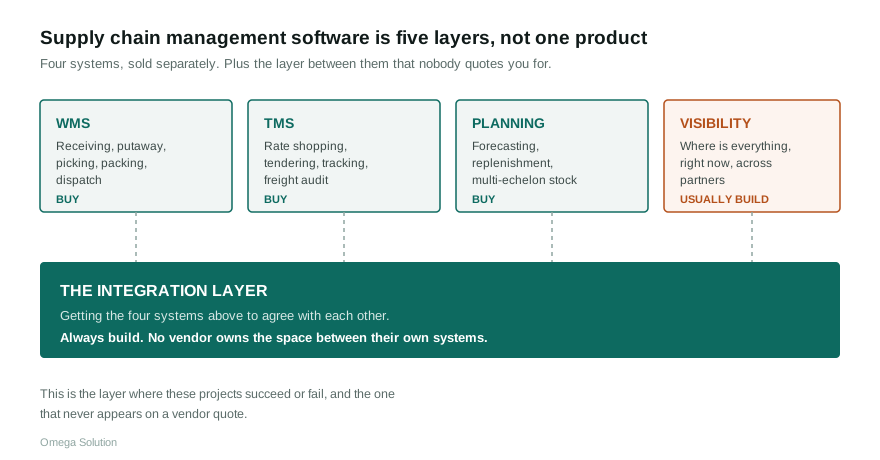
That last row is where these projects live or die, and it’s the one nobody quotes you for.
Why the layers matter more than the features
Goods arrive as built pallets, mixed pallets, or loose cartons. Every case gets counted and weighed. If the weight’s wrong it goes to inspection, where a supervisor decides whether the contents are normal, damaged or missing. Only then does the pallet get an ID, a storage location and a printed label.
Products go into cases, cases onto pallets, pallets into locations. The software’s real job is keeping that hierarchy true after a few thousand movements a day by people working at speed.
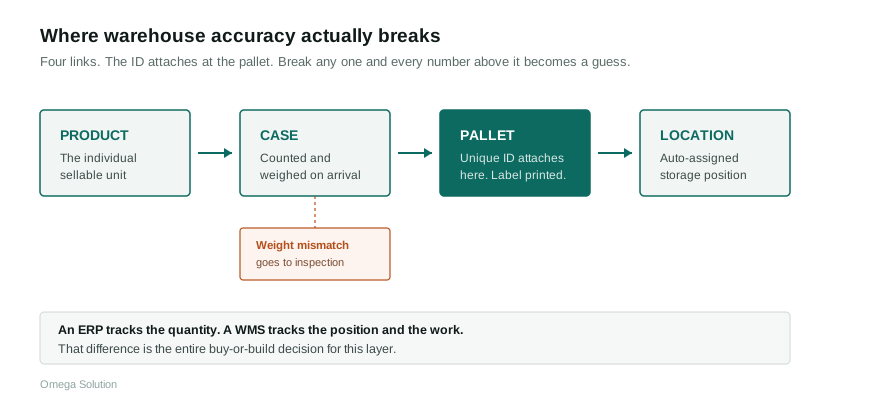
Break one link and all three answers become guesses. Every layer you add on top inherits that error.
Why Businesses Invest in Supply Chain Software in 2026
Three forces are pushing these projects onto roadmaps this year, and they all end in the same requirement: proving what you have and where it came from.
Traceability regulation with dates attached
The EU Deforestation Regulation applies to large and medium operators from 30 December 2026, and it requires operators to retain supplier and buyer records for five years. The EU Digital Product Passport registry has been live since 20 July 2026, batteries follow in February 2027, and steel, textiles and tires run through 2027.
In the US, FSMA 204 moved. The Federal Register notice of 7 August 2025 is titled “Compliance Date Extension” and pushes the deadline to 20 July 2028.
Every one of those deadlines moved at least once. The data requirement survived all of them.
Tariff volatility
Tariffs turned sourcing into a data problem. McKinsey’s supply chain risk survey (2 December 2025) found 82% of firms with tariff-affected supply chains and an average pass-through to customers of just 45%, so most companies absorb the rest themselves. Dual sourcing and landed-cost comparison stopped being finance exercises.
AI, eventually
Spend on supply chain software with agentic AI is forecast to grow from under $2 billion in 2025 to $53 billion by 2030, with adoption rising from 5% to 60% of enterprises (Gartner, 7 April 2026).
The caution matters more than the forecast. Gartner separately predicts that 60% of supply chain digital adoption efforts will fail to deliver promised value by 2028 (7 May 2025). Buying the software is not the hard part.
Why Omega Solution Builds Supply Chain Systems
We are a custom software company, not a platform vendor, and on this topic that distinction changes the advice you get. We have no license to protect on either side of the buy-or-build question, and warehouse and logistics work has produced our longest-running engagements. Here is what that means in practice.
A decade of engineering delivery
Ten years building custom software. Our Smart Factory Worx build in Singapore has been in continuous development for three and a half years. That’s not a project. It’s a system somebody’s operation depends on daily.
We sell no license, which changes the advice
Every ERP vendor’s page concludes the ERP module is enough. Every WMS vendor’s page concludes you need a WMS. Both answer honestly from where they sit, and neither is much use to you.
We build custom software and have no license on either side. That’s the only reason this guide can give you a threshold instead of a recommendation, including the parts where the answer is “buy the platform and build nothing.”
The Bangladesh delivery advantage
Senior engineering capacity at a fraction of US and Western European rates, with the team structure and process discipline of a Western agency. On a system that runs for years rather than months, that difference compounds.
5.0 across client reviews
Verified on Clutch and Upwork, from clients in Singapore, the United States, Colombia and Bulgaria.
What We Provide
Five service lines, and they map onto the layer table above. We do not sell you a warehouse platform. We build the parts that no vendor sells, and we tell you which parts to buy instead.
Custom warehouse and WMS development. Where a packaged system won’t fit the physical flow, or robotics is involved.
Integration layer engineering. The connective work between your ERP, WMS, courier APIs, customer EDI and finance systems. This is the piece no vendor owns and every project needs.
Traceability and compliance systems. Lot, batch and chain-of-custody records built to survive an audit under EUDR, the Digital Product Passport or FSMA 204.
Customer-facing visibility. The tracking and status your clients see, which is a product feature rather than back office.
Maintenance and support. Because warehouse software is judged over years, not at go-live.
Our Process: From First Call to Running System
Six steps, roughly four weeks from first call to a fixed-price scope you own. The first three exist to establish whether you should build anything at all, which is why they come before any code and before any commitment.
Step 1: Discovery and current-state audit (Week 1 to 2)
We map what you run today, where the data actually lives, and where people are working around the system. That last part matters most. The spreadsheets nobody admits to are the specification.
Step 2: Buy-versus-build assessment (Week 2 to 3)
Layer by layer, against the table above. We tell you which parts to buy, name the vendors worth shortlisting, and scope only what’s left. If the honest answer is that a packaged system covers you, this is where we say so.
Step 3: Architecture and fixed-price scope (Week 3 to 4)
A specification, a data model, an integration map and a real number. Delivered as documents you own, whether or not you build with us.
Step 4: Build, in slices that go live (Month 2 onward)
One capability at a time, each one usable on its own. Never a single big-bang go-live. That mistake has a $100 million price tag attached, and we’ll come to it.
Step 5: Data-accuracy gate before every launch
A threshold set before the date is set, and the threshold moves the date. Not the other way round.
Step 6: Ongoing development
The Smart Factory Worx engagement is in its fourth year. That’s the normal shape for a system that runs a warehouse.
Case Studies
Three supply chain systems we built, in three countries, at three very different scales. Each one is on the site in full, and each names the client, the team size and the duration. Read them for the shape of the work rather than the feature lists.
Smart Factory Worx: robotics orchestration in Singapore
An established warehouse business decided to automate with robotics. They needed a central hub that could coordinate a fleet of robots and sensors alongside human operators. Nothing on the market was going to talk to their particular fleet.
We built the system operators use across the whole cycle (inbound, pallet and location management, physical inventory, packing lists, dispatch) with granular identifier tracking down to individual parts, rapid inbound processing, frictionless outbound scanning, automated dispatch, and task delegation across robots and people at once.
Team: three front-end developers, three back-end, two DevOps engineers, one project manager. Duration: 3.5 years of continuous development.

“This is my second project with Omega Solution. The way they approached challenges, ensured smooth functionality, and delivered a high-quality solution is commendable.”
Gopal Bhandari, Director, Smart Factory Worx
The detail worth noticing isn’t a feature. It’s second project.
Courier Market: automated courier and billing, Colombia
Bulk order entry, automated SIIGO invoice generation via API, multi-method payment tracking, and service-wise and weight-based VIP pricing. Built in six weeks with a four-person team.
“Great Team, you can trust them. Very Professional, and they are experts in the accounting system. I recommend 1000%”
Juan Pablo Hernandez Nieto, COO, Cale&Cael
Fulfillment by People: 3PL operations at scale
Order management for a third-party logistics operation that has since handled over 500,000 orders at 98% satisfaction.
How to Evaluate a Supply Chain Software Partner
Five questions that separate a vendor from a partner. None of them are about features, because features are the part every shortlisted supplier will have. These are the questions that surface what happens after the contract is signed.
Ask which connectors are actually built
Not on the roadmap. Not “we can build that.” Which integrations are running in production with another client today. The gap between those three answers is where timelines go.
Confirm who owns the integration code
It’s usually the most business-specific software in the project, you paid for all of it, and it’s routinely written into the vendor’s IP. Get it in the contract.
Check the exit terms before the features
Minimum term, notice period, annual price escalation, and whether data export includes transactional history or just current stock. Across 27 first-page results we read on this topic, not one discussed any of it.
Ask what they’d talk you out of
A partner who has never recommended against their own service is selling, not advising. Ours is on record above. Step 2 exists to reach that answer.
Look at engagement length, not project count
Anyone can claim 200 projects. Ask how many clients came back, and how long the longest engagement has run.
Buy vs Build: Supply Chain Software Compared
Large software projects fail at high rates in both directions, and the failures share a shape. Gartner predicts 60% of supply chain digital adoption efforts will fail to deliver promised value by 2028, and the four disasters later in this guide were all bought platforms.
Custom builds are not exempt. Our own experience is that the projects that survive are the ones scoped narrowly and shipped in slices. Smart Factory Worx went live capability by capability across three and a half years. Courier Market shipped in six weeks because the scope was one workflow, not a platform.
Here is the rule that survives both sets of evidence.
Buy where the process is genuinely standard and the vendor’s roadmap is your roadmap. Build where your process is the reason customers pick you, or where nobody sells the thing at all.
| Buy this | Build this |
|---|---|
| Conventional warehouse management | The integration layer between systems |
| Standard freight execution | Customer-facing visibility |
| Demand forecasting statistics | Your actual exception workflows |
| Core ERP and financials | Anything touching robotics or non-standard flow |
More on the general decision in build vs buy software and custom software vs off-the-shelf.
Supply Chain Software Cost: What to Budget in 2026
Nobody publishes list prices at the enterprise end. SAP IBP, Oracle SCM Cloud, Blue Yonder, Manhattan, Kinaxis and o9 all quote individually.
The most useful public anchor is audited rather than estimated. In its fourth-quarter 2025 results (4 March 2026), Kinaxis reported “over 100 software deals above $1 million in total software contract value and more than 20 deals above $1 million in average annual software contract value,” on $433 million of annual recurring revenue. That tells you the shape of the enterprise market more honestly than any pricing page.
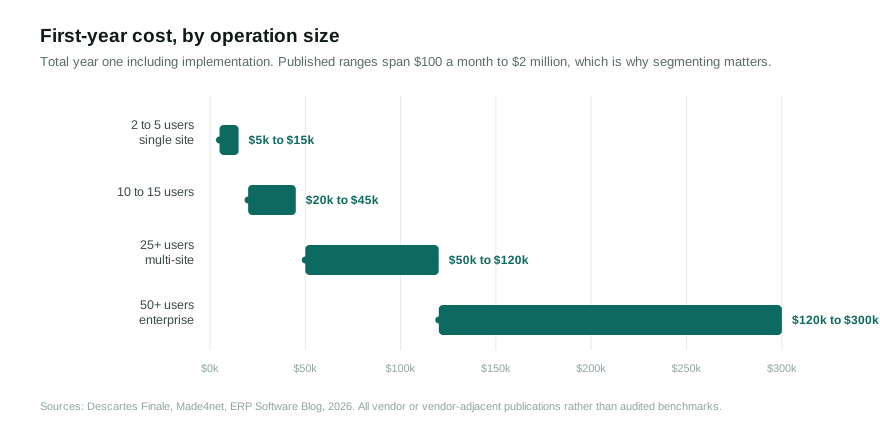
At the mid-market end, warehouse management is the one layer with published ranges:
| Operation size | First-year total | Per user, per month |
|---|---|---|
| 2 to 5 users, single site | $5,000 to $15,000 | $22 to $200 |
| 10 to 15 users | $20,000 to $45,000 | $100 to $350 |
| 25+ users, multi-site | $50,000 to $120,000 | $200 to $500 |
| 50+ users, enterprise | $120,000 to $300,000+ | $400 to $600+ |
Sources: Descartes Finale, Made4net and ERP Software Blog, 2026. All three are vendor or vendor-adjacent publications rather than audited benchmarks.
The three costs that aren’t in the quote
Every figure in this section comes from the same three sources as the table above. The implementation multiple and the setup, integration, migration and training ranges are Made4net’s. The hidden-cost percentage and the buffer recommendation are ERP Software Blog’s. The hardware prices, the $100 to $500 per-user band and the 10% to 25% maintenance range appear in Descartes Finale’s guide and are corroborated by at least one of the other two.
- Implementation runs one to three times the annual software cost. Setup $75,000 to $300,000 at the enterprise end, integration $10,000 to $80,000, data migration $10,000 to $30,000, training $5,000 to $50,000.
- Hidden costs add 20% to 50% to the initial budget, which is why carrying a 20% to 30% buffer is standard advice.
- Hardware isn’t in a software quote. Scanners $300 to $1,000 each, industrial $1,200 to $2,500, label printers $300 to $1,500. Roughly $1,000 to $3,000 per warehouse user.
Two figures have genuine agreement across independent sources: per-user cloud pricing clusters at $100 to $500 a month, and annual maintenance runs 10% to 25% of license cost.
Industries We Serve With Supply Chain Software
Six sectors where we’ve built supply chain systems. The pattern worth noticing is that the differentiator is almost never a feature. It’s a compliance regime, and compliance is a data model decision rather than a module you switch on.
| Industry | What it actually needs | Compliance driver |
|---|---|---|
| Warehousing and 3PL | WMS, robotics orchestration, multi-client billing and reporting | Client audit requirements, SLA reporting |
| Courier and last mile | Bulk order entry, automated invoicing, route and payment tracking | Local tax and e-invoicing rules |
| Retail and eCommerce | Multi-channel inventory sync, order management, returns | Consumer returns law, marketplace terms |
| Manufacturing | Production inventory tied to bill of materials, supplier records | Product liability, supplier due diligence |
| Food and agriculture | Lot and batch traceability from source to shelf | FSMA 204 (US, July 2028), EUDR (EU, December 2026) |
| Pharma and healthcare | Serialization, full chain of custody, temperature records | Serialization mandates, patient safety regulation |
Common Mistakes in Supply Chain Software Projects
Four failures, four different companies, and a combined cost well over a billion dollars. Not one was caused by picking the wrong vendor. Read them as a checklist of decisions to make differently rather than as a warning about software.
Mistake 1: Letting the scope run instead of contracting it
Lidl wrote off €500 million. Three years into an SAP rollout planned for 10,000 stores and more than 140 logistics hubs, the project was dropped in August 2018. A memo reported to be from Lidl head Jesper Hoyer said “the strategic goals as originally defined by the project could not be achieved without the retailer having to spend more than it wanted.” The scope never came down.
Mistake 2: Going live on bad data
Target Canada launched on SAP with an item master nobody trusted. In Canadian Business, Joe Castaldo reported that “the investigative team estimated information in the system was accurate about 30% of the time. In the U.S., it’s between 98% and 99%.” Wrong dimensions, missing tariff codes and wrong currencies followed. Distribution centers overflowed while stores received the wrong assortments, and Target’s annual results released in February 2014 revealed “a US$941-million loss in Canada” (The Last Days of Target Canada, 2016). The Canadian business closed the following year.
Set the data-accuracy threshold before the go-live date, and let the threshold move the date.
Mistake 3: Going live on several systems at once
Hershey pushed SAP, Siebel and Manugistics live together ahead of the Halloween 1999 peak, in what CIO described as “a $112 million combination of software from ERP maker SAP, CRM provider Siebel and supply chain” planning. The problems, CIO reported, “were going to keep Hershey from delivering $100 million worth of Kisses and Jolly” Ranchers, and “Hershey’s stock price fell more than 8 percent on that September day” (Supply Chain: Hershey’s Bittersweet Lesson, 2002). The company ran a successful SAP upgrade three years later. The software was never the problem.
Mistake 4: Holding the date when the system isn’t ready
MillerCoors filed suit against its systems integrator over a fixed-price SAP work order of roughly $53 million, later increased by $9.6 million. UpperEdge reported that MillerCoors “claims that this alleged breach resulted in significant damages to MillerCoors in excess of $100M dollars,” and that “per the lawsuit, the final testing of the implementation indicated there were 8 critical severity defects and 47 defects of high severity” (2017). The go-live proceeded anyway.
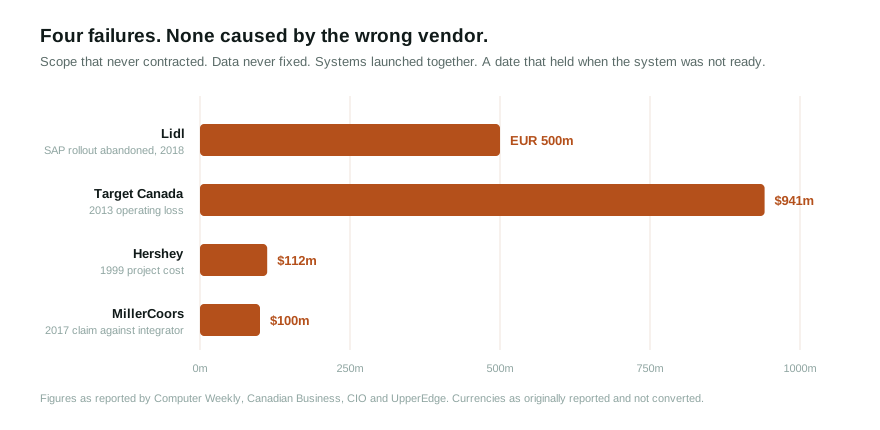
Scope. Data. Sequencing. The decision to go live anyway. We’ve covered the same pattern from the delivery side in ten software development mistakes to avoid.
Frequently Asked Questions About Supply Chain Management Software
The questions below came from two places: the pages currently ranking on Google’s first page for supply chain and warehouse software terms, and the questions prospects actually ask us on scoping calls. Where published answers contradict each other, we’ve said so rather than picking the convenient one.
Which supply chain software includes warehouse, inventory and accounting in one system?
Very few, and the ones that claim to usually mean an ERP with a warehouse module attached. If you need warehouse, inventory and accounting genuinely integrated, you have three routes:
- An ERP with a bolt-on warehouse module. Cheapest, weakest on directed work.
- A WMS integrated to your existing accounting system. Strongest on the floor, but the integration has to be built.
- A single platform that does all three adequately and none of them well. Ask any vendor claiming all three which modules were built in-house and which were acquired. The seams show up in the reporting.
What is the cheapest supply chain software that still works?
For a single site under about 200 order lines a day, the honest answer is your existing ERP inventory module plus disciplined barcode scanning, which costs scanners at $300 to $1,000 each and nothing in license. Below roughly $5,000 in year one you are buying stock counting, not warehouse management. The gap between free tools and paid ones is not features on a list. It is directed work, labor management, audit trails, and somebody answering the phone at 2am when dispatch cuts off at 6.
Does our industry change which supply chain software we should pick?
Yes, and mostly through compliance rather than features. Food and agriculture need lot and batch traceability built for FSMA 204 and EUDR, which is a data model decision rather than a module you switch on. Pharma needs serialization and full chain of custody. 3PL needs multi-client billing, which most single-tenant systems handle badly. Retail and eCommerce need multi-channel inventory sync more than warehouse depth. Manufacturing needs production inventory tied to the bill of materials. A generic WMS handles retail and general warehousing well and struggles with all of the others.
Does it matter where the development team is based?
For a packaged platform, no. For custom development it changes the economics rather than the quality. Senior engineering rates vary by a factor of three or more between the United States, Western Europe and South Asia, and on a system that runs for years that difference compounds into whether you can afford ongoing development at all. What matters is timezone overlap with your operations team, written English good enough for a specification, and whether the team is still there in year three. Our Smart Factory Worx engagement in Singapore has run three and a half years from Dhaka, which is the only evidence on that question worth anything.
How much does warehouse management software cost?
Between $5,000 and $15,000 in year one for a small single-site operation, and $120,000 to $300,000+ for a 50-user enterprise deployment. Per-user cloud pricing clusters at $100 to $500 a month across independent sources, with annual maintenance at 10% to 25% of license cost. Implementation adds one to three times the annual software cost on top.
Do we need a WMS if our ERP already has an inventory module?
Only when the work needs directing rather than recording. An ERP module tracks quantities. A WMS tracks positions and work: which bin, which pallet, which operator, in what order. You’ve outgrown the ERP module when any of these are true:
- One SKU lives in several locations and pickers have to know which
- You need directed putaway, or wave, batch or zone picking
- Lot, serial or expiry tracking has to survive an audit or a recall
- There’s automation on the floor, or there will be within a year
- Someone maintains a spreadsheet to work around the system
How long does implementation take?
Four to twelve weeks for a single conventional site, four to six months with several integrations, and six to eight months for the first site of a multi-site rollout. Anything involving robotics takes materially longer: in the 2026 Intralogistics Robotics Survey published by Modern Materials Handling, 48% of robotics projects took 7 to 12 months and 26% took 13 to 18.
How long before it pays for itself?
Published payback runs from six months to three years and the sources openly disagree, which is itself the useful finding. Every published figure we could trace came from a vendor selling the software. Before you accept any of them, ask what your current inventory and picking accuracy actually is. If it’s already above 95%, most published ROI cases do not apply to you.
Cloud or on-premise?
Cloud is cheaper upfront, and the five-year picture is contested. One source puts SaaS 30% to 40% ahead over three to five years, another puts cloud breakeven at seven years, and both sell one or the other. Choose on-premise for regulatory or air-gap requirements, heavy customization, or infrastructure you already own. Otherwise cloud.
Will it integrate with what we already have?
Yes, and the real question is what that costs: $2,000 to $20,000 at the simple end, $10,000 to $80,000 where several systems and a custom connector are involved. Ask which connectors are running in production today rather than on a roadmap.
At what point do we actually need this software?
There’s no published threshold and we won’t invent one. The tell is the point where somebody’s job becomes reconciling two systems that disagree. A supervisor rekeying between the ERP and a spreadsheet. A picker walking over to ask where something is. A monthly count that never matches. Those hours are already on your payroll, and they’re the budget for the software.
Are free or open-source tools good enough?
For stock counts, basic locations and simple reporting, often yes. Not for directed work, labor management, audit trails, or support at 2am when dispatch cuts off at 6. The decision is about what happens when something goes wrong at the worst possible moment, not about the feature list.
What’s the difference between a WMS and a TMS?
A WMS runs what happens inside the four walls. A TMS runs what happens between buildings: rates, carrier tendering, tracking, freight audit. They meet at the loading dock, and that handoff is where most integration effort goes.
What happens when we want to leave a vendor?
Ask five things before you sign, and get the answers in the contract rather than in an email:
- Minimum term and notice period. Three-year lock-ins are common and rarely come up in a demo.
- Annual price escalation, and whether it’s capped. A 5% to 8% uplift compounds into a different product over five years.
- Data export format, and whether it includes transactional history or only current stock.
- Who owns the integration and configuration work you paid for.
- How long you keep access after termination, and whether they’ll support a parallel run while you migrate.
Is custom more expensive than buying?
Higher upfront, no per-user license, and you own it. Compare five-year totals including integration, customization, per-user growth and the modules you’ll be upsold, not license against build cost. See our custom software development cost breakdown.
What about blockchain traceability?
It didn’t survive as a platform play. TradeLens, the IBM and Maersk joint venture, launched in 2018 and was discontinued in a November 2022 announcement, with Maersk stating that the platform had not reached the level of commercial viability necessary to continue and that the full global industry collaboration it needed had not been achieved. What replaced it was regulatory data standards: EUDR reference numbers, FSMA key data elements, the Digital Product Passport registry, and GS1 Digital Link.
Can AI fix our forecasting?
It’ll improve it if your data is clean and amplify your problems if it isn’t. Be careful with the numbers you’re shown. The figures most often quoted in this space (15% lower logistics costs, 35% lower inventory, 65% higher service levels) come from a 2021 consultancy publication describing “early adopters,” with no published methodology, and they are still circulated as though they described this year.
Conclusion: Supply Chain Software Is a Layer Decision, Not a Vendor Decision
The question isn’t which platform. It’s which of the five layers you buy, which you build, and who owns the integration between them, because that’s the part no vendor sells and every project needs.
The four failures in this guide cost over a billion dollars between them, and not one was caused by choosing the wrong vendor. They were scope that never contracted, data that was never fixed, systems launched together, and a date that held when the system wasn’t ready. All four are avoidable with a gate and a slice-by-slice rollout.
If you’re mid-way through a selection, the useful conversation is about which parts of the problem your shortlisted vendor won’t solve, and what those cost separately. Twenty minutes, and if the answer is buy the platform and build nothing, we’ll say so.
If you already know the shape of the work, our fixed-price scoping sprint turns it into a specification, an architecture and a real number, delivered as documents you own whether you build with us or not.

 Aug 26, 2025


