

MVP vs Prototype vs POC: Key Differences 2026
 By Ashiqur Rahman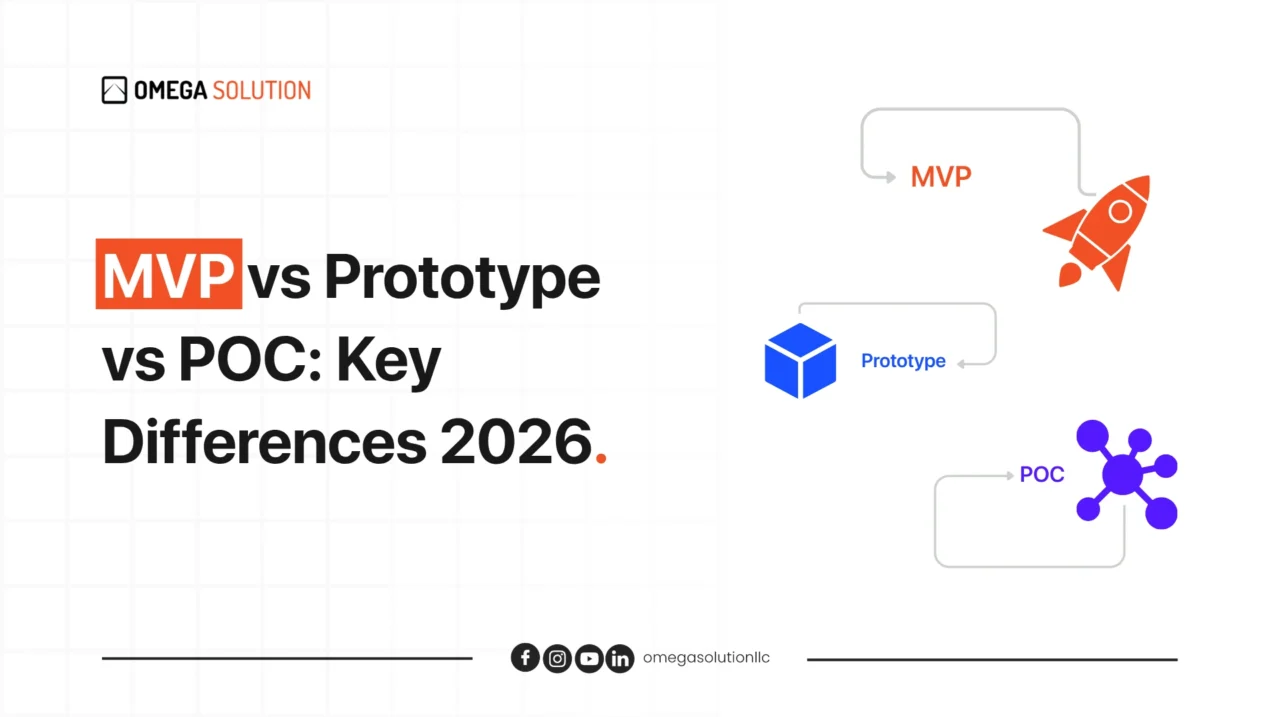
You have a product idea. You know it can work. However, you are stuck on one question nobody can answer clearly: should you build an MVP, a prototype, or a Proof of Concept? You search online. Every article uses these three terms differently. One agency calls your idea an MVP. Another calls it a prototype. A third recommends starting with a POC. As a result, you feel more confused after researching than you did before.
That confusion is not your fault. These three terms genuinely mean different things, and the development industry does a poor job of explaining them clearly. Furthermore, choosing the wrong one does not just delay your launch. It costs real money. Many startups skip early idea validation entirely, which increases the risk of choosing the wrong approach and leads to wasted time and effort. Consequently, founders build prototypes when they need an MVP, or launch MVPs when a two-week POC would have saved months of wasted development. Therefore, this guide gives you the clear answer: which tool to build first, why it matters, and what happens when you get it wrong.
Why These Three Terms Cause So Much Confusion
The terms MVP, prototype, and proof of concept are often used interchangeably. Unfortunately, they are very different, and confusing them leads to wasted time, budget, and effort.
Furthermore, investors sometimes use these terms loosely. Development agencies occasionally describe prototypes as MVPs to justify higher fees. Founders often call a POC an MVP because it sounds more impressive in pitch decks. As a result, teams build the wrong artefact at the wrong stage, and discover the mistake only after a significant budget disappears.
At a high level, a POC tests whether something can be built. A prototype shows how something will look and work. An MVP launches the smallest version that delivers real value to real users.
These three sentences contain everything you need. However, the real value comes from understanding when to use each one, and what happens when you choose the wrong tool at the wrong moment.
What Is a Proof of Concept?
A proof of concept is a small-scale experiment used to validate the feasibility of an idea before development begins. It tests whether a specific technical idea can work, not how it will look or whether the market wants it.
Furthermore, a POC is a feasibility study conducted in the project discovery phase before full-scale product development. It usually examines just one feature or integration, so if you need to check the feasibility of several features, you run several separate POCs.
What a POC Is NOT
A POC is not a user-facing product. It does not need a polished interface. Furthermore, it does not need to scale or perform under real user load. Its only job is to answer one specific question: can this technology work the way we need it to?
When to Build a POC
Build a POC when your product depends on a technical assumption that has not been proven in your specific context. You need a POC when you are unsure whether a core algorithm is achievable, when you need to test integrations with third-party systems, or when you want to check performance under specific architectural constraints.
Furthermore, if your concept proves viable after the POC stage, you can move to prototyping or MVP development with confidence. If not, that is the perfect time to adjust your idea or pivot, without significant financial risk.
POC in Real Life, Omega Solution Example
The Claim Central AI project began with one technical question: could an AI model process insurance claim data accurately enough to reduce manual review time? Omega Solution ran a focused POC on the core AI logic before any user-facing development began. The POC confirmed feasibility. Development then proceeded with confidence, resulting in an investor-ready MVP delivered on time and within budget. Full details: Claim Central AI case study.
What Is a Prototype?
A prototype is a representation of the final product used to test design ideas, gather user feedback, and show stakeholders how the experience will work. It is not production-ready.
Furthermore, a prototype is a visual or interactive model representing a product’s user interface. It allows teams to explore design ideas before any coding begins. Unlike a POC, which proves that something can work, a prototype shows how it will look and feel.
What Makes a Prototype Unique
A prototype can range from rough paper sketches to highly interactive digital simulations built in tools like Figma or UXPin. However, it shares one characteristic regardless of fidelity: it is not functional. Users cannot complete real tasks with a prototype. It cannot process real data, handle real payments, or generate real analytics.
Furthermore, a prototype lacks the business logic of your product. It addresses questions of design and UX, not market viability or technical feasibility. As a result, prototype feedback tells you whether users understand your product, not whether they will pay for it.
When to Build a Prototype
Build a prototype when you need to validate user experience and interface design before committing development resources. Furthermore, build a prototype when you need to pitch to investors and want something visual that communicates the product direction clearly.
Moreover, prototypes serve as a powerful tool to secure buy-in from stakeholders by demonstrating a clear, visual model of the intended product. They demonstrate thinking without requiring a working product, making them cost-effective communication tools at the earliest stage.
Prototype vs POC: The Key Distinction
The distinction is simple but critical. A POC answers: Can we build this technically? A prototype answers: Does this design make sense to users? Furthermore, one tests technical reality while the other tests human perception. Both are essential in different contexts. However, they answer completely different questions and should never replace each other or an MVP.
What Is an MVP?
An MVP is a fully functional product with only the core features needed to find early adopters and validate product-market fit.
Furthermore, an MVP is the most basic version of a solution that provides users with core functionalities. It lets development teams test the product’s value and market fit in real conditions while allocating minimal resources.
What Makes an MVP Different From a Prototype
This distinction matters more than any other in the MVP vs prototype vs POC comparison. MVPs are not prototypes with a few more buttons. They are the smallest functional version of your product that real users can actually test.
A prototype cannot be used to complete real tasks. An MVP can. A prototype generates opinions. An MVP generates behaviour data. Furthermore, behaviour data is dramatically more reliable than opinions for making product decisions. Consequently, an MVP produces the evidence that validates market assumptions in a way that no prototype or POC ever can.
What Makes an MVP Different From a POC
A POC answers: Can this technology work? An MVP answers: Will real users pay to use this in their real lives? These are fundamentally different questions at fundamentally different stages. Moreover, an MVP tests the market to find early adopters. A POC validates whether the project is worth building in the first place.
Therefore, a POC typically precedes an MVP. You confirm the technology works first, then you build the minimum functional product to confirm the market wants it.
When to Build an MVP
Build an MVP when you are ready to test your core value proposition in the market, when you want to validate assumptions before heavily investing in development, and when you want to start building a user base and generating revenue.
Furthermore, build an MVP only after validating the core problem through customer discovery. If you have not yet spoken to real potential customers, read: how to validate your startup idea before building.

MVP vs Prototype vs POC: The Complete Comparison
Now that each concept is clear individually, here is how all three compare across every dimension that matters to a founder making a build decision.
| Dimension | POC | Prototype | MVP |
| Primary Goal | Test technical feasibility | Test design and UX | Test market demand |
| Functional? | Partially | No | Yes |
| User-facing? | No | Yes | Yes |
| Real users? | No | Sometimes | Yes |
| Generates revenue? | No | No | Potentially |
| Deployable to production? | No | No | Yes |
| Feedback type | Technical data | Design opinions | Behavior data |
| Timeline | Days to weeks | 1 to 4 weeks | 6 to 16 weeks |
| Cost | Lowest | Low to medium | Medium to high |
| Best for | Technical risk reduction | Investor pitches and UX testing | Market validation and early adopters |
The Right Sequence: POC, Then Prototype, Then MVP
There is a logical sequence to these three tools. First, validate that the core idea is technically feasible with a POC. Second, design and test the user experience with a prototype. Third, build and ship the minimum functional product as an MVP.
However, not every product needs all three stages. Furthermore, skipping stages is sometimes the right decision, but only when you have already answered that stage’s core question through other means.
When to Skip the POC
Skip the POC when your product relies entirely on proven, well-established technology. If you are building a standard SaaS tool using common frameworks with documented performance data, technical feasibility is already established. Therefore, a POC adds no value in this context. Move directly to a prototype or MVP depending on your most urgent validation needs.
When to Skip the Prototype
Skip the prototype when you already have strong UX validation from customer discovery interviews or from previous products in the same space. Furthermore, skip prototyping when speed to market is the primary competitive advantage, and you have high confidence in the interface design already.
However, never skip prototyping when pitching to investors who need to visualise the product. Moreover, never skip it when the user journey is genuinely novel and has not been tested with your target segment before.
When to Go Straight to MVP
Skip directly to the MVP when both technical feasibility and UX design are already validated, either through previous work or through established market precedents. Consequently, most experienced founders with strong domain expertise in a proven market can move directly from idea to MVP without a formal POC or prototype stage.
Common Mistakes Founders Make With MVP vs Prototype vs POC
These mistakes appear in every industry and at every funding stage. Understanding them before you build consistently saves significant time and budget.
Mistake 1: Calling a Prototype an MVP
This is the most expensive confusion in product development. A prototype cannot generate the behaviour data that validates market demand. Presenting a prototype as an MVP to investors or customers creates false confidence. Furthermore, it delays the moment you discover whether real users will actually pay, which is the only validation signal that matters commercially.
Mistake 2: Building an MVP Before Proving Technical Feasibility
Some products depend on technical capabilities that are genuinely unproven: custom AI models, complex real-time integrations, novel hardware interfaces, or untested compliance architectures. Building a full MVP before running a POC on these capabilities means investing months and significant budget in a product that may hit an insurmountable technical wall. A two-week POC would have revealed the same information at a fraction of the cost.
Mistake 3: Skipping the Prototype and Building a Poor UX MVP
User experience problems in an MVP generate feedback about design rather than value. As a result, teams cannot distinguish between users who rejected the idea and users who rejected the interface. Furthermore, this confusion leads to rebuilding the MVP based on UX assumptions, rather than validating the original concept. A prototype costing $2,000 to $5,000 prevents this outcome entirely.
Mistake 4: Treating All Three as Mandatory Sequential Steps
Some products genuinely need all three stages in sequence. However, many do not. Treating POC, prototype, and MVP as mandatory steps for every product adds unnecessary time and cost to straightforward builds. Therefore, evaluate each stage against the specific risks your product faces, and include only the stages that address real, unresolved questions. For a broader guide on the mistakes that derail software projects at every stage, read: 10 software development mistakes to avoid in 2026.
How to Decide Which One to Build First
Use this decision framework before committing to any development path. It consistently produces the right answer for products at any stage and in any industry.
Start With Your Biggest Risk
Ask yourself: what is the single assumption that, if wrong, makes the entire product fail? The answer tells you exactly which artefact to build first.
If the biggest risk is technical, can we build this? Start with a POC. If the biggest risk is experiential, will users understand how to use this? Start with a prototype. If the biggest risk is commercial, will users pay? And technical and design risks are already resolved, so start with an MVP directly.
The Step-by-Step Decision Tree
Step 1: Is your core technology proven in your specific context? If no, build a POC first. If yes, proceed to step two.
Step 2: Is your user interface genuinely novel or untested with your target users? If yes, build a prototype. If no, proceed to step three.
Step 3: Have you validated through customer discovery that real users have this problem and will pay to solve it? If yes, build an MVP immediately. If no, read: how to validate your startup idea before building.
How Omega Solution Guides Clients Through POC, Prototype, and MVP Decisions
Omega Solution’s discovery sprint at the start of every engagement identifies which artefact the client actually needs, not which one they asked for. This distinction consistently saves clients from the most expensive mistakes in early-stage product development.
For technically complex products, the discovery sprint identifies unproven assumptions that require POC validation before any development investment; for products with novel UX requirements, it identifies the prototype phase needed before the MVP build. For products with validated problems and proven technology, it confirms the MVP path and produces the prioritised feature list immediately.
Furthermore, Omega Solution’s full-service capability means the same team handles every stage, from POC through prototype through MVP to full product scale. Clients never manage handoffs between agencies or rebuild architectural decisions made by a different team. Consequently, the product evolves on one coherent foundation from the earliest validation stage through to an enterprise-grade platform.
For a complete picture of what Omega Solution’s MVP development process looks like from discovery through launch, read: best MVP development company in 2026. Additionally, to understand how to prioritise features once the MVP path is confirmed, read: MVP feature prioritization guide for startups 2026.
Cost and Timeline: POC vs Prototype vs MVP
Understanding the relative investment required for each approach helps founders plan their pre-launch budget realistically.
| Artifact | Typical Cost | Typical Timeline | Key Deliverable |
| POC | $2,000 – $15,000 | 1 – 3 weeks | Technical feasibility confirmation |
| Prototype | $3,000 – $20,000 | 1 – 4 weeks | Interactive design mockup |
| Simple MVP | $15,000 – $50,000 | 6 – 10 weeks | Deployable product with core journey |
| Moderate MVP | $50,000 – $150,000 | 10 – 16 weeks | Full core product with integrations |
| Complex MVP | $100,000 – $250,000+ | 16 – 24 weeks | AI-powered or regulated platform |
Furthermore, Omega Solution’s USA-Bangladesh delivery structure consistently brings enterprise-grade quality to the lower end of these ranges. Consequently, founders get more validation for the same budget, which directly translates to more iterations, more user feedback, and better-informed product decisions before scaling.
For a complete, phase-by-phase cost breakdown covering MVP development specifically, read: custom software development cost breakdown 2026.
Frequently Asked Questions About MVP vs Prototype vs POC
What is the difference between MVP vs prototype vs POC?
A POC tests whether something can be built. A prototype shows how something will look and work. An MVP launches the smallest version that delivers real value to users. Furthermore, a POC addresses technical feasibility, a prototype tests design and UX, and an MVP validates market demand through real user behaviour. These are three distinct validation tools used at different stages, not interchangeable terms for the same concept.
Should I build a POC, prototype, or MVP first?
The answer depends on your biggest unresolved risk. If technical feasibility is uncertain, build a POC first; if user experience is untested, build a prototype. If both technical and design questions are resolved and you need market validation, build an MVP. Furthermore, not every product requires all three stages. Evaluate each stage against your specific risks rather than treating them as mandatory sequential steps.
Can a prototype replace an MVP?
A prototype cannot replace an MVP. A prototype generates design opinions from users. An MVP generates behaviour data from users who actually complete real tasks. Furthermore, behaviour data is far more reliable for product decisions than opinions about a clickable mockup. Consequently, if market validation is your goal, an MVP is the only artefact that achieves it definitively.
How much does a POC cost compared to an MVP?
A POC typically costs $2,000 to $15,000 and takes one to three weeks. A simple MVP typically costs $15,000 to $50,000 and takes six to ten weeks. Furthermore, the POC investment is often the most cost-efficient decision in the entire product development journey; it confirms technical feasibility before any significant development budget is committed.
What comes after an MVP?
After an MVP, the product enters iterative development, building the next layer of features based on real user behaviour collected since launch. Furthermore, the MVP’s architecture should support this growth from day one. Omega Solution’s Maintenance and Support service keeps the platform secure and improves throughout this phase. Additionally, Omega Solution’s custom software development service handles the full product build when the MVP confirms market demand.
How does Omega Solution decide which artefact a client needs?
Omega Solution’s discovery sprint maps the client’s biggest unresolved risks, technical, experiential, and commercial. Based on this mapping, the sprint recommends the right artefact for the client’s current stage. Consequently, clients start development with a clear, evidence-based path, not a default assumption that every project begins with an MVP regardless of context.
Conclusion: Choose the Right Tool for the Right Question
The MVP vs prototype vs POC debate has a clear resolution. Each tool answers a different question. A POC answers: Can we build this? A prototype answers: Will users understand this? An MVP answers: Will users pay for this? Therefore, the right choice at any given stage is the tool that answers the most important unresolved question, at the lowest possible cost and in the shortest possible time.
Furthermore, using the wrong tool at the wrong stage is not a minor inefficiency. It is an expensive mistake that delays real learning, wastes development budget, and creates false confidence based on the wrong kind of feedback.
Consequently, before committing to any development path, identify your biggest risk. Then choose the artefact that addresses it directly. Moreover, work with a partner who asks this question before recommending a build path, not one who defaults to the same artefact for every client, regardless of context or stage.
Ready to identify which artefact your product actually needs? Explore Omega Solution’s MVP Development service and contact the team for a free 15-minute consultation. Additionally, if you are ready to move to full custom software development after your MVP, read: custom software benefits for business growth 2026.


 Aug 26, 2025


 Dhaka, Bangladesh

