

AI Agents vs Chatbots: Key Differences 2026
 By Admin OS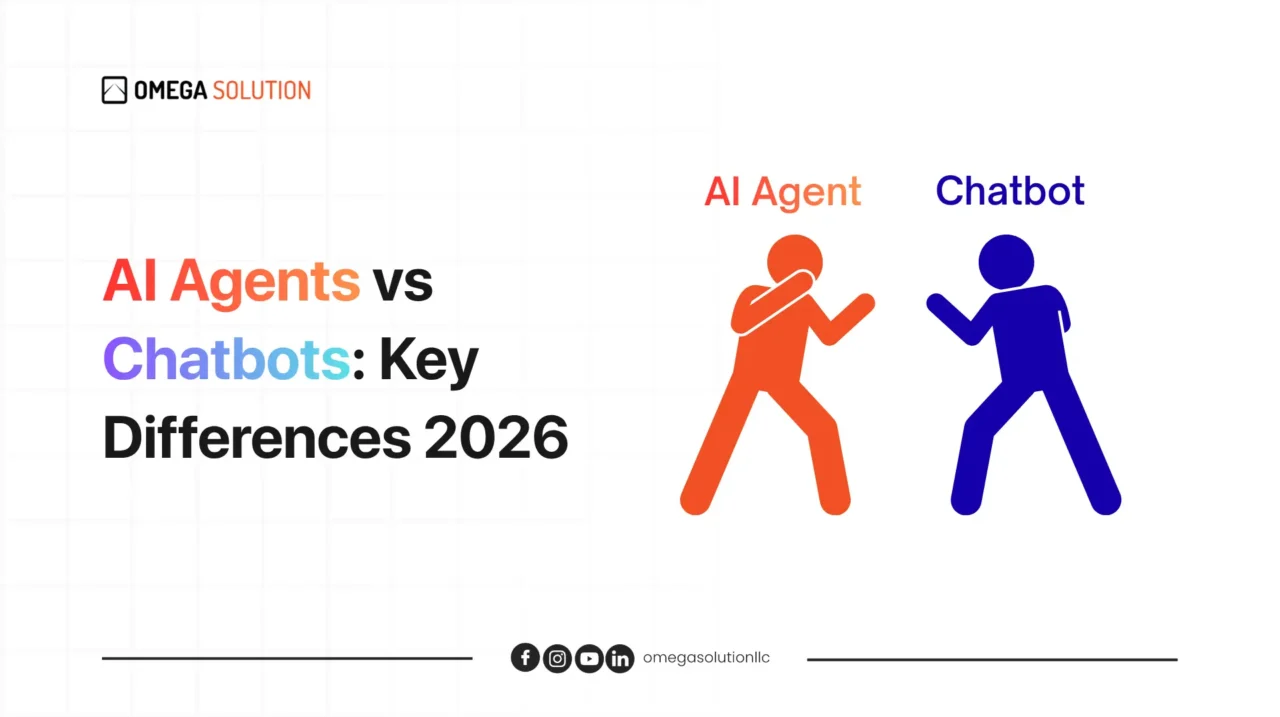
You ask your support bot for a refund. It returns a polite reply with a link to the policy page and waits for your next message. You still have to email someone. You still have to wait.
Furthermore, you are now wondering why this “smart assistant” your company invested in cannot actually do anything beyond pointing you toward a document you have already read twice. This experience is not unusual, and it is exactly why so many businesses feel disappointed by their chatbot investment. Most products marketed as “AI agents” in 2026 are still retrieval systems, sitting at a low level on a four-level maturity spectrum.
Furthermore, of the thousands of vendors calling their product an “AI agent,” only approximately 130 are verifiably agentic by any meaningful architectural standard. This confusion costs businesses real money, paying agent prices for chatbot capability, or worse, deploying a chatbot where the business problem genuinely needed an agent that could finish the job.
Therefore, the AI agents vs chatbots decision is one of the most consequential technology choices a business makes in 2026, and getting it right requires understanding the real architectural difference, not the marketing language. This guide gives you that clarity.
What Is a Chatbot?
A chatbot is a conversational system designed to answer questions or route requests based on predefined rules or language models. Furthermore, a chatbot matches your question to a pre-written FAQ answer or a knowledge-base article, it responds, but it does not act.
A typical AI chatbot works like this: the user sends a message, the system retrieves relevant context from a knowledge base, passes the message and context to a language model, and returns the generated response. There is no reasoning loop, no tool selection, and no iterative execution. Each user message triggers a single response cycle.
Chatbots are reactive. They answer questions and stop. Moreover, a chatbot resolves the conversation, not necessarily the underlying problem. This distinction matters more than it first appears, because resolving a conversation and resolving a problem produce very different customer outcomes.
For a broader understanding of how conversational AI fits into overall business automation, read: AI in business automation — complete guide 2026.
What Is an AI Agent?
An AI agent is an autonomous system that plans and executes multi-step actions to achieve a goal. Furthermore, an AI agent is a system built around a language model that can reason about tasks, use tools, maintain memory across interactions, and execute multi-step workflows autonomously.
The language model operates inside a loop where it observes, reasons, acts, and evaluates whether the task is complete. An AI agent understands the context behind your question, reasons across connected systems, and takes action to resolve the issue. Moreover, an AI agent resolves the problem, not just the conversation.
The cleanest one-line summary is this: a chatbot reads and replies; an AI agent reads, writes, and acts. Omega Solution’s AI and Automation service builds both categories, selecting the right architecture based on whether your workflow needs a response or a completed action.
The Core Difference: Five Dimensions That Separate Them
The AI agent vs chatbot difference is architectural. Chatbots are read-only. AI agents read, write, and act. Five dimensions separate them for real understanding, action, memory, reasoning, and learning.
Dimension 1: Understanding
A rule-based chatbot follows a fixed script, matching keywords to predetermined responses. An AI chatbot understands natural language and answers from a knowledge base. An AI agent goes further; it reasons, chains actions together, and makes decisions autonomously without human intervention at each step.
Dimension 2: Action
This is the most commercially significant dimension. Chatbots cannot act in the outside world. They can only generate text. AI agents call tools, query databases, update records, send emails, and trigger workflows, taking real actions that change real systems rather than simply describing what should happen.
Dimension 3: Memory
Chatbots typically process each message in isolation or with limited short-term context within a single session. AI agents maintain memory across interactions, remembering what happened in previous conversations, previous tasks, and previous decisions, which allows them to build on prior context rather than starting fresh every time.
Dimension 4: Reasoning
Chatbots match inputs to outputs through retrieval or pattern matching. AI agents reason through compound problems, breaking a complex request into steps, deciding which tool to use for each step, and adjusting their approach based on what each step returns. An LLM chatbot without a reasoning loop processes one request at a time, while an agent can chain multiple observations and actions to solve compound problems.
Dimension 5: Learning
Chatbots operate with static logic unless manually updated. AI agents improve through accumulated interaction data, refined prompts, and expanded tool access, becoming more capable over the lifetime of the deployment rather than remaining fixed at their initial configuration.
AI Agents vs Chatbots: Complete Comparison
| Factor | Chatbot | AI Agent |
|---|---|---|
| Core function | Responds to questions | Completes tasks and resolves problems |
| Can take action | ❌ No, text only | ✅ Yes, calls tools, updates systems |
| Memory across sessions | ❌ Limited or none | ✅ Persistent context |
| Multi-step reasoning | ❌ Single response cycle | ✅ Chains multiple steps |
| Handles compound requests | ❌ Fails or deflects | ✅ Breaks down and executes |
| Implementation speed | ✅ Days to weeks | ⚠️ Weeks to months |
| Initial cost | ✅ Lower | ❌ Higher |
| Resolution rate | ~15% of queries | ~70% of queries |
| Best for | Simple FAQ, basic routing | Complex workflows, multi-system tasks |
When a Chatbot Is the Right Choice
Avoid relying on chatbots alone if your business plans to grow significantly. However, chatbots remain the correct choice in specific, well-defined situations, and recognising these situations prevents overspending on agent complexity where it adds no real value.
Your Use Case Is Simple: FAQ or Routing
A bot works well when a user selects an option from a menu or asks a typical FAQ question. If the entire interaction can be satisfied by retrieving a single piece of information from a knowledge base, a chatbot delivers that outcome faster and at lower cost than an agent architecture.
You Need to Launch Quickly at Low Cost
Chatbots offer quick wins. They require minimal infrastructure and deliver immediate automation benefits. For businesses testing whether conversational automation fits their use case at all, starting with a chatbot validates the concept before committing to agent-level investment.
Your Volume Does Not Justify Agent Complexity
For these cases, low-volume, low complexity scenarios, agentic complexity adds cost without value. A chatbot handling fifty simple inquiries per week does not need the reasoning, memory, and tool integration that an agent provides, because the marginal benefit never offsets the additional implementation and maintenance cost.
When an AI Agent Is the Right Choice
You need an AI agent when tasks span multiple systems, decisions depend on context, follow-ups are required, humans are doing copy-paste work between systems, or scale and personalisation must coexist simultaneously.
Your Tasks Span Multiple Systems
If resolving a customer request requires checking an order in one system, validating a policy in another, and issuing a credit in a third, a chatbot cannot complete this; it can only describe the steps. An AI agent executes across all three systems and reports the completed outcome in one response.
Decisions Depend on Context That Changes
When the right response depends on account history, prior interactions, or specific circumstances that vary by customer, rule-based chatbot logic breaks down quickly. AI agents reason through this context dynamically rather than requiring a predetermined script for every possible scenario.
You Are Losing Customers to Slow Resolution
Traditional chatbots handle roughly 15 percent of customer queries successfully. AI agents handle 70 percent. Furthermore, if you are still running a script-based bot in 2026, you are actively losing customers to competitors who have already switched to agent-based resolution.
The Business Case Justifies Higher Investment
AI agents deliver 35 percent cost reductions and 55 percent efficiency gains across organisations that have moved beyond basic automation. For high-volume, high-complexity workflows, this return consistently justifies the additional implementation investment within months rather than years.
For a complete guide on identifying which specific business workflows benefit most from AI automation, read: AI use cases in real businesses — proven examples 2026.
How to Tell a Real AI Agent From a Rebranded Chatbot
This is the most practical section in this guide, because vendor marketing language makes the AI agents vs chatbots distinction deliberately blurry. Run these three tests in any vendor demonstration before committing to the budget.
Test 1: The Multi-Step, Real-World Action Test
Ask the system to do something with two steps and a real-world side effect, for example, find a specific invoice and email the PDF. A chatbot will explain how to do it. An agent will actually do it.
Test 2: The Memory Test
Mention something specific from an earlier conversation and see whether the system references it accurately in a later interaction. Chatbots typically cannot recall context across separate sessions. Agents with genuine memory architecture will reference prior context correctly.
Test 3: The Compound Problem Test
Present a request that does not fit into a single button or FAQ answer, something that requires checking data, applying a rule, and taking an action based on the result. If the system can chain these steps without you manually directing each one, it is functioning as a genuine agent.
Furthermore, when a vendor’s product fails these three tests, the appropriate conclusion is that you are evaluating a chatbot with agent marketing, not an agent with chatbot limitations. This distinction should directly inform what you are willing to pay.
The Maturity Spectrum: How Businesses Evolve From Chatbots to Agents
Most organisations evolve from chatbots to agents through four stages: chatbots that reduce volume, tool-connected bots that fetch data, agentic workflows that execute tasks, and multi-agent systems that coordinate across domains.
Stage 1: Chatbot for Volume Reduction
The starting point for most businesses. A chatbot handles the highest-frequency, lowest-complexity inquiries, deflecting volume away from human agents without requiring significant investment or organisational change.
Stage 2: Tool-Connected Bot
The system gains the ability to retrieve live data, checking an order status or account balance, but still cannot take action based on what it finds. This is the architectural midpoint between chatbot and agent, and it is where most products marketed as “AI agents” in 2026 actually sit.
Stage 3: Agentic Workflow
The system gains genuine tool-use capability, not just retrieving data but acting on it. This is where multi-step task completion becomes possible, and where the business case for agent-level investment typically becomes clear through measurable outcome improvement.
Stage 4: Multi-Agent Coordination
Multiple specialized agents coordinate across domains, a sales agent handing context to a support agent, or a finance agent triggering action in an operations agent. This stage represents the leading edge of 2026 deployment and is typically appropriate only for businesses with substantial workflow complexity and volume.
Real Business Results: AI Agents in Action
Omega Solution: Claim Central AI: Agent-Based Claims Processing
Danny Long Tran at 40Hrs Staffing needed a system that could do more than describe insurance claim requirements; it needed to extract data, apply decision logic, and route exceptions automatically. Omega Solution built a production-grade AI system incorporating document understanding, data extraction, decision logic, and exception routing, functioning as a genuine agent rather than a conversational chatbot. The result was an investor-ready MVP delivered on time and within budget. Full details: Claim Central AI case study.
Omega Solution: Coinex Crypto: Agent-Based Fraud and Compliance Monitoring
Coinex required a system that could monitor transaction patterns, reason across multiple signals, and take action, flagging or blocking suspicious activity automatically rather than simply alerting a human to review it later. Omega Solution built this agent-based monitoring layer alongside rule-based compliance checks for auditability. The result was $40 million in exchange volume and a 1,120 percent profitability increase within six months. Full details: Coinex Crypto case study.
Industry Example: Customer Support Cost Reduction
A mid-sized SaaS company replaced a script-based chatbot with an AI agent capable of resolving billing disputes end-to-end, checking account history, applying the refund policy, processing the credit, and confirming resolution to the customer. The agent paid for itself within the first week of operation through reduced human escalation volume alone.
Common Mistakes in the AI Agents vs Chatbots Decision
Understanding these mistakes prevents the most expensive and most common errors businesses make when choosing between conversational automation approaches in 2026.
Mistake 1: Buying Agent Pricing for Chatbot Capability
Many vendors market basic retrieval chatbots using agent language because agent positioning commands higher prices. Run the three tests in this guide before accepting any vendor’s “AI agent” claim and price the solution based on what it actually does, not what it is called.
Mistake 2: Deploying a Chatbot Where the Workflow Needed an Agent
When a business problem genuinely requires multi-system action, deploying a chatbot produces persistent customer frustration. Every day you run a chatbot-level system on agent-level problems, you pay a hidden cost in support escalations, repeat contacts, and customer churn that rarely appears in the original automation budget.
Mistake 3: Deploying Agent Complexity Where a Chatbot Would Suffice
The opposite mistake is equally costly. For simple, low-volume, low-complexity scenarios, agentic complexity adds cost without value. Building a full agent architecture for a use case that a basic FAQ chatbot would resolve just as effectively wastes implementation budget and ongoing maintenance investment.
Mistake 4: Ignoring the Governance and Oversight Requirement
AI agents that take real actions on real systems require stronger guardrails than chatbots that only generate text. Furthermore, deploying agents without proper safety controls, action limits, and human escalation paths introduces operational risk that a misconfigured chatbot simply cannot create. For a complete guide on the implementation risks that apply specifically to autonomous AI systems, read: AI implementation challenges — how to solve them in 2026.
How Omega Solution Builds the Right Solution: Agent or Chatbot
Omega Solution’s discovery process evaluates every conversational AI requirement against the same criteria covered in this guide: task complexity, system integration needs, volume, and the cost of failed resolution. Furthermore, the recommendation differs by workflow, not by which technology generates a larger project fee.
For straightforward FAQ and routing needs, Omega Solution builds efficient, fast-to-deploy chatbot systems using OpenAI and Claude integration. And for workflows requiring multi-system action, claims processing, fraud monitoring, lead qualification, and order management, Omega Solution builds genuine agent architecture with tool access, memory, and multi-step reasoning, including voice-based agents using Retell AI and VAPI for businesses where phone interaction remains the primary channel.
For a complete overview of Omega Solution’s full AI automation service portfolio, including both chatbot and agent capabilities, visit: Omega Solution AI and Automation services.
Frequently Asked Questions About AI Agents vs Chatbots
What is the main difference between an AI agent and a chatbot?
A chatbot is a conversational system that responds to user prompts with answers, suggestions, or guided flows. An AI agent is an autonomous system that plans and executes multi-step actions to achieve a goal. Furthermore, the cleanest summary is that a chatbot reads and replies, while an AI agent reads, writes, and acts, taking real action across connected systems rather than only generating text responses.
Is an AI agent always better than a chatbot?
No. For these cases, low-complexity, low-volume scenarios, agentic complexity adds cost without value. Chatbots remain the right choice for simple FAQ handling, basic routing, and businesses validating whether conversational automation fits their needs before committing to a higher investment. AI agents win specifically for multi-step, multi-system, high-volume workflows.
How do I know if a vendor’s “AI agent” is actually an agent?
Run three tests in any vendor demonstration. Ask it to complete a two-step task with real-world action. Mention something from an earlier conversation and check if it remembers accurately. Present a compound problem that requires chaining multiple steps without manual direction. Of the thousands of vendors calling their product an “AI agent,” only approximately 130 are verifiably agentic by any meaningful architectural standard.
What is the resolution rate difference between chatbots and AI agents?
Traditional chatbots handle roughly 15 percent of customer queries successfully without escalation. AI agents resolve approximately 70 percent. Furthermore, this gap directly reflects the architectural difference; chatbots can only respond with information, while agents can take the actions needed to actually close the request.
How much does it cost to build an AI agent versus a chatbot?
Chatbots typically cost less and deploy in days to weeks due to minimal infrastructure requirements. AI agents require greater upfront investment, covering tool integration, memory architecture, and multi-step reasoning logic, and typically take weeks to months to implement properly. However, AI agents deliver 35 percent cost reductions and 55 percent efficiency gains at scale, which frequently offsets the higher initial investment within months.
Can a business start with a chatbot and upgrade to an AI agent later?
Yes, most organizations evolve from chatbots to agents through four stages, starting with basic volume-reducing chatbots and progressively adding tool access, action capability, and multi-agent coordination as business needs and confidence in the technology grow. This staged approach allows businesses to validate automation value before committing to full agent-level investment.
How does Omega Solution decide between building a chatbot or an AI agent?
Omega Solution’s discovery process evaluates task complexity, system integration requirements, interaction volume, and the cost of unresolved requests for every conversational AI project. Furthermore, most engagements result in the right-sized solution for the specific workflow, not a default push toward whichever technology generates a larger project fee. Visit Omega Solution AI and Automation services for a complete overview.
Conclusion: Choose Based on What the Job Actually Requires
The AI agents vs chatbots decision comes down to one question: Does this workflow need a response, or does it need a completed action? Chatbots excel at simple, low-volume, low-complexity interactions where retrieving information satisfies the request. AI agents excel at complex, multi-step, multi-system workflows where the customer or business needs the problem actually resolved.
Furthermore, the businesses winning in 2026 are not the ones that bought the most expensive technology. They are the ones that matched the right architecture to the right problem, chatbots where chatbots suffice, and genuine agents where the workflow demands real action across connected systems.
Therefore, before your next conversational AI investment, run the three vendor tests in this guide. Verify what you are actually buying. Match the investment level to the actual complexity of the problem you are solving, not to the marketing language used to describe the solution.
Ready to identify whether your business needs a chatbot, an agent, or both? Explore Omega Solution’s AI and Automation services and contact the team for a free consultation today. Additionally, to see real documented results from production AI deployments across industries, read: AI use cases in real businesses — proven examples 2026.


 Aug 26, 2025


