

Custom Construction Software Development
 By Ashiqur Rahman
Custom construction software development is worth paying for where a statutory payment clock, a certified payroll format or a cost-centre structure does not fit a catalogue product. Omega Solution’s unified ERP for Alotbi took four people four months, about 2,768 hours. Across twelve agency pages ranking for this subject, not one publishes an hours figure at all.
This guide opens on what custom construction software development covers, what construction management software is actually worth buying, and what construction project management software means. Omega Solution’s own work comes next: the layer it builds in, the five steps a build runs through, and the delivered project nearest to construction, with its team size and duration taken from the page that publishes them. The numbers follow. Why construction projects overrun, and whose research that claim rests on. What the software costs to buy, against what it costs to build. What estimating and BOQ tools actually do. Where construction ERP parts company with project management tools. Last come the statutory clocks, the five questions worth putting to any development partner, and four mistakes that cost contractors more than any missing feature ever will.
What Custom Construction Software Development Covers
Custom construction software development means building the systems a contractor cannot buy ready-made: job cost structures that match how the company bids, payment and payroll workflows that match the statutes it works under, and the joins between field, finance and the owner. The packaged products are mature. Custom work earns its place at their edges.
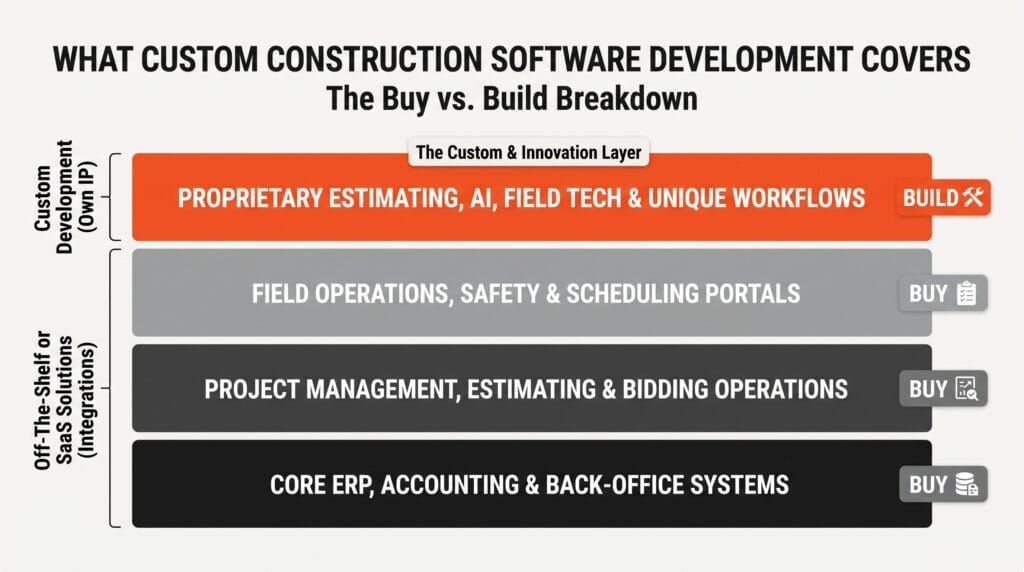
Four layers make up the category. Three are solved by products already on the market. The last is where a build is normally justified.
| Layer | Scope | Verdict |
|---|---|---|
| Takeoff and estimating | Measure drawings, price assemblies, produce a bid | Buy. PlanSwift, STACK, Clear Estimates and Buildxact own this |
| Project management and field | Schedules, daily logs, photos, RFIs, submittals, punch lists | Buy. Procore, Autodesk, Fieldwire, Buildertrend and Raken own this |
| Accounting and job costing | Job cost ledgers, progress billing, retainage, certified payroll | Buy with care. Sage, Premier and Knowify sit here, and two of those three publish no price |
| Cost structure, statutory workflow and integration | How the company’s own cost centers work, which clock each payment runs on, and the joins between the three layers above | Build. No catalog product fits one contractor’s cost codes or one jurisdiction’s deadlines |
Omega Solution’s work is located in the fourth row, which is also the layer that the ranking pages mention the least. The first page on this topic is found in seven agency service sites. Not a single one of them releases an hourly figure. An hourly rate is not published by anyone. At all, only one publishes a build cost.
Buy first, and say so out loud
For most contractors, most of the time, a packaged product is the correct answer. A development partner who will not say that is selling. Procore works. Buildertrend works. The real question is narrower than either: is the slice of the process they cannot hold worth building around, and what is that slice costing in office hours and interest exposure while it sits in spreadsheets?
Where custom work earns its keep
Three patterns recur. A cost code structure the company has used for years that no product will accept without flattening it. A payment obligation with a legal deadline attached, where a missed date carries interest. And a reporting line to an owner, lender or public agency in a format no vendor exports. All three are integration and workflow problems, not replacements for the products above.
There are no construction products offered by Omega Solution. There is no Omega field app or Omega takeoff tool available. The fourth layer’s build work and the integrations with the three layers above it are available, and they will be completed by a designated team in a predetermined amount of hours.
Construction Management Software and the Buy Decision
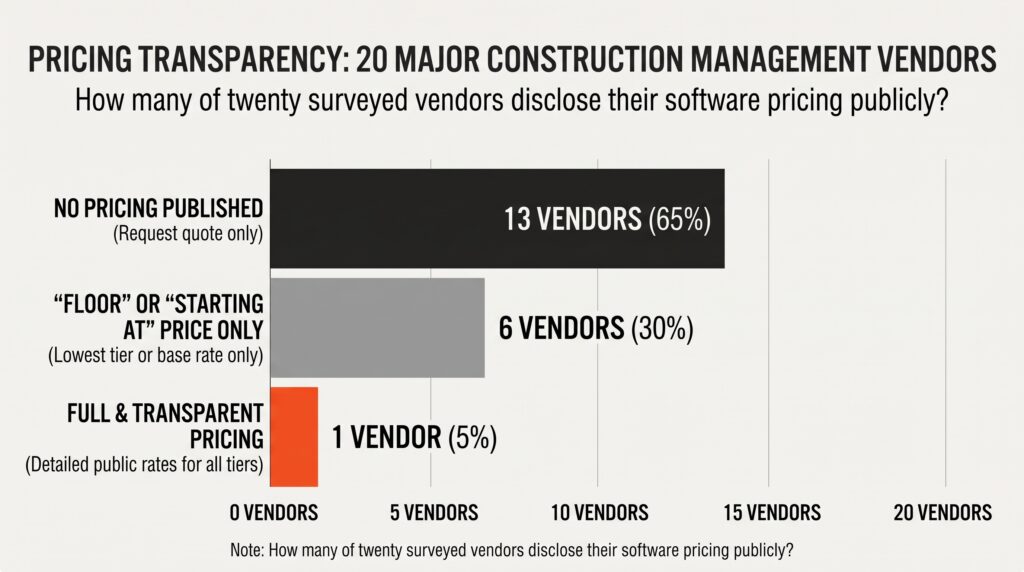
Construction management software is the packaged category covering scheduling, documents, field reporting and sometimes job costing, sold as a subscription. For most contractors the first decision is not what to build but what to buy, and the finding from reading twenty-one vendor pricing pages is that nearly half of this market will not publish a price.
Of twenty-one products from twenty vendors read on 5 and 6 October 2026, nine publish no price at all on their own site.
| Vendor | What its own pricing page publishes |
|---|---|
| Procore | No figure. Start here to get a custom quote |
| Buildertrend | No figure. Custom quote; all-in-one”, with “Special offer: 10% off against an unpublished base |
| Raken | No figure. Raken offers custom pricing built to fit your company’s needs |
| Premier Construction Software | No figure. Let’s build your quote |
| Archdesk | No figure. Answer four quick questions and get a quote |
| CoConstruct | No pricing page at all |
| Sage Construction Management | No figure. The pricing path returns a 404 |
| Trimble Quest | No figure. Request a demo |
| Trimble Viewpoint | No figure. To get the most accurate quote possible, we need to talk first |
The eleven that do publish are listed in the cost section below, with their plan structures worked out. Three caveats belong here rather than there. STACK publishes three figures and prefixes every one with as low as, so all three are floors. Autodesk is partly gated rather than gated: its Forma Build buy page shows nothing, but its overview page prints starting at $117 / month, so it counts as publishing. Buildxact’s United States pricing page could not be read at all, so it is reported as unknown rather than as withholding.
What the no-price pages say instead
The substitute for a number is a promise about the number. Procore prints fixed, predictable pricing from day one and NO hidden fees, with a footnote excluding one product that is priced based on FTE. Archdesk prints Implementation and support included and no five-figure line item on top. Both may be true. Neither can be checked before a call.
One pricing page is serving an unfilled template
Buildertrend’s pricing page renders its personalization tokens as literal text: Pricing designed to help {state} {builder_type} stop losing high-value leads and “See what it costs {state} {builder_type} to keep every project organized from day one”. Five subheadline variants print those raw tokens, and on the companion page the competitor comparison column prints the per-extra-user cell as a currency symbol followed by a dash, where a number belongs. No Buildertrend price is affected, because there is none.
When a quote cannot be compared, request it in three separate parts: the annual platform figure, the per-seat price, and the implementation figure. A bundle cannot be compared to the published rate cards in the cost section below, and a vendor who refuses to separate them is charging a bundle.
What Is Construction Project Management Software
Construction project management software is the field-facing layer: schedules, daily logs, drawings and sheet versions, RFIs, submittals, change orders, photos and punch lists, usually with a mobile app for people who are not at a desk. It is distinct from construction accounting, which holds the job cost ledger, and from estimating, which produces the bid.
The useful split for a buyer is between what the software records and what it decides.
Recording tools
Most of the category records. A daily log, a photo with a location and a timestamp, a signed delivery ticket, a sheet revision. Fieldwire’s free tier is explicit about this scope, publishing limits of five users, three projects and one hundred sheets at “$0 per user/month”. Recording tools are cheap to buy, easy to adopt, and rarely worth building.
Deciding tools
A smaller part decides: this change order affects that line of the schedule, this invoice starts that statutory clock, this subcontractor is now past a notice deadline. Deciding requires the company’s own rules, which is why this is the layer that gets built rather than bought.
A buyer who asks for project management software and means job costing will be shown the recording layer, adopt it, and discover six months later that the cost ledger still lives in a spreadsheet. The distinction matters more than any feature list, and almost no vendor page draws it, because drawing it narrows the product.
The nine pages ranking for this term on 5 October 2026 are seven vendor product pages, a vendor listicle and a university news article. None of them defines the category against construction accounting, and none mentions a statutory obligation. The definition is treated as a feature inventory, which is why a feature inventory is a poor basis for a buying decision.
Why Contractors Commission Custom Software in 2026
Four reasons recur in the work Omega Solution is asked to quote, and none of them is a missing feature. They are a cost structure the product will not hold, a legal deadline the product does not model, a reporting format nobody exports, and an integration that silently costs more in office hours than the subscription saves.
The payment deadlines are in statute, not in the workflow
On federally funded construction in the United States, FAR 52.232-27 sets the clocks. On federal work in Canada, the Federal Prompt Payment for Construction Work Act, in force since 9 December 2023, sets different ones, and runs the subcontractor’s clock from a different event. A product with one configurable payment terms field cannot model both at once, and the compliance section below sets out exactly why.
Certified payroll is a data model constraint, not a report
Davis-Bacon work requires a certified payroll every week, and 29 CFR 5.5 forbids putting full Social Security numbers on the weekly transmittal while requiring them in the underlying records. That is two different storage rules for the same field, which is a schema decision, not a template.
The cost code structure is the company
Contractors bid in the cost codes they have used for years, and estimators price in them from memory. A product that flattens or renames them does not save work; it moves the work into reconciliation. This is the single most common reason a construction company ends up commissioning a build.
The subscription is not where the money goes
A ten-person office paying a few hundred dollars a month is not spending much on software. It is spending on the hours that move data between the estimating tool, the field app and the accounting system. Those hours do not appear on any pricing page, and they are what a custom integration layer is bought to remove.
What Omega Solution Builds for Contractors and Developers
Omega Solution builds in the fourth layer and across the joins: cost center and project mapping, budget against actual, approval workflows with real thresholds, document and receipt capture, payroll feeds, and the integrations that let the field, the office and the owner read the same numbers. The work is quoted in hours by a named team.
Cost structure, budget control and approvals that bite
Mapping the company’s own cost codes into a structure that reports by job, phase and cost center at once, so a budget-against-actual view does not require a monthly export, with multi-level approval thresholds the company sets on top of it. A variation above a stated figure cannot be committed without the approval it needs. The value is not the screen; it is that the threshold is enforced at the point of commitment rather than discovered at month-end. This is the module Omega Solution built for Alotbi, described below, and the same structure that sits behind Omega Solution’s custom real estate software development work.
Document and receipt capture
Digital receipt and document management, so a delivery ticket or a site expense is captured where it happens and attached to the cost code it belongs to. Omega Solution has shipped this against an external fuel API, which is the closest analogue to a materials or plant feed.
Statutory clocks and payroll feeds
Timers that start from the event the law names, not from the day someone remembers. A proper invoice received starts one clock, a payment received starts another, and the two belong to different jurisdictions. Alongside them, attendance to payroll automation, including the separation between what a weekly transmittal may contain and what the retained record must contain. Because the rules vary by contract and nation, this is construction work. On a completed project, Omega Solution developed attendance-to-payroll; nevertheless, it states that it has not yet developed a verified payroll transmittal.
How Omega Solution Runs a Construction Build
Five steps, each with a timeframe, reconstructed from the delivered project described below and Omega Solution’s named services. These steps are the standing process for a build of this shape and are confirmed with the client before any schedule is committed.
Step 1: consultation
One to two weeks. An IT consultation that establishes what is bought, what is manual, which deadlines carry a legal consequence, and which cost codes are load-bearing. The output is a written scope, not a proposal deck.
Step 2: cost code and clock mapping
One to two weeks. The company’s cost structure and every date obligation are mapped before any screen is designed, because both of them constrain the schema. Where a jurisdiction is involved, the statute is read, not summarised.
Step 3: architecture, and what stays bought
One week. Which parts remain in the packaged products, which get built, which get joined together. A build that could have been a configuration is written down as such at this step, which occasionally ends the engagement, correctly. Omega Solution’s build versus buy guide sets out the test used here.
Step 4: development
Six to sixteen weeks depending on scope, in two-week increments with a working demo at the end of each. The Alotbi build ran four months with four people at this stage.
Step 5: maintenance and support
Ongoing. Omega Solution offers maintenance and support as a named service. A construction build in particular needs it, because the statutory dates and the owner reporting formats both change without notice.
Construction Project Tracking: What Has Actually Been Delivered
Omega Solution has not delivered a construction project tracking system for a contractor, and this section says so rather than dressing an adjacent project as one. The closest delivered work is Alotbi, a unified ERP for a real estate company in the United Arab Emirates, which carries the two modules a construction tracking build would reuse.
Here is what the published case study states, and what it does not.
| Published on the Alotbi case study page | Figure |
|---|---|
| Duration | Time Taken: 4 Months |
| Team | 1 Front-end, 1 Back-end, 1 DevOps Engineer, 1 Project Manager |
| Industry | Real Estate |
| Country | United Arab Emirates |
| Services | Custom Software Development, IT Consultation, Maintenance & Support (the page spells it that way) |
| Named reviewer | Amitsingh Gohil, Project Engineer, Alotbi |
| Before and after figures | None published |
Four people over four months is 17.3 weeks. At forty hours each, that is 2,768 hours, and the page publishes both inputs, so the figure is derived rather than asserted.
What the Alotbi build actually covered
Two modules transfer directly to construction. Cost centre & project mapping is the structure a contractor needs to report by job, phase and cost center at once. Budget vs Actual Cost Analysis with Multi-Level Approval Workflows is the control that stops a variation being committed without approval. The page also publishes Digital Receipt & Document Management, Attendance-to-Payroll Automation and an external fuel API integration, which is the nearest analogue to a plant or materials feed.
What it did not cover
No takeoff, no bill of quantities, no schedule logic, no RFI or submittal workflow, no certified payroll transmittal, no retainage ledger and no lien or notice tracking. A contractor reading this should treat Alotbi as evidence of the cost and approval layer only. The field and estimating layers are unproven in Omega Solution’s delivered work, and this page does not claim otherwise.
How this case study scores against the five tests
Omega Solution grades every case study on the same five tests used on the Real Estate and Insurance pillars: a named client, a published project cost or budget, a named person with a title, a published timeline, and a stated baseline for any outcome figure. Changing the test set between pillars would flatter whichever page is being graded, so the set is fixed.
Alotbi scores two.
| Test | Result |
|---|---|
| Named client | Pass. Alotbi, named on the page |
| Published project cost or budget | Fail. No cost or budget figure appears anywhere on the record |
| Named person with a title | Fail. The page names Amitsingh Gohil, Project Engineer, Alotbi, but the same name is listed elsewhere as Chief Operating Officer of a different company. An unconfirmed attribution scores Fail, as agreed on the Real Estate pillar |
| Published timeline | Pass. Time Taken: 4 Months |
| Stated baseline | Fail. The page publishes no before-and-after numbers at all, and inventing them is not an option |
The open items on that page
Three defects are live and should be read as part of the evidence. The page carries two duplicate Launch Date 2025 Country UAE blocks from duplicated layouts. It spells the service as Maintenance & Support. And it renders the shared case study carousel, so the stale 500k Orders / 98% Client Satisfaction Rate card appears on the very page this section points a reader to.
Why Construction Projects Overrun
Construction projects overrun for four reasons that software can touch and several it cannot. The ones it can touch are late information, unpriced variations, cost codes that do not reconcile, and payment dates nobody is counting. What follows first is a correction, because the statistics quoted for this question almost never describe the projects the reader has.
Four figures circulate, and they measure four different populations.
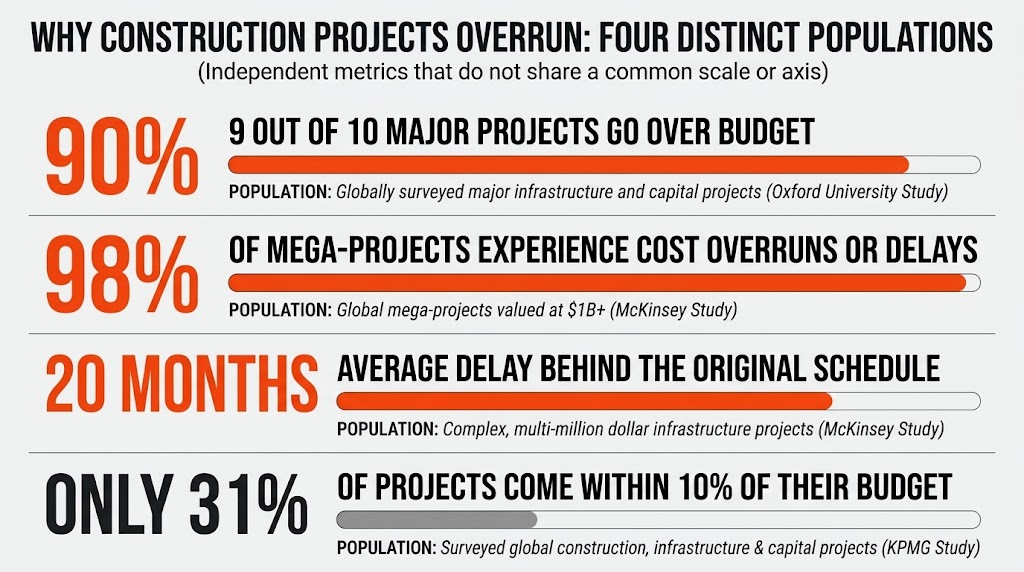
| Figure | Who published it | What population it actually describes |
|---|---|---|
| Nine out of ten such projects have cost overruns | Bent Flyvbjerg, Project Management Journal, Vol. 45, No. 2, 6-19, 2014 | Megaprojects, which that paper defines as large-scale, complex ventures that typically cost US$1 billion or more |
| Large projects across asset classes typically take 20 percent longer to finish than scheduled and are up to 80 percent over budget | McKinsey, 24 June 2016, Rajat Agarwal, Shankar Chandrasekaran and Mukund Sridhar | Large projects across asset classes, not construction alone, and the article is ten years old |
| 85%, to be exact! experienced cost overrun, with an overall average of “28%” | Propeller Aero, 3 November 2020, byline a role account | 258 transport infrastructure projects, rail, bridges, tunnels and roads, the newest completed in 1998, reached through a 2017 literature review that measured nothing itself. The underlying figure is 86%, not 85% |
| Just 25% of projects came within 10% of their original deadlines in the past 3 years | KPMG, Climbing the curve: Global construction survey 2015, March 2015 | 109 senior leaders at organizations running significant capital projects, reporting on a three-year window, not a seventy-year one |
None of the four is a figure about a typical commercial or residential contractor’s jobs. The first is explicitly about projects above a billion dollars.
Why the scope error matters more than the number
A contractor who reads “nine out of ten projects overrun” and buys software on that basis has bought against a statistic drawn from dams, tunnels and rail links. The failure modes of a billion-dollar megaproject are political, geological and financial. They are not the failure modes of a fifteen-person general contractor, which are an unpriced variation and a late invoice.
The statistics page on this results set misreports two of its own sources
Propeller Aero’s statistics page is dated 3 November 2020 and its byline is a role account rather than a person. It links its sources, which is more than most pages here manage. Two of the figures it draws from them are wrong.
It prints “85%, to be exact!” The source it links says 86%. The emphasis is doing work the number does not support.
Just 25% of projects came within 10% of their initial deadlines throughout that same time span is printed. KPMG’s Climbing the Curve is the source: The phrase in the past 3 years concludes the Global Construction Survey 2015, which was released in March 2015 from 109 top leaders. Propeller substituted “the same time span” for the three-year timeframe, referring to the seventy-year dataset two paragraphs prior in its article. A reader can verify that with a single click by naming the survey.
What the 2017 paper actually is
It is Aljohani, Ahiaga-Dagbui and Moore in the International Journal of Innovation, Management and Technology, volume 8 issue 2: a literature review of seventeen prior studies. It measured nothing itself. The 86% and 28% pair is quoted from Flyvbjerg, Bruzelius and Rothengatter (2003), whose underlying data is Flyvbjerg, Holm and Buhl (2002): 258 transport infrastructure projects, rail, bridges, tunnels and roads, across twenty nations, completed between 1927 and 1998.
No buildings. Nothing completed this century. A general contractor citing that figure is citing twentieth-century transport infrastructure, at two removes, through a paper that collected no data.
What software can actually prevent
Three things, and they are unglamorous. A variation captured and priced at the moment it is agreed rather than at month end. A cost code that reconciles between the estimate, the ledger and the progress claim without a manual export. And a date obligation that raises itself before it expires. Everything else on the overrun list is commercial or physical.
The remainder of the list is something that software cannot stop. A low bid to secure the job. A design that was incomplete at the beginning of the project. Ground conditions, the weather, and a client who decides to alter their mind. The overrun research is frequently cited to suggest that any vendor page that suggests a subscription addresses these is offering the wrong item.
Construction Software Cost
Construction software cost splits into two questions. Buying it costs between nothing and a few thousand dollars a month, published by half this market and withheld by the other half. Building it is quoted between eight thousand and four hundred thousand dollars, a spread of fifty to one, and not one page shows its arithmetic.
Start with the published subscriptions, because those numbers are checkable.
| Vendor | Published price, verbatim | Users included |
|---|---|---|
| Fieldwire | $0 per user/month; Pro $39 per user/month billed annually; Business $64; Business Plus $89 | Free tier capped at “5” users, “3” projects, “100” sheets |
| Contractor Foreman | $49, $105, $166, $221, $332 per month, on its /plans/ page | “1 User”, up to 3, up to 8, up to 15, unlimited |
| Jobber | Core $29/mo at 1 user; Connect $99/mo at 1 user; Grow $149/mo at 1 user; Plus $399/mo at 5 users, all billed annually. Note that $149/mo is also Connect at five users, so the figure means nothing without its plan and seat count | Add users for $29/mo each |
| Knowify | Core $99/month; Advanced $329 / month, billed yearly | Includes 1 user and Includes 10 users. Each additional user is $29/month |
| Projul | $199/mo, $399 /mo, $599/mo, $1,199 /mo billed annually | Up to 3, up to 10, up to 20, unlimited. No per-user rate published |
| Houzz Pro | Design $99/mo; Pro $199/mo; Teams Starting at $399/mo | 1 user, 1 user, unlimited. $50/user/mo for additional users |
| Bluebeam | $260, $330, $440, $590 per user, billed annually. The $590 is labelled “Introductory price” and is not the standing list price | Per user throughout |
| PlanSwift | $2,000/year; $3,000 / year | 1 seat each. Additional seats are “Discounted pricing for additional seats” with no figure published |
| Clear Estimates | $59, $99, $199* per month billed annually | Additional users (+$9/mo) on the middle plan only |
| STACK | As Low As $299, As Low As $49, As Low As $348 per user/month | Floors only, so not comparable |
Three published plan structures invert
In three cases the cheaper-looking plan costs more than the dearer one above a specific headcount, using only the vendors’ own published figures.
Jobber’s Connect plan, billed annually, is $99/mo for one user and $149/mo for five, with extra users at $29/mo each. A three-person crew on the one-user plan pays $99 plus $29 times 2, which is $157. The five-user plan is $149. At three people, the cheaper plan costs eight dollars more and carries two fewer seats.
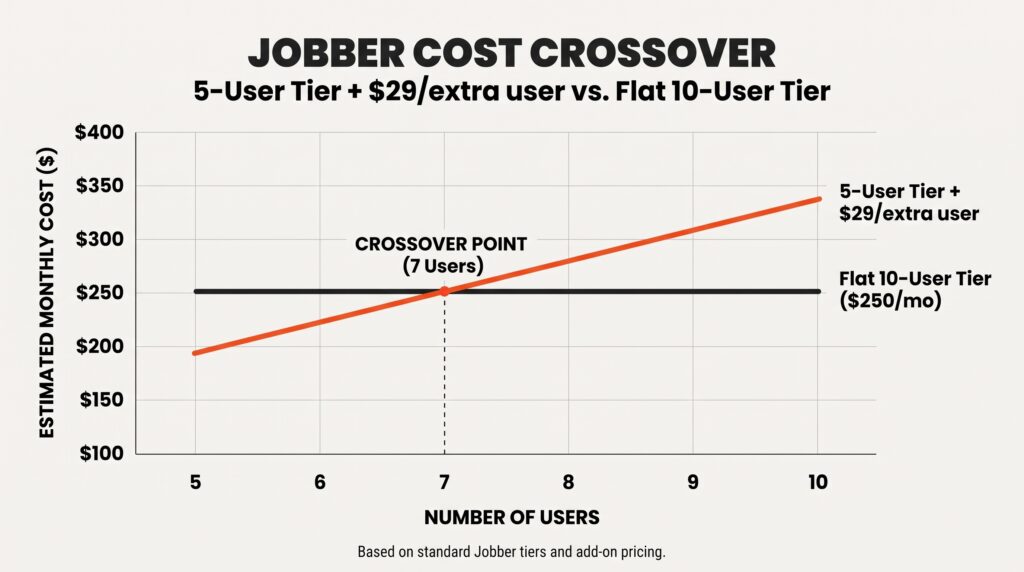
Jobber’s Plus plan repeats it higher up. Five users is $399/mo billed annually and ten users is $449/mo. Seven users on the five-user plan is $399 plus $29 times 2, which is $457, against $449 for a plan that includes three more seats than the company needs. The crossover is the seventh user.
Knowify inverts at the ninth. Core is $99/month with “Includes 1 user” and Advanced is $329 / month with “Includes 10 users”, both billed yearly, with additional users at $29/month. Nine users on Core is $99 plus $29 times 8, which is $331, two dollars above Advanced, which still has a tenth seat spare. Equality falls at 8.93 users.
Houzz Pro ties then inverts, with a caveat. Pro is $199/mo for one user with additional users at $50/user/mo, and Teams is “Starting at $399/mo” for unlimited users, rendered on the page as “Starting at $399/mo”, which is a rendering artefact rather than a typo on Houzz’s part. Five users on Pro is exactly $399, a tie. Six users is $449. The caveat is that Teams is published as a floor, so the crossover is exact only against that floor.
Two more structures that are cliffs rather than crossovers
Projul publishes no per-user rate at all, so every cap is a step. The fourth user moves a company from “$199/mo” to “$399 /mo”, which its own page states as “Billed annually at $2,388” and “Billed annually at $4,788”. That is $2,400 a year for one seat. The eleventh user costs another $2,400 a year, and the twenty-first costs $7,200 a year.
Fieldwire’s free tier is capped at five users and three projects. The sixth user or the fourth project moves every seat onto Pro at “$39 per user/month billed annually”, so a six-person team goes from zero to $234 a month in a single step, because the paid rate applies to all users rather than to the marginal one.
A third structure is a bundle with no discount in it. STACK publishes “As Low As $299 per user/month” for Takeoff and Estimate, “As Low As $49 per user/month” for Build and Operate, and “As Low As $348 per user/month” for the Full STACK Platform. The first two add to exactly the third. On the published floors, the bundle carries no discount against buying both parts separately.
What building costs instead, and why nobody shows the math
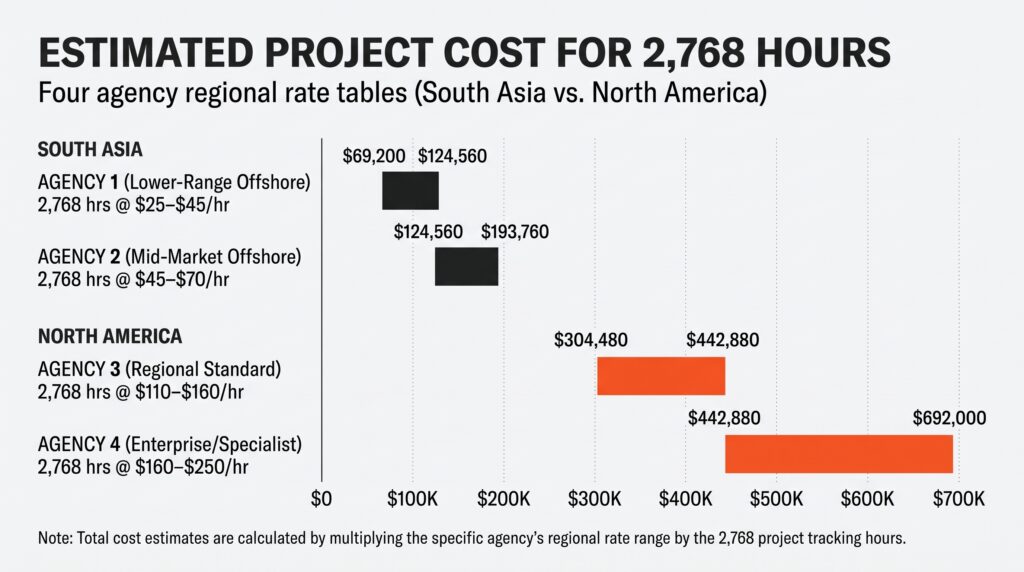
Twelve agency pages were read for this question. Five publish build cost figures, and the totals run from “$8,000” for a basic platform to “$180K – $400K” for a full enterprise ecosystem, a spread of fifty to one. Four publish regional hourly rate tables. Not one of the twelve publishes a single development hours figure, which means no total on any of those pages can be checked against that page’s own numbers. The rate tables sit beside the totals and are never multiplied into them.
The same figure also carries incompatible scopes. “$80,000” is the top of the entire range on one page, the ceiling of the enterprise tier on a second, and the ceiling of a minimum viable product on a third. No page sources it.
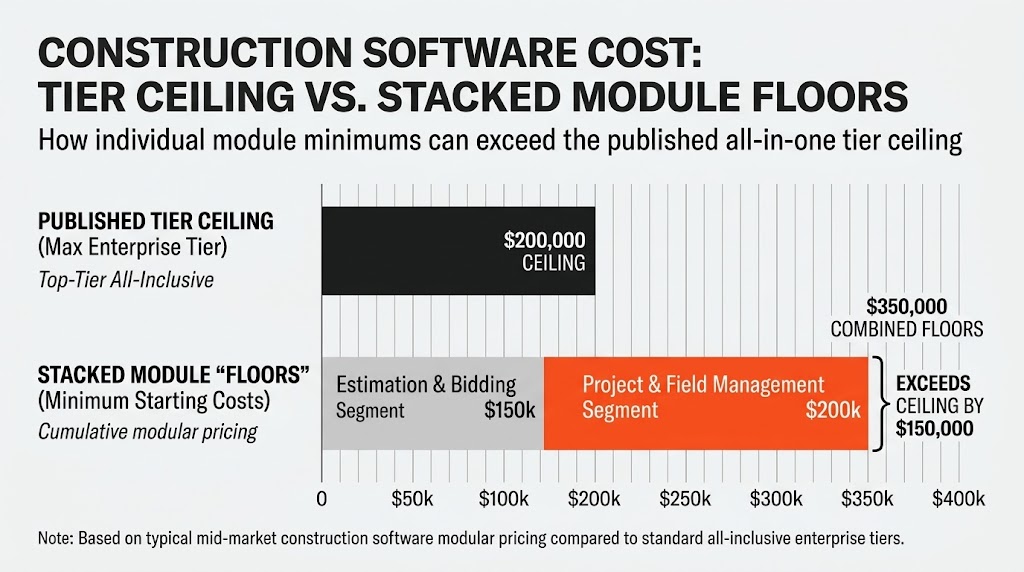
One page blatantly contradicts itself. Cost “begins at $8,000 and escalates to $80,000” and specifies its enterprise tier as “$50K-80K” with “AI analytics, IoT, AR/VR, compliance engines, role-based permissions.” Its own module table then prices “AI/Analytics” at “$40K-150K” and “IoT/AR Integrations” at “$60K-200K”. At their respective stated floors, two of the five components it names total $100,000, which is already 25% more than the tier’s own ceiling. Just the two approach $350,000 at the module ceilings.
What 2,768 hours costs at those pages’ own rates
Omega Solution’s Alotbi build is 2,768 hours, derived from a published team of four and a published duration of four months. Priced at the regional rate tables those same agency pages publish, that single figure spans most of their stated range on its own.
| Rate table, as published | Low | High |
|---|---|---|
| India and APAC, $15-$30/hr | $41,520 | $83,040 |
| South Asia, $20-$45/hr | $55,360 | $124,560 |
| Eastern Europe, $25-$45/hr | $69,200 | $124,560 |
| United States and Canada, $40-$70/hr | $110,720 | $193,760 |
| North America, $100-$200/hr | $276,800 | $553,600 |
The page that publishes the “$40-$70/hr” United States and Canada rate also states the whole category tops out at “$80,000+”. Its own rate, applied to a four-person, four-month build, reaches $193,760, which is 2.4 times its stated maximum. The rate table and the total on that one page describe different markets.
Cost Estimation and BOQ Software
Cost estimation and BOQ software measures quantities off drawings and prices them into a bid. It is the most expensive seat in construction software by a wide margin, because the estimate is the commercial document the whole job hangs on. Four vendors publish a price for it.
An estimating seat costs between six and eight times a field seat, using published figures only.
| Product | Published price | Per seat per year |
|---|---|---|
| STACK, Takeoff and Estimate | As Low As $299 per user/month | $3,588 at the published floor |
| PlanSwift Core | $3,000 / year, 1 seat | $3,000 |
| PlanSwift Essential | $2,000 / year, 1 seat | $2,000 |
| Clear Estimates Pro | $99 per month, billed annually | $1,188 |
| Fieldwire Pro, for comparison | $39 per user/month billed annually | $468 |
STACK’s estimating floor is 7.7 times the Fieldwire Pro field seat. PlanSwift Core is 6.4 times it. Both multiplications use the vendors’ own published figures and nothing else.
Why the estimating seat is priced that way
The estimate decides the margin. A field app that loses a photo costs an argument; an estimate that misses a quantity costs the job. Vendors price accordingly, and they also price for a small number of users, because a company with forty people on site may have two estimators.
What a bill of quantities needs that a United States estimating tool often lacks
In the Commonwealth, the Gulf, and most of Europe, a bill of quantities is a structured, itemized measure that is priced line by line. The schedule of values, a coarser breakdown agreed upon for progress billing, is the basis for US practice. When a business follows a BOQ discipline or enters a market that requires one, it often discovers that the packaged estimating tools will generate a bid but not the BOQ document that the client truly desires.
Where the build happens in estimating
Rarely in the measurement itself, which the packaged tools do well. Usually in two places: a rate library that holds the company’s own build-ups rather than a generic published rate set, and the export that turns an accepted bid into the cost code structure the ledger uses. The second one is almost always a build, because it has to match both systems.
Of the nine results for this term on 7 October 2026, the first is an encyclopedia entry, and the rest are vendor product pages, a vendor blog guide and an app store listing. There is no development agency page and no review site barrier. The practical consequence is that this term is not winnable with an article, and Omega Solution says so in the targeting notes rather than publishing a page that cannot rank.
Construction ERP vs Project Management Tools
Construction ERP holds the general ledger, job costing, payroll and procurement, and treats projects as cost objects inside a financial system. Project management tools hold the schedule, the drawings and the field record, and treat money as a field on a project. The practical difference shows up in what each category will tell you before a sales call.
The split is visible in the pricing pages themselves.
The enterprise tier does not publish, the small business tier does
Almost every product positioned at enterprise withholds its price: Procore, Sage Construction Management, Premier Construction Software, Archdesk and both Trimble products. Autodesk is the exception, and only partly: its buy page is gated while its overview page prints Starting at $117 / month. Every product positioned at a small or mid-size contractor published one: Contractor Foreman, Jobber, Knowify, Projul, Fieldwire, Clear Estimates. The one clear exception is Raken, a field reporting tool that publishes nothing and says “Raken offers custom pricing built to fit your company’s needs”.
The one statutory feature named anywhere is marked with an undefined dollar sign
Across twenty-one pricing pages, exactly one names a statutory obligation as a feature. Knowify’s comparison table carries a row reading “Prevailing Wage”, described as “Job costing and labour tracking for Davis-Bacon work.” Its Core and Advanced cells each hold a dash. Its Enterprise cell holds a bare “$”, and nothing on the page says what that symbol means. There is no legend, no footnote and no key.
Knowify publishes a price for Core and for Advanced. It publishes none for Enterprise. So the only compliance capability named anywhere in this market is marked with an undefined dollar sign, on the only tier with no price.
If a contractor’s requirement is prevailing wage or certified payroll, the published price list is no longer relevant, because the capability is above it and carries a symbol the page never defines. That is the point at which a build quoted in hours becomes comparable to a subscription quoted on a call, and it is the most common reason a construction company ends up on both sides of the comparison at once.
Where the two categories genuinely overlap
Job costing. Both sides claim it, and they mean different things. In an ERP, a job cost is a ledger entry with a posting date. In a project management tool, it is usually a budget line that someone updates. A company that buys the second expecting the first will reconcile by hand forever, and this is the single most common integration Omega Solution is asked to build.
The nine results for this comparison on 7 October 2026 are four self-ranked vendor listicles, two independent review and comparison sites, a vendor blog, a comparison tool page and a directory comparison page. Every vendor listicle places its own product first or in the top three. A buyer reading them is reading positioning, not analysis, and should go to the pricing pages instead.
What Compliance Adds to a Construction Build
Compliance adds dates, formats and storage rules, and each of the three is a schema decision rather than a feature. The deadlines below are quoted from the regulation, the clause or the statute itself. None of the twelve agency pages read for this guide cites a single one.
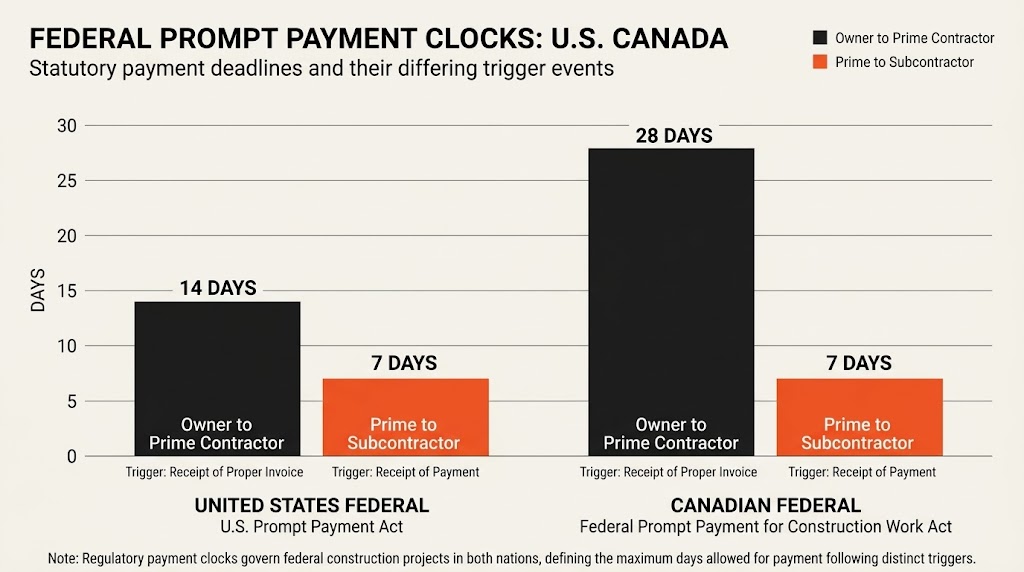
Two jurisdictions, two payment clocks, and they are not the same shape.
| Obligation | United States federal construction | Canada federal construction, in force since 9 December 2023 |
|---|---|---|
| Owner pays the prime, on a progress payment | “The due date for making such payments is 14 days after the designated billing office receives a proper payment request”, FAR 52.232-27(a)(1)(i)(A). Final payment runs on a separate clock at (a)(1)(ii)(A) | “no later than the 28th day after the day on which the proper invoice is received”, section 9(2) |
| Defective invoice returned | “the designated billing office must return it within 7 days after receipt, with the reasons why it is not a proper invoice”, FAR 52.232-27(a)(2) | Notice of non-payment “no later than the 21st day after the day on which the proper invoice is received”, section 9(3) |
| Prime pays the subcontractor | A flow-down drafting duty, not a direct obligation. “The Contractor shall include in each subcontract … A payment clause that obligates the Contractor to pay the subcontractor … not later than 7 days from receipt of payment”, FAR 52.232-27(c)(1) | “no later than the 35th day after the day on which the proper invoice is received by Her Majesty or a service provider”, section 10(1) |
| Retainage released to the subcontractor | “as specified in the contract or, if not specified, 30 days after approval by the Contracting Officer for release to the Contractor”, FAR 52.232-27(a)(1)(i)(B) | Not set by the same section |
The two clocks run from different events, and that is the build
Read the two subcontractor rows together. The United States clause does not pay the subcontractor directly: it obliges the prime to write a clause into each subcontract, and that clause starts seven days from the moment the prime is paid. The Canadian act starts the subcontractor’s thirty-five days from the moment the owner or a service provider receives the invoice. The Act is in force: it came into force on 9 December 2023 by SI/2023-77, alongside SOR/2023-269, 270 and 271. One is an event-driven timer that floats with the owner’s behaviour; the other is an absolute date the subcontractor can calculate itself on the day it invoices. The same pattern of statutory clocks driving a data model appears in Omega Solution’s logistics software development and insurance software development work.
A single payment terms field cannot hold both. Modelling them properly means storing the trigger event alongside the interval, which is a different table from the one most products ship with. A statutory rule turning into a schema decision, which is what this whole section is about.
Certified payroll is weekly, and the record and the transmittal differ
On Davis-Bacon covered work, the rule is weekly. The contractor “must submit weekly, for each week in which any DBA- or Related Acts-covered work is performed, certified payrolls” under 29 CFR 5.5(a)(3)(ii)(A). Under (a)(3)(i)(A), records “must be maintained by the contractor and any subcontractor during the course of the work and preserved for all labourers and mechanics working at the site of the work (or otherwise working in construction or development of the project under a development statute) for a period of at least 3 years after all the work on the prime contract is completed”. The scope clause matters: it defines whose records are covered.
The storage rule splits in two, and this is the part products get wrong. The regulation says that “full Social Security numbers and last known addresses, telephone numbers, and email addresses must not be included on weekly transmittals”, and instead “the certified payrolls need only include an individually identifying number for each worker (e.g., the last four digits of the worker’s Social Security number)”. The underlying record keeps the full data. The transmittal must not. One field, two rules, and a template cannot enforce that.
The form itself is not mandatory. The regulation says the information may be submitted using Optional Form WH-347 or in any other format desired, which is why a custom transmittal is permissible in the first place.
The OSHA electronic submission rule reaches construction unevenly
Two appendices to 29 CFR 1904.41 decide it, and the difference between them is routinely misreported. Appendix A lists “23 Construction” as a whole, so a construction establishment with 20 to 249 employees must electronically submit its Form 300A summary. Establishments with 250 or more must do so regardless of industry, but that tier is not pure headcount: it applies only where “this part requires your establishment to keep records”. The deadline in both cases sits at 1904.41(c), not inside (a), and is “by March 2 of the year after the calendar year covered by the form(s)”.
Appendix B is narrower than most summaries suggest. Titled “Designated Industries for 1904.41(a)(2)”, it names exactly one construction entry: 2381, Foundation, Structure, and Building Exterior Contractors. That is one industry group inside NAICS 238. Establishments of 100 or more employees in that group must submit the detailed Forms 300 and 301. The rest of specialty trade, all of building construction and all of heavy and civil engineering construction are not named there at all.
Thus, once a year, a general contractor with 150 workers gives a report. A 150-person foundation and exterior contractor submits case-level information. The kind of differentiation that determines a data model is that software designed for one is not compatible with the other.
What was deliberately left off this page
Three items were cut rather than published. State prompt payment and lien deadlines vary enough that a table of them would need a jurisdiction-by-jurisdiction read, and a partial table invites exactly the scope error criticized above. The European Union’s Construction Products Regulation, Regulation (EU) 2024/3110 of 27 November 2024, is in force, but its application dates could not be verified against the regulation’s own final articles within this research window, so no date for it appears here. And the only federal series that ever measured construction software spending was suspended: the Census Bureau’s Information and Communication Technology Survey put Construction, NAICS 23, at $2.7 billion for 2013, $1.2 billion noncapitalized and $1.4 billion capitalized, and reference year 2013 is the last one it published.
How to Evaluate a Construction Software Development Partner
Five questions separate a partner who has built this before from one writing a proposal. Each one is answerable in a sentence, and each one was failed by most of the twelve agency pages read for this guide. A partner who cannot answer all five in a first call is quoting a brochure.
How many hours will this take, split by role, across how many weeks?
Not a price band, a count. Zero of the twelve agency pages read for this guide publish an hours figure, and four of them publish regional hourly rate tables with nothing to multiply. If the answer is a range with no hours in it, the range was not derived from anything.
Which statute does this module enforce, and by which section?
A partner building a payment workflow for federal work should be able to name FAR 52.232-27 and say whether the subcontractor clock runs from receipt of payment or from receipt of the invoice. A partner building certified payroll should know that the weekly transmittal may not carry full Social Security numbers. These are not trick questions; they are the specification.
What will you recommend against building?
The right answer names the packaged products. Takeoff, field reporting and the general ledger are mature, and a partner proposing to rebuild them is either misreading the requirement or selling hours. Ask for the list of things the engagement deliberately leaves to the products already bought.
Which numbers in your case studies were measured, and measured against what?
Of the twelve agency pages, several publish outcome percentages and not one publishes a baseline. One page carries “reduce manual work by 70%” and “reducing manual effort by 70%” for two different clients. Another lands on forty percent for two unrelated case studies. A percentage without a starting figure is not a measurement.
Who reviewed this for accuracy, by name?
Across twelve agency pages, four name an author and all four are commercial principals of the agency selling the service: a managing director and three co-founders or directors. Not one page names a reviewer, a fact-checker or an editor. In a subject where a wrong date carries interest, that is the gap worth asking about.
Four Mistakes Contractors Make When Commissioning Software
Four mistakes account for most of the money wasted when a contractor commissions software, and none of them is a technical failure. Each one is a decision made before any code is written: rebuilding what is already mature, modeling one payment clock, buying against the wrong statistic, and comparing prices that are not comparable.
Mistake 1: rebuilding the layer that is already mature
Takeoff, field reporting and drawing management are solved by products that cost a few hundred dollars a month. Commissioning them again buys a worse version at fifty times the price. The build belongs at the cost structure and the integration, which is the layer no product fits.
Mistake 2: one payment clock for every contract
A single configurable payment terms field looks like flexibility and is not. United States federal work starts the subcontractor’s clock at receipt of payment; Canadian federal work starts it at the owner’s receipt of the invoice. Storing an interval without its trigger event guarantees a wrong date eventually, and the wrong date carries interest.
Mistake 3: buying on a statistic drawn from a different population
The overrun research most quoted in this market describes megaprojects above a billion dollars, large projects across all asset classes, or a seventy-year sample across twenty countries. None of them describes a fifteen-person contractor. Software bought against the wrong population solves a problem the company does not have.
Mistake 4: comparing a published subscription to an unpublished one
Nearly half this market will not publish a price, and the one compliance capability named anywhere in it, prevailing wage on public and Davis-Bacon work, is marked with an undefined dollar sign on the one tier its vendor does not price. Comparing the published plans against each other while the real requirement is above all of them produces a decision about the wrong products.
Frequently Asked Questions
What is custom construction software development?
Custom construction software development is building the parts of a contractor’s systems that packaged products cannot hold: the company’s own cost code structure, statutory payment and payroll workflows, and the integrations between estimating, field and accounting. It is not a replacement for takeoff or field apps, which are mature and cheap to buy.
How much does custom construction software development cost?
Five of the twelve agency pages read publish totals, from $8,000 to $400,000, a spread of fifty to one, and none of the twelve publishes an hours figure to support any of it. A derivable comparison is Omega Solution’s four-person, four-month build at 2,768 hours, which at those pages’ own published rates is $41,520 to $553,600 depending on region.
What is construction project management software?
Construction project management software holds the field record: schedules, drawings and sheet versions, daily logs, RFIs, submittals, change orders, photos and punch lists, usually with a mobile app. It is distinct from construction accounting, which holds the job cost ledger, and from estimating, which produces the bid. Most of the category records rather than decides.
How much does construction management software cost?
Of twenty-one products read on 5 and 6 October 2026, nine publish no price at all. Among those that do, published plans run from Fieldwire’s “$0 per user/month” free tier to Projul’s “$1,199 /mo” unlimited tier. Three published plan structures invert, so a cheaper plan costs more above a specific headcount.
Why do construction projects overrun?
For commercial and physical reasons software cannot touch, and four it can: late information, variations priced at month end rather than when agreed, cost codes that do not reconcile between estimate and ledger, and payment dates nobody is counting. The widely quoted overrun statistics describe megaprojects and large asset-class projects, not typical contractors.
Should a contractor buy construction ERP or project management software?
They answer different questions. ERP holds the ledger, job costing, payroll and procurement; project management tools hold the schedule and the field record. Both claim job costing and mean different things by it. The overlap between them is where most integration work sits, and where a build is usually justified.
How long does a construction software build take?
Omega Solution’s nearest delivered project ran four months with four people, which the case study page publishes. The agency pages read for this guide quote three to sixteen months without stating where those bands came from. A build scoped in hours by named roles can be checked; a band in months cannot.
Does construction software have to handle certified payroll?
Only on covered work, and then weekly. Under 29 CFR 5.5(a)(3)(ii)(A) a contractor must submit certified payrolls weekly for each week of Davis-Bacon covered work, records must be kept at least three years after the prime contract completes, and full Social Security numbers must not appear on the weekly transmittal.
If you want a construction build costed in hours rather than quoted as a band, the place to begin is an Omega Solution IT consultation. The wider custom software development service page sets out how these engagements are structured.



 Aug 26, 2025


 Dhaka, Bangladesh

