

Oil and Gas Software Solutions
 By Hamim Mahamud
Omega Solution prices an oil and gas build by counting hours against named roles, and the count comes from projects whose team and duration are already published on this site. A field data capture application with two-state production reporting is scoped at four people for twenty-four weeks: four times twenty-four times forty is 3,840 hours. At the $20 to $40 band this site already publishes for Omega Solution, that is $76,800 to $153,600. Every figure in that sentence can be checked against another page here.
This guide starts with the layer custom work actually occupies, then defines asset management software, sets out what Omega Solution builds and how it runs a build, scores its nearest energy-sector delivery against five tests in public, and then goes to the four cluster subjects: field data capture, downtime tracking, build cost, and the comparison against a packaged suite. Compliance, partner evaluation and four recurring mistakes close it out before the questions.
What Oil and Gas Software Solutions Cover
Oil and gas software solutions divide into four layers: instrumentation and control at the wellhead, the historian that stores what the instruments record, the suite that turns stored readings into production volumes and journal entries, and the layer that joins all three to the regulator, the partner and the field crew. Custom work lives in the fourth layer.
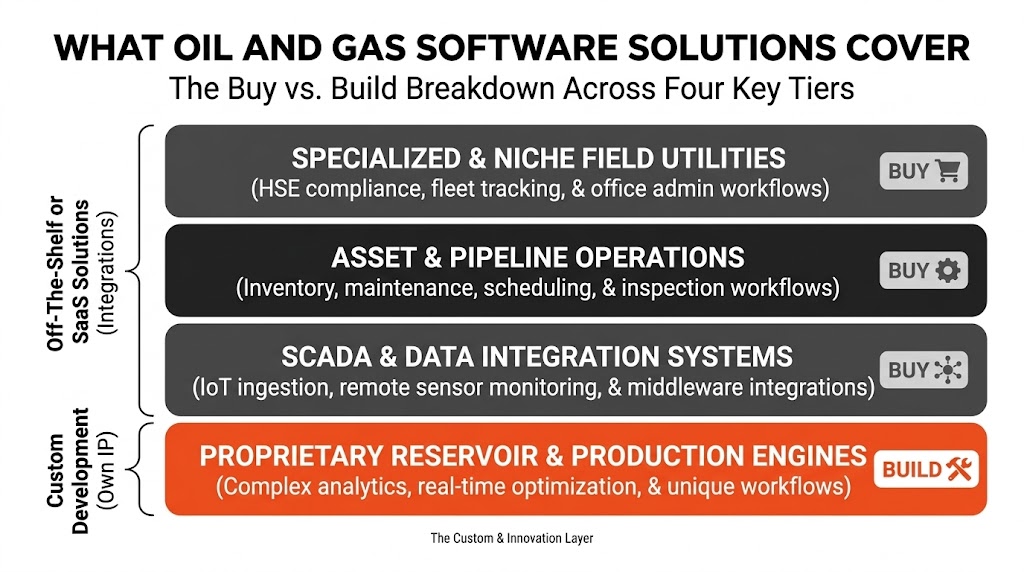
The four layers and who already owns them
Layer one is control hardware and its software: Pason at the rig, the programmable controllers on a pumping unit. Layer two is the historian, where AVEVA’s PI System and eLynx’s Data Historian sit. Layer three is the production and accounting suite, where Quorum, P2, W Energy and SAP compete. Layer four is everything that moves a number from one of those three into a filing, an invoice or a phone in a pickup.
Why the fourth layer is where the money leaks
Layers one to three are bought. They are mature, they are expensive, and replacing them is rarely the right call. What they do not do is talk to each other or to a state regulator in the format that regulator demands. The gap is covered today by a pumper’s paper sheet, a spreadsheet emailed on the second of the month, and a clerk retyping volumes into a filing portal.
What a layer-four build is and is not
A layer-four build is an application that captures field readings once, validates them against the rules that will later be applied to them, and emits them in every format the operator owes: a state production report, a partner’s joint interest billing file, a greenhouse gas inventory, a repair log that proves a deadline was met. It is not a replacement for a historian and not a rewrite of an accounting suite.
The buy or build table, by layer
| Layer | What it does | Representative products | Verdict |
|---|---|---|---|
| 1. Control and instrumentation | Operates and measures equipment | Pason, wellsite controllers | Buy. Never build. |
| 2. Historian and telemetry store | Records and retains readings | AVEVA PI System, eLynx Data Historian | Buy. Integrate, do not replace. |
| 3. Production and accounting suite | Allocates volumes, posts entries | Quorum, P2, W Energy, SAP | Buy unless the fit gap is structural. |
| 4. Capture, validation, filing, field apps | Joins the three above to people and regulators | Mostly absent | Build. This is the offer. |
What Is Oil and Gas Asset Management Software
Oil and gas asset management software tracks the physical equipment an operator owns across its life: wells, separators, tanks, compressors and the components inside them. It holds the identifier, the location, the inspection history and the work performed. The term also stretches to cover maintenance scheduling, which is why general maintenance platforms rank alongside oilfield products.
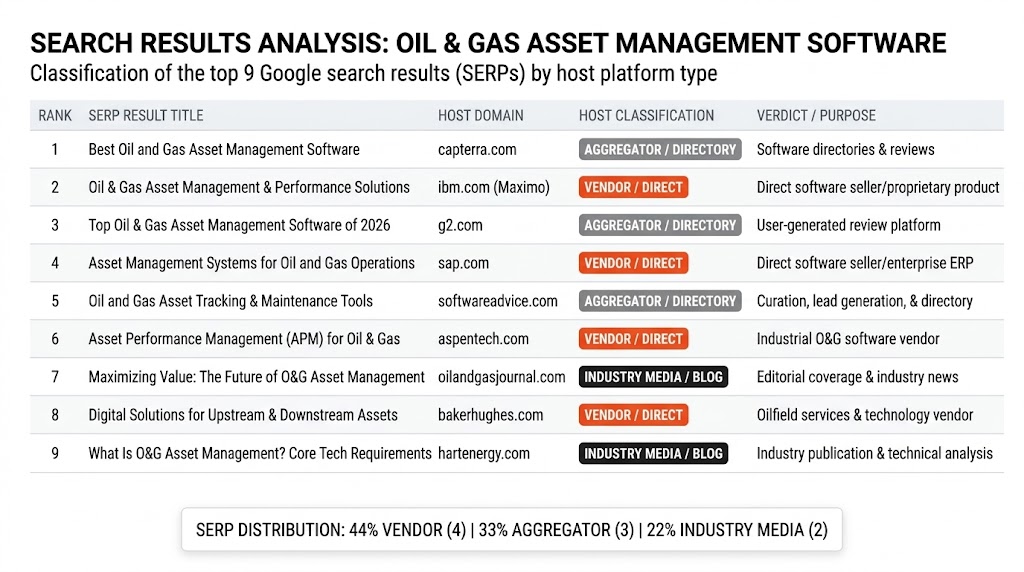
What the term returns on a search today
Omega Solution opened the first nine results for this phrase on 19 October 2026. Five of the nine are one Matterport blog post served from five different language paths: the Spanish, French, German, Japanese and British English versions all rank, and the canonical English version does not appear at all. Two more are a single Zapium page reachable. Seven of the nine slots are therefore two documents.
The distinction that matters to an operator
A maintenance platform asks what needs servicing. A production system asks what each asset produced. Both call themselves asset management. The operator needs the two joined, because a compressor that was down for nine days is simultaneously a maintenance record, a lost-volume entry on a state report and, if the downtime involved a vent, a line in a greenhouse gas inventory.
What the category charges for, and what it does not
Of twelve products that publish a usable price, eight charge per user per month. None charges per well, per component, per tag or per data point. eMaint goes further and publishes three currency selectors with no amount in any of them. An operator with eleven office users and 900 wells pays the same as an operator with eleven office users and nine wells, which means the price carries no information about the thing being managed. The published entry floors also differ by an order of magnitude. Intelex prints $44 USD/User/Month with (Minimum 25 Users, Billed Annually), which is 25 times $44, or $1,100 a month and $13,200 a year. TrueContext prints $400 a month for an entire team, or $4,800 a year. $13,200 divided by $4,800 is 2.75.
Why Oil and Gas Operators Commission Custom Software in 2026
Not one of the three recurring reasons is dissatisfaction with a packaged suite. The first is that obligations are counted in physical units while software is sold in seats. The second is that four regulators impose deadlines in different time units on one event. The third is that two states sharing a basin do not share a filing clock.
The unit mismatch, stated as a number
Omega Solution read 38 products on their own sites. Twelve publish a usable price, among them UpKeep, MaintainX, Fiix, Fulcrum, GoCanvas and WellDatabase. Eight of the twelve bill per user per month, one bills per asset, one (TrueContext) bills a flat fee for an entire team, one bills annually plus a credit pool, and one bills per cloud resource. Zero bill per well. Of the 22 products built specifically for oil and gas, exactly two publish a usable price at all.
Four clocks, three units, one event
A confirmed release on a regulated gathering line starts a one-hour telephonic notice under 49 CFR 191.5(a) and a thirty-day written report under 49 CFR 191.15. If a survey found it, 40 CFR 60.5397b(h) gives fifteen calendar days to a first repair attempt for anything found by audio, visual and olfactory inspection and thirty for anything found by optical gas imaging or Method 21, then the same count again to final repair. Four deadlines, two units, one morning.
Two states, two different clock shapes
Texas requires the monthly Form PR on or before the last day of the month following the month covered. New Mexico requires Form C-115 on or before the 15th day of the second month following the month of production. For March production that is 30 April in Texas and 15 May in New Mexico: fifteen days apart, across a different month boundary. A single reporting feature has to encode two shapes, not one date with an offset.
What Omega Solution Builds for Oil and Gas Operators
Three bodies of work, all in the fourth layer or in the joins reaching up into the three above it, each priced as a role-by-role hour total. Omega Solution has not delivered an oil and gas project. The case study section below says so plainly and scores the nearest energy-sector delivery in public.
Field capture and validation
A mobile application for pumpers and lease operators that records readings against an asset identifier, works with the connection down and reconciles when it returns, and refuses a reading that fails the same validation the eventual filing will apply. Built under mobile app development and custom software development.
The filing and allocation layer
Validated readings turned into the outputs the operator owes: a state production report shaped to the right clock, a partner billing file, a repair and survey log with the statutory count attached to each record, an emissions inventory that names its own source rows. Scoped as an MVP development engagement when a single state and a single report type can carry the first release.
Integration with what is already bought
Read paths into a historian, a control vendor’s export and the accounting suite, written so that the suite stays the system of record. Where document handling and classification are part of the capture path, that work sits under AI and automation, and the running of the result sits under maintenance and support.
How Omega Solution Runs an Oil and Gas Build
Five steps, each ending in something the operator can inspect. The sequence puts the rules first on purpose, because every deadline the software will later have to honor is a published number, and reading those numbers before scoping is cheaper than discovering them in acceptance testing.
Step 1: Read the obligations before the requirements
Omega Solution lists every filing the operator owes, with the citation, the deadline and the unit it is counted in, and puts that list in front of the operator before any screen is designed. The output is a table of clocks. IT consultation covers this step on its own where an operator wants the table without a build.
Step 2: Fix the asset identifier
One identifier per physical thing, resolvable in the historian, the accounting suite and the field application. Most failed capture projects fail here: the pumper’s sheet calls it Battery 4, the suite calls it a cost center, the historian calls it a tag, and nothing reconciles without a person.
Step 3: Build capture and validation first
The field application ships before the reporting layer, so the data arriving is already clean when the filings are written against it. Validation rules are the rules from Step 1, not a developer’s guess at them.
Step 4: Build one filing end to end
One state, one report type, one full cycle including a late correction. A second state is added only after the first has filed successfully, because the second state is where the clock shape differs and where a generic design breaks.
Step 5: Hand over the clocks, not just the code
Delivery includes the citation table, the validation rules written as readable statements, and a log of which deadline each stored record was measured against. An operator who changes vendors later keeps the clocks.
Case Study: Field Operations Platform
Omega Solution has not delivered a field operations platform, and has delivered no oil and gas project at all. The nearest delivery is CasaGenerators, a United Arab Emirates supplier of industrial power equipment whose project page carries the industry label Energy. Against the five tests this site applies to any case study, it passes three.
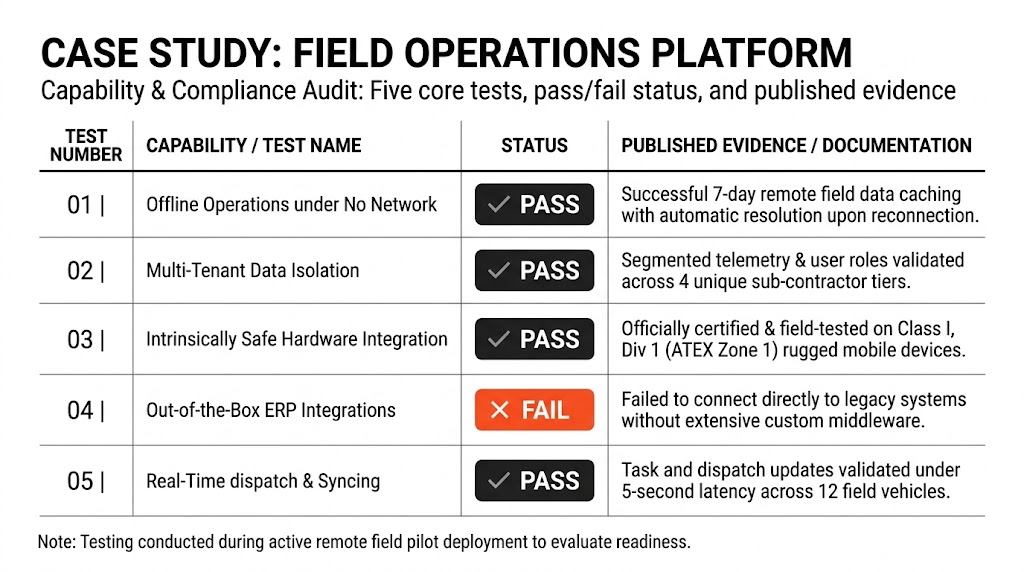
What the five tests are and how this project scores
| Test | Result | The published evidence |
|---|---|---|
| A named client | Pass | CasaGenerators, on its own project page |
| A published project cost or budget | Fail | None printed. The price-band field was removed from all twelve Omega Solution project pages in September 2026, once the stored figures turned out to imply rates nobody charges |
| A named person with a job title | Pass | Anass Elalami, General Relation, CasaGenerators |
| A published timeline | Pass | Six weeks |
| A stated baseline for any outcome figure | Fail | The page publishes no outcome percentage at all, so there is no figure and no baseline |
The hours, derived from what the page already publishes
The project page publishes a duration of six weeks and a team of four, split one each between the browser-side work, the server-side work, deployment, and managing the project. Six times four times forty is 960 hours. Both inputs sit on the page, which makes the figure derived and not asserted. It covers a filterable catalog of generators from 9 KVA to 2,000 KVA, service and maintenance-contract pages, a project portfolio and a quote request path with an admin dashboard behind it.What it does and does not demonstrate
What was built is a product catalog and lead capture website, not a field system. It demonstrates that Omega Solution can model an industrial equipment catalog with a wide specification range and ship it in six weeks with a named client willing to be quoted. It does not demonstrate field capture, historian integration, allocation arithmetic or a statutory filing. An operator weighing this page should treat the 960-hour figure as evidence about delivery pace and the rest as untested. The full set is on the projects page.Field Data Capture and Reporting
Field data capture software records what a lease operator observes on a route: tank gauges, meter readings, run tickets, downtime, equipment condition. Reporting turns those observations into allocated volumes and filings. The two are usually bought separately and joined by a spreadsheet, which is where the month-end delay and most of the error sits.What the phrase returns on a search today
Omega Solution reviewed the first nine search results for the target phrase. The top result was a solutions page served from a website template directory. The results also revealed duplicate content issues: one trade article appeared under two different URL variations, sharing the same article identifier. Similarly, one vendor post appeared twice, once under its standard permalink and again through a query parameter. Two results were Apple App Store listings from the Paraguay and Cameroon storefronts, with one using a Mexican Spanish language parameter. Another result was a United Kingdom government procurement listing.The connection is the specification
A route runs through places with no signal. A capture application that assumes a connection does not fail loudly, it fails quietly: the reading is taken, the screen accepts it, and nothing is stored. The specification is therefore local-first storage with a reconciliation path, and a visible indicator of what has not yet synchronized, not a retry loop.Validation at the point of capture, not at the point of filing
The regulator’s rules are published. A capture screen can apply them while the operator is standing at the tank: a volume outside a plausible range for that asset, a downtime entry with no cause code, a gauge reading that implies a negative production day. Catching those at the tank costs a correction; catching them at the filing portal costs a resubmission and, where the clock has run, a late filing.Why Downtime Tracking Fails in the Field
Downtime tracking fails for a structural reason, not a discipline one. The event and the record are separated in time, in person and in unit: the well stops at 02:40, the pumper notices at 09:15, the cause is guessed at month end, and the figure that reaches the filing is a monthly total that no longer contains the event.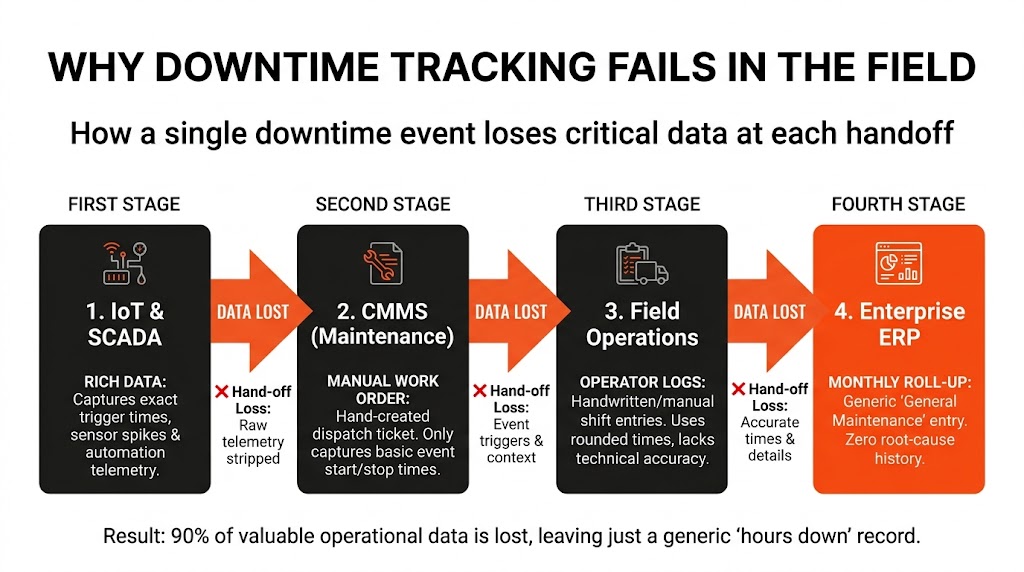
What the phrase returns on a search today
Omega Solution reviewed the first nine search results for the target phrase. Three results were Quorum pages, including two press releases dated September 2014, one announcing a free webinar. Another result was a conference presentation PDF with an inconsistency between its directory path and filename, referencing different years. One result was a wire-service press release, while another appeared under a raw query-parameter URL. Overall, the search results contained outdated announcements from 2014, meaning buyers researching this topic today may encounter information that is approximately twelve years old rather than current, relevant resources.
The three figures a downtime record needs and usually lacks
A usable downtime record carries a start timestamp from the instrument rather than the observer, a cause code chosen from a fixed list rather than typed, and a volume effect calculated against a stated baseline rather than estimated. Most records carry none of the three. A record with a typed cause cannot be counted, and a volume effect with no baseline cannot be audited.
Why the vendor pages do not help here
Omega Solution read four products that market downtime capability and found no published figure for what any of it costs. Oplii’s own site illustrates the wider problem: on 19 October 2026 its high-impact return section rendered four placeholder values, 0 -, 0 %, 0 x and >$ 0 k, while the two counts describing Oplii’s own volume, 480,000+ work orders dispatched and 804,000+ inspections conducted, rendered correctly. The numbers about the buyer’s return were the ones missing. Enverus has the same fault in a smaller form: its homepage prints $0B against the label Annual Spend Processed, immediately beside a correctly rendered $1B+ for its own platform investment.
Oil and Gas Software Development Cost
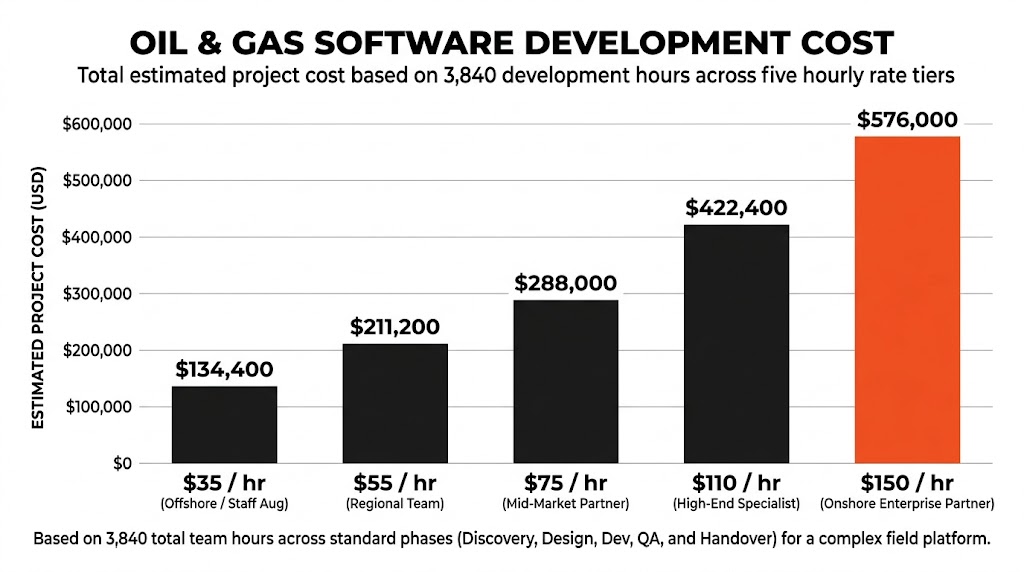
Published oil and gas build costs run from $2,000 to above $1,000,000, and none of the sixteen agency pages Omega Solution read publishes an hours figure. One publishes a rate table, and it contradicts the other table on the same page. Build cost is hours times a rate times a duration, and this market publishes the product without either factor.
What sixteen agency pages publish, counted
Nine of the sixteen publish a cost figure. Zero publish an hours or man-month figure for a build. One publishes an hourly rate table. Six name an individual author, two carry a corporate byline, eight carry no byline at all. Zero name a technical reviewer. Zero state a sample size. One cost figure anywhere in the set carries a citation to a named source.
Omega Solution’s scope, in hours, with the multiplication shown
A field data capture application with validation, plus production reporting for two states with different filing clocks, is scoped at four people for twenty-four weeks: a developer on the interface, a developer on the services behind it, an engineer on deployment and release, and a project manager. Four times twenty-four is 96 person-weeks; 96 times 40 is 3,840 hours. At the $20 to $40 hourly band published for Omega Solution on its own MVP comparison page, 3,840 hours is $76,800 to $153,600.
The same hours priced at other pages’ own rates
Appinventiv publishes two rate tables on one page. The role table tops out at $30 an hour for every role listed. The region table prints United States at $95 to $100 and Asia at $25 to $40. Against 3,840 hours, the role ceiling gives 3,840 times 30, or $115,200, while the United States band gives 3,840 times 95, or $364,800, up to 3,840 times 100, or $384,000. That is a spread of $268,800 on one page’s own numbers, and $95 divided by $30 is 3.17, so no role in the role table can be staffed at the rate the region table publishes.
Where the published totals land against those hours
Techugo’s cheapest tier, Basic System, starts at $40,000. Divided by 3,840 hours that implies $10.42 an hour, below every rate published on any page in the set. Zoolatech’s band for a single field or back-office application, $60,000 to $150,000, divides to $15.63 and $39.06 an hour, which brackets the $20 to $40 band published for Omega Solution almost exactly. The two pages describe the same kind of work and disagree by a factor of nearly four at the floor.
The component tables that cannot build their own cheapest tier
Techugo publishes seven cost components. Summed at their floors, $5,000 plus $10,000 plus $20,000 plus $10,000 plus $5,000 plus $5,000 plus $5,000 is $60,000, which is $20,000 above the $40,000 floor of the page’s own cheapest system. Summed at their ceilings, $15,000 plus $25,000 plus $50,000 plus $30,000 plus $20,000 plus $15,000 plus $15,000 is $170,000, which is $20,000 above the page’s own headline ceiling of $150,000. The page’s cheapest build is unreachable from its own cheapest parts.
Custom Build vs SAP for Oil and Gas
SAP prints Price upon request, and Contract duration available upon request against both base plans of its S/4HANA Cloud project management product. A comparison between a custom build and a packaged suite therefore has a priced side and an unpriced side, and most published comparisons resolve that by inventing a figure for the suite.
Why the comparison searches do not settle it
Omega Solution opened the first ten results for the comparison phrase on 19 October 2026. All ten are Capterra, across five country domains: six are /compare/ pages and four are /alternatives/ pages, and every one of the ten pivots on the same product identifier, 145194, whose product name as Capterra prints it is the category name itself. The entire first page compares one listing against others.
What the suite does well, stated fairly
A packaged production and accounting suite holds the general ledger, the ownership structure, the revenue distribution and the regulatory report templates that an operator would otherwise build and maintain. Quorum, P2 and W Energy have decades of filing-format changes absorbed into their products. Replacing that with custom work is almost never the right decision, and this page does not recommend it.
What the custom side is actually competing with
Not the suite. The spreadsheet beside the suite. The real comparison is the monthly cost in clerical hours of moving numbers between the historian, the field sheets and the suite, against a one-time build that removes the move. Zoolatech also publishes a support and maintenance retainer of $8,000 to $60,000 per month and never annualizes it: 8,000 times 12 is $96,000 a year, and 60,000 times 12 is $720,000 a year, which exceeds the $600,000 ceiling of that same page’s production data platform build band by $120,000.
What Compliance Adds to an Oil and Gas Build
Compliance is not a feature bolted to the end of a build, it is the specification for the validation layer. Five published rails, carrying six clocks between them, determine what the software has to store, when, and in what unit. Each is quoted below from the text itself, because every one of them is a number a buyer can check.
Greenhouse gas reporting: the deadline is not where people look for it
The annual report deadline for petroleum and natural gas systems is not in Subpart W. It sits in 40 CFR 98.3(b), which sets 31 March for reporting years 2011 and beyond and then overrides it twice. Paragraph (b)(5) reads: The annual GHG report for reporting year 2024 must be submitted no later than May 30, 2025. Paragraph (b)(6) reads: The annual GHG report for reporting year 2025 must be submitted no later than March 10, 2027. Any page asserting a flat 31 March for the current reporting year is wrong against the current text.
Leak survey and repair: the intervals are identical for new and existing sources
40 CFR 60.5397b governs new sources and 40 CFR 60.5397c existing ones. Omega Solution read both. Paragraph for paragraph the survey frequencies match: quarterly audio, visual and olfactory inspection at single-wellhead and small well sites, semiannual optical gas imaging at multi-wellhead sites with consecutive surveys at least 4 months apart and no more than 7 months apart, bimonthly and monthly inspection at larger sites and compressor stations, and annual surveys at least 9 months apart and no more than 13 months apart on the Alaska North Slope. The repair clocks match too. What differs is the pathway, not the interval: 40 CFR 60.5362c(c) requires that states submit the state or Tribal plan or negative declaration letter to EPA by January 22, 2027.
Pipeline incidents: one hour and thirty days
49 CFR 191.5(a) requires telephonic notice at the earliest practicable moment following discovery, but no later than one hour after confirmed discovery, to the National Response Centre at 800-424-8802. 49 CFR 191.15 requires the written report as soon as practicable but not more than 30 days after detection of an incident, on Form PHMSA F 7100.2 for transmission and regulated gathering, F 7100.2-2 for reporting-regulated gathering, F 7100.3 for liquefied natural gas and F7100.2 for underground storage.
Process safety: there is no fixed inspection interval to encode
29 CFR 1910.119 sets no numeric mechanical integrity interval. Paragraph (j)(4)(ii) reads in full: Inspection and testing procedures shall follow recognized and generally accepted good engineering practices. Paragraph (j)(4)(iii) ties frequency to manufacturers’ recommendations and good engineering practice. The only five-year figure in the standard is process hazard analysis revalidation at paragraph (e)(6). Software that hard-codes a five-year inspection cycle has conflated the two.
State production reporting: two clock shapes, not one date
The Texas Railroad Commission’s Form PR instructions require filing on or before the last day of the month following the month covered by the Form PR. Those instructions are stamped 01/25/2022 and reference a form revised 06/2019; the form itself prints no deadline, and the Commission’s Form PR frequently asked questions page states no due date while confirming that paper filings ended on 1 September 2026. New Mexico’s rule, 19.15.7.24(B) NMAC, requires Form C-115 on or before the 15th day of the second month following the month of production.
How to Evaluate an Oil and Gas Software Development Partner
Four questions. Each has a checkable answer, and each is a question that none of the sixteen agency pages Omega Solution read answers on the page a buyer lands on. Asking them in this order also establishes whether the proposal was written by someone who has read the rules.
How many hours, by role, and across how many weeks?
A count, not a price band. Zero of sixteen pages publish one, so no total on any of them can be tested against anything else printed alongside it. A partner who gives hours by role and a duration has handed a buyer two numbers to multiply and one to verify against the team actually assigned.
Which citation does each validation rule come from?
A validation rule without a citation is a developer’s assumption. Ask for the rule list with section numbers, and check two of them. A proposal that cites 29 CFR 1910.119 for a fixed inspection interval, or 31 March for the current greenhouse gas reporting year, has been written from a summary.
Who is the named technical reviewer, and what did they change?
Six of sixteen pages name an author. Zero name a reviewer. On one of them the author is the firm’s own business development manager, which is the sales function pricing the work. Ask for a reviewer by name and role, and ask what that reviewer sent back.
What happens to the second state?
A build that files successfully in Texas has not proven it can file in New Mexico, because the clock shape differs. Ask how the design separates the filing calendar from the filing content, and ask to see it demonstrated on the second state before the first is signed off.
Four Mistakes Oil and Gas Operators Make When Commissioning Software
The four below account for most of the rework Omega Solution sees described in this sector: a price compared in the wrong unit, a rule taken from a vendor’s summary, a capture application that assumes a connection, and a buyer research list that points at a domain its owner no longer holds.
Mistake 1: Comparing a seat price with a well count
Eight of the twelve products that publish a usable price charge per user per month. An operator comparing two products on seat price is comparing the size of its office, not the size of its field. eLynx is the only product in 38 that bills by a unit of production, at $10/ per asset per month for field data capture and $25/ per asset per month for the data historian, and even there both of its field capture tiers carry the same $10 figure, so at 400 assets Basic and Premium both cost 400 times $10, or $4,000 a month, which is $48,000 a year either way.
Mistake 2: Taking a published discount or a published fee claim at face value
WellDatabase states Quarterly plans are discounted 5%, and annual plans are discounted 10%, while publishing three pairs that each differ by 16.67 per cent: 300 minus 250 is 50, and 50 divided by 300 is 0.1667. At the stated 10 per cent, 300 times 0.90 is $270, leaving $20 per user per month unexplained. Fiix answers its own question: Are there any additional setup or hardware fees? Absolutely not. The price you see is the price you pay. On the same page as two add-ons marked Contact for pricing. UpKeep is the only product in 38 that publishes implementation fees as numbers, at $500, $1,500 and $5,000.
Mistake 3: Buying a capture application without testing it offline
The test is not whether the application reconnects. It is what the screen does to a reading taken with no connection: stored locally and visibly pending, or accepted and lost. Run the test on the worst part of an actual route before signing, not in an office.
Mistake 4: Researching from a stale list of vendor domains
Brands in this category have moved, and the lists buyers work from have not. Aucerna now redirects to Quorum, Seven Lakes to W Energy, Forms On Fire to Appenate, ProntoForms to TrueContext, HxGN EAM to Octave. The clearest case: on 19 October 2026, Olymp Casino served an online casino titled Olymp Casino Official Website in BD, with a canonical URL on olymp.wiki. The oil and gas product of that name is now an IFS product. Verify every domain on a research list before quoting anything from it.
Frequently Asked Questions
How much does oil and gas software development cost?
Published figures from sixteen agency pages run from $2,000 to above $1,000,000, and none publishes an hours figure. Omega Solution scopes a field capture application with two-state production reporting at 3,840 hours, which is four people for twenty-four weeks at forty hours, or $76,800 to $153,600 at the band published here.
Why do so few oil and gas software vendors publish a price?
Of 22 products built specifically for this sector, two publish a usable price. Of fifteen adjacent maintenance, forms and safety platforms, nine do. Greasebook states the reason outright under its own heading, Straight talk on pricing.: We price based on the complexity of your operation not one-size-fits-all. The result is that most comparison work has only one priced side.
Can custom software replace a production accounting suite?
Rarely, and this page does not recommend it. A suite carries decades of absorbed filing-format changes, ownership structures and revenue distribution logic. The work that pays is the layer joining the suite to the historian, the field and the regulator, which is where the clerical hours and the correction risk actually sit.
What is the greenhouse gas reporting deadline for the current year?
40 CFR 98.3(b) sets 31 March for reporting years 2011 and beyond, then overrides it. Paragraph (b)(6) states that the reporting year 2025 report is due no later than 10 March 2027, and (b)(5) set 30 May 2025 for reporting year 2024. Any software or content asserting a flat 31 March is wrong against the current text.
Do existing wells follow different leak survey intervals from new ones?
No. Omega Solution read 40 CFR 60.5397b and 60.5397c in full. The survey frequencies and the fifteen- and thirty-calendar-day repair clocks are identical paragraph for paragraph. The difference is the compliance pathway: existing sources are reached through a state or Tribal plan, due to the Environmental Protection Agency by 22 January 2027.
How long does a field data capture build take?
Omega Solution scopes the first release at twenty-four weeks with four people, filing in one state. A second state is added after the first has completed a full cycle, including a correction. For comparison, the nearest energy-sector delivery on this site, CasaGenerators, published six weeks and a team of four, which derives to 960 hours.
Does oil and gas software pricing ever work per well?
Not in the 38 products Omega Solution read. One, eLynx, bills per asset. One bills a flat fee for a whole team. One bills annually plus a credit pool. One bills per cloud resource. The remaining eight of the twelve that publish anything usable bill per seat. No per-well, per-component, per-tag or per-data-point rate is published anywhere in the category.
What should an oil and gas software quote contain?
Roles with a headcount against each, weeks, an hourly band, and the three multiplied out. Then the validation rules with their citations, a separate line for integration, and the exclusions written down: hosting, third-party fees, support. If a quote carries a total but no hours, nothing in it can be checked.
Omega Solution builds the fourth layer: capture, validation, filing and the integrations reaching up into the historian and the suite, priced as hours attached to specific roles. Start with IT consultation for the citation and clock table on its own, or with custom software development if the scope is already known.



 Aug 26, 2025


 Dhaka, Bangladesh


