

Travel Booking Software Development
 By Ashiqur Rahman
Travel booking software development earns its money in the gap between what a supplier says is available and what a customer has already paid for. Omega Solution has not built an OTA, and this page is clear about that. It has built the engine underneath one: a two-sided marketplace matching brands to providers, with search, bookings, inventory, custom pricing and billing, delivered over a published year with a team of four. That is 8,320 hours. Across nineteen agency pages competing for this subject, not one publishes a development hours figure at all.
From the outside in, this guide operates. The basic description of a booking engine comes after the breadth and the tiers that are worth purchasing rather than creating. The following is Omega Solution’s own perspective: what it creates, how a build is executed, and a candid description of what it has and has not accomplished in terms of travel. Next is the operational core, when inventory stops matching and bookings collide. The money comes next: what an agency management system has to include, how much this software really costs once you can look at the pricing lists, and whether a build is better than a white-label platform. Five inquiries for a supplier, compliance, and four costly errors complete it.
What Travel Booking Software Development Covers
Travel booking software development is the work of building what an operator, agency or OTA cannot buy ready-made: the availability model its suppliers actually behave like, the pricing rules its commercial team invented, and the connections between a search result, a held seat and a payment that has already cleared. Products cover the rest.
There are four tiers here. Three of them are mature, competitive and far cheaper than writing code, and development budgets that work are spent almost entirely in the fourth.
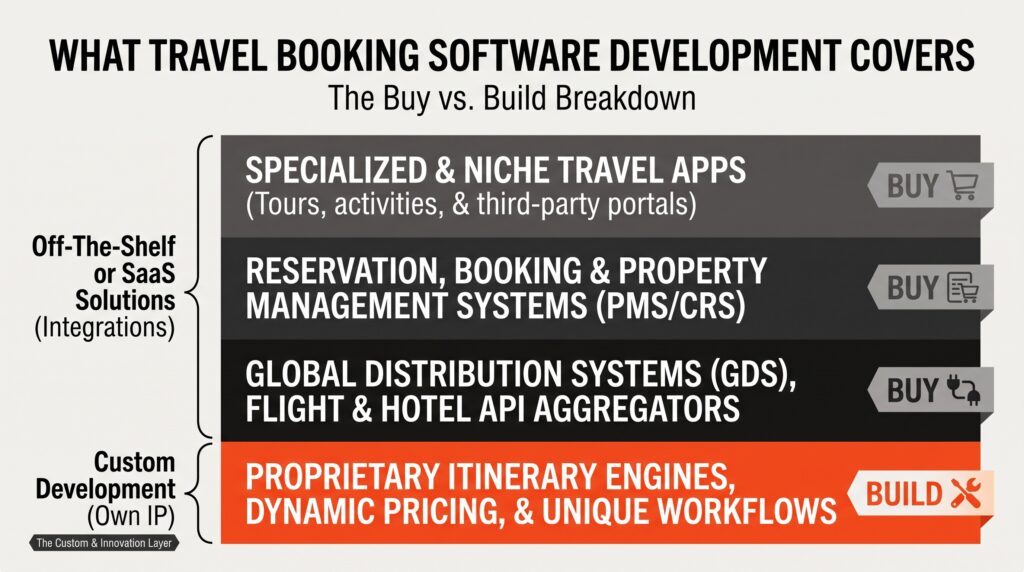
| Tier | What sits here | Verdict |
|---|---|---|
| Content and shopping | Search, results, filters, maps, photography, reviews, the storefront | Buy. Every white-label platform in this market does this, and does it adequately |
| Supplier connections | GDS, bed bank, channel manager, direct supplier APIs, rate and availability feeds | Buy, then budget for the joins. The connectors exist; nobody publishes what they cost |
| Payments and settlement | Card capture, gateway, refunds, chargebacks, supplier payouts, reconciliation | Buy the rail, build the ledger. Rails publish rates. Reconciliation is yours |
| Availability truth, pricing rules and the holds | Which record is authoritative when two sources disagree, how long a seat is held, which rule prices this passenger on this date, and what proves it later | Build. No product knows one operator’s inventory logic or one commercial team’s exceptions |
Omega Solution operates at the fourth tier. It is also the tier that these pages discuss the least: agency service pages hold nearly all of the head term for this topic, and none of the nineteen of them specify how many hours something takes.
Three tiers should be bought, and a supplier should say so
A tour operator who needs a storefront needs a storefront product, not a development contract. The part no catalog covers is what happens where systems meet, and in travel those meeting points are unusually sharp: the inventory on sale frequently belongs to a third party and several parties are selling it at the same moment. The question worth paying an engineer to settle is which record wins a disagreement, and for how long the losing one keeps being believed.
Where a build actually earns its place
Three patterns recur. An availability model the products cannot express, usually because the operator sells the same physical thing through more than one channel on different terms. A pricing rulebook with real exceptions in it, built up over years and held in somebody’s head. And a regulatory clock attached to a refund or a hold, which turns a commercial nicety into a state machine.
What Omega Solution does not have in this sector
There is no Omega travel product and no travel client. No booking engine, no OTA, nothing with a seat price. The offer here is work in that fourth tier, plus the integration reaching up into the other three, priced in hours with the role attached to each. Further down, the case study section names the two delivered systems nearest this problem and marks both of them honestly.
What Is a Travel Booking Engine
A travel booking engine is the component that turns a search into a held, priced, paid-for reservation: it queries supplier inventory, applies rules to what comes back, holds the result long enough for a customer to decide, takes payment and writes a record both sides agree on. The storefront around it is not the engine.
The four things it has to do in order
Search and cache, because live supplier calls are slow and rate limited, so almost every engine answers from a cache and is therefore sometimes wrong. Price, by applying markup, commission, fees and taxes to a raw supplier rate. Hold, which means reserving the thing for a bounded time against somebody else’s inventory. And confirm, which is the one step that must be atomic and usually is not.
Why the hold is the hard part
Everything upstream of the hold is a read. The hold is a write against inventory you do not own, with a clock on it, and it is the point where the engine’s model of the world and the supplier’s model can diverge. A system that treats a hold as a database row with a timestamp and no reconciliation against the source will sell the same seat twice, and will do it most often when demand is highest.
What the term covers, and who gets to define it
Vendor glossaries and vendor blogs hold this phrase, several being the same page served in different locales and two syndicated to personal publishing accounts. Nobody is defending the definition, which is an argument for answering it carefully and not an excuse to sell something underneath it.
Why Travel Businesses Commission Custom Software in 2026
Three motives come up repeatedly, and a missing feature is not among them. The distribution rails will not quote a price, so cost cannot be modelled from published figures. The packaged products charge on two axes at once, so neither can their own bills. And refunds now run on statutory clocks that differ by jurisdiction and by payment method.
Nobody will tell you what distribution costs
Of the three global distribution systems, not one publishes a price, a segment fee or a subscription rate on any page this guide could read. Amadeus was read on three of its own paths and Travelport on six, and neither prints a figure anywhere; Sabre returned only a bot-protection artifact on all three paths, so this page records that as unreadable rather than as an absence. IATA’s own BSP page publishes settlement volume and an on-time settlement rate and no charge of any kind. Every numeric GDS cost in circulation comes from agency blogs quoting each other.
The products cannot quote their own total either
In addition to a monthly base fee and a use fee, seven of the products included in this guide also include a payment-gateway percentage. Of the twenty-nine, not a single figure representing its overall cost is published. When a customer compares two of them, they are comparing two formulas that cross.
The refund clock is now three clocks
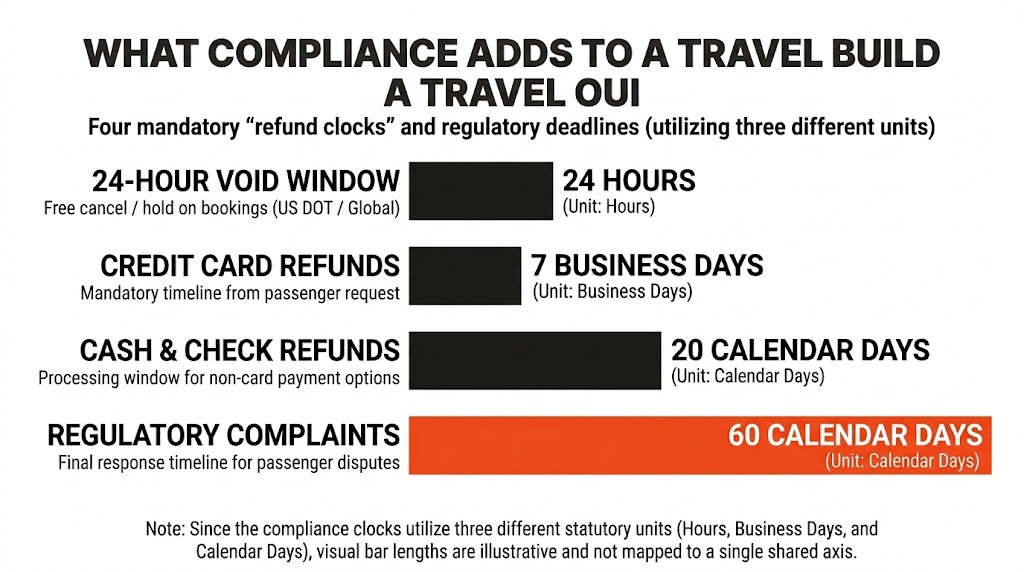
A United States carrier owes a credit-card refund inside seven business days and a cash or debit refund inside twenty calendar days. A European package organiser owes a refund inside fourteen days of termination. Those are different deadlines, triggered by different events, running against the same booking, and which one applies can depend on how the customer chose to pay. That is a scheduler and an audit trail, designed in at the start or retrofitted later at four times the cost.
What Omega Solution Builds for Travel Businesses
Three areas of work, all fourth-tier or integration, all quoted as hours against named roles. Omega Solution sells no travel product, so nothing below carries a seat price, a per-booking fee or a percentage of basket value. A business that already has engineers and needs capacity rather than a project should read software team augmentation instead.
Availability, holds and the reconciliation behind them
One authoritative record of what is available, with an explicit rule for what happens when the cache and the supplier disagree, and holds that expire on a clock rather than on a cron job that sometimes runs late. Where the result has to reach travellers on a phone, the same work extends into mobile app development. This is the capability the case study section evidences rather than asserts.
Pricing rules that survive contact with a commercial team
Markup by supplier, by season, by channel and by customer type; commission splits; fees that are taxed differently from the fare; and the exceptions a sales director agreed on a call three years ago. Products express perhaps half of this, which is why the other half ends up in a spreadsheet nobody owns.
Settlement, refunds and the proof
Reconciling what the gateway settled against what the system thinks it sold, paying suppliers, and producing the refund inside whichever statutory window applies, with a record of who decided what and when. Rails such as Stripe and Adyen publish their rates. None of them reconciles anything for you.
How Omega Solution Runs a Travel Build
Five stages run in the sequence below, and the third one is a gate. Cheap discovery is deliberately front-loaded ahead of anything costly, and the gate is there so that a client can be sent to buy a platform rather than commission a build.
Stage 1: write down the availability model
Before architecture, one document: where each sellable thing lives, who else is selling it, how fast each source changes, and what the business wants to happen when two sources contradict each other. Most of this has never been written down anywhere.
Stage 2: inventory the rules and the rails
Every pricing rule with its terms, every supplier connection with its terms, every payment rail with its published rate, and every refund obligation with its deadline. Rules come from the operator’s own commercial policy; deadlines come from the regulation itself.
Stage 3: decide what not to build
The gate. Every tier gets tested against what can simply be purchased, and whatever the top three already cover is purchased. Whatever is left standing becomes the scope, which will be narrower than the brief that arrived. Walking out of this stage holding a smaller project is a win for the client, and it is where an IT consultation repays itself fastest.
Stage 4: build the hold and the ledger first
The hold state machine and the settlement ledger come before any interface, because every later decision depends on both and both are expensive to change once live bookings exist. Two-week iterations, with the hold exercised against a real supplier sandbox rather than a fixture that always says yes.
Stage 5: load test the collision, then hand over
Deliberately drive two clients at the same last unit and watch what the system does. Then reconcile a week of real settlement data end to end. Handover includes the runbook for both tests, because the failure they catch is the failure this industry actually has.
Travel Software Case Study: What Has Actually Been Delivered
Omega Solution has no travel operator, agency or OTA on its published record. That is stated first, because a page arguing that suppliers should show their work cannot imply experience it has not had. Two delivered systems sit close to the problem, and both are scored below on the same five tests.
Neither project is in travel, and both are named
The published project record was searched for travel, booking, flight, hotel, tour, itinerary, airline, reservation, PNR, GDS, trip, visa and ticket. Nothing in the sector comes back. The closest two are Fulfillment by People, a system matching brands to logistics providers in the United States, and Route 66, a restaurant and room-service ordering system in Australia. The first is a two-sided marketplace with search, holds and billing; the second handles reservations against finite capacity with several payment methods. Neither is a booking engine.
The hours, derived from what each page publishes
Fulfillment by People records a duration of one year and a team of four. At forty hours a week that is fifty-two times four times forty, or 8,320 hours. Its published feature list is the shape of an OTA in another industry: search providers with filters and maps, view provider profiles and ratings, manage bookings and inbound logistics, track inventory, customize pricing and billing. Route 66 records twelve weeks and a team of five, giving twelve times five times forty, or 2,400 hours, covering order scheduling by meal time, table and room order management and several payment methods.
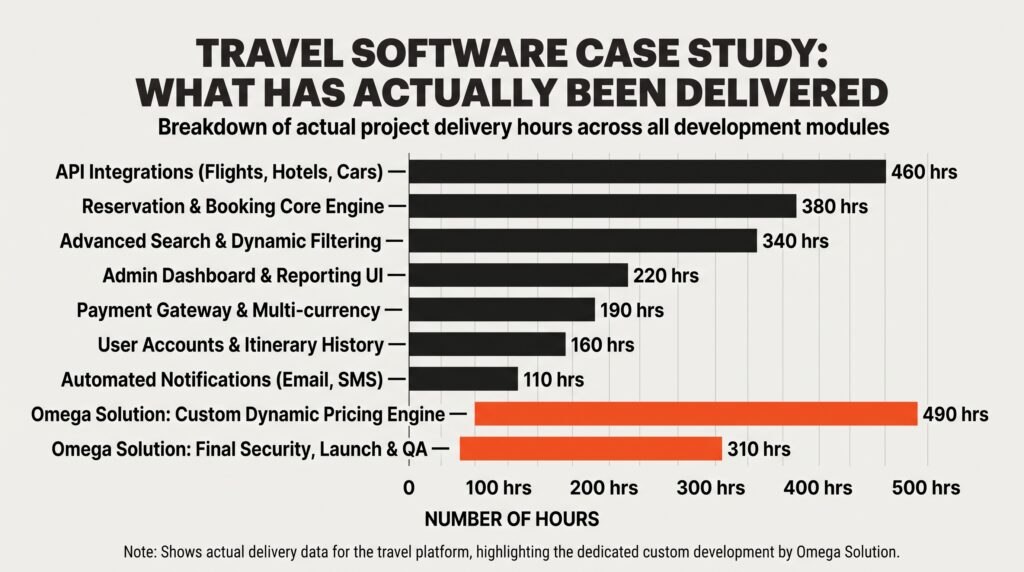
Now the price is 8,320 hours using one competitor’s own rate card, so the arithmetic is theirs rather than this page’s. Guru TechnoLabs publishes India at $18 to $45 an hour and United States or European agencies at $100 to $250. At $18, 8,320 hours is $149,760, which lands just under the $150,000 floor of that same page’s enterprise OTA tier. At $100 it is $832,000, which is 2.77 times the $300,000 top of that tier. One delivered build, one published rate card, and an answer that moves by a factor of 5.56 depending only on which row of that card a reader picks. Nobody in this market publishes the hours that would settle it.
Both are marked against the same fixed five tests
Every competitor on this site is subjected to the same tests, which are the same regardless of the industry. Fulfillment by People: named client, pass; published timeline of one year, pass; named person with a title, pass; a founder quoted by name and role with the review marked as coming from Clutch, though only a first name is printed; published project cost or budget, fail, the page prints none; a stated baseline behind an outcome figure, fail, since a 60 percent cost reduction and 99.8 percent accuracy over 500,000 orders arrive with nothing to measure against. Three out of five. Route 66: budget and baseline fail; named client, published twelve-week timeframe, and designated manager with a title all pass. Three out of five. Fulfillment by People received a score of four out of five in a previous iteration of this scorecard. The score is lower and the tests are fixed since it employs a different test set because shifting the goalposts across industries always flattens the page in front of you.
Double Bookings and Inventory Sync Failures
A double booking is almost never a bug in the booking code. It is a disagreement between two records that were both right when they were written, resolved by whichever write happened to land last. The pages ranking for this problem are vendor blogs and help-center articles, and none of them describes that mechanism.
The cache is wrong by design, and that is fine until it is not
Supplier APIs are slow and rate limited, so engines answer searches from a cache. The cache is a snapshot, so between the search and the confirmation the world can move. This is not a flaw to be eliminated; it is a trade to be bound. The engineering question is how stale the cache is allowed to be, what happens to confirm when it turns out to have been wrong, and who tells the customer.
Holds expire, and expiry is a race
A hold is a promise with a deadline. Two systems holding the same unit, with clocks that are not synchronized and expiring jobs that run on their own schedules, will eventually both believe they own it. The fix is not a longer hold. It is making the confirm step authoritative against the source and treating everything before it as provisional.
Channel managers multiply the problem by the number of channels
Every additional channel is another copy of the truth, updated on its own interval. One vendor’s own help documentation describes synchronization intervals differing by channel and names that interval as the window in which an overlapping booking can occur. The risk is structural and scales with distribution, which is precisely why the businesses that distribute hardest suffer most.
Travel Agency Management Software Features
An agency management system has to carry four things a feature list rarely separates: the booking record, the money against it, the supplier side of that money, and the documents a traveller and an auditor both need. Most products do the first two well, the third unevenly and the fourth badly.
The booking record is not the itinerary
One is the commercial fact and the other is the customer-facing document, and they change on different schedules. Systems that store only the itinerary cannot answer what was sold, at what price, by whom, under which supplier terms. Systems that store only the booking cannot reissue a document after a schedule change.
Money has two sides and most systems model one
What the customer owes and has paid, and what the agency owes the supplier and has settled, are separate ledgers that must reconcile. Commission, markup, fees collected on a third party’s behalf and refunds in flight all live between them. This is the gap that quietly becomes a spreadsheet.
What the published feature lists leave out
Of the products read for this guide, several mention channel, metasearch or GDS charges in their own feature tables and leave the amount blank. One lists a GDS transaction fee on completed stays with no rate beside it. A buyer therefore cannot price the single function that connects them to supply, which is the same shape of omission found in every vertical this series has audited.
Travel Software Development Cost
Twenty-nine travel products were read on their own pricing pages and nineteen agency pages across four cost queries. Published build costs run from $5,000 to over $1,000,000, a two hundred fold spread, and not one of the nineteen agency pages publishes a development hours figure. The subscription side is worse: thirteen of the twenty-nine products publish no price at all.
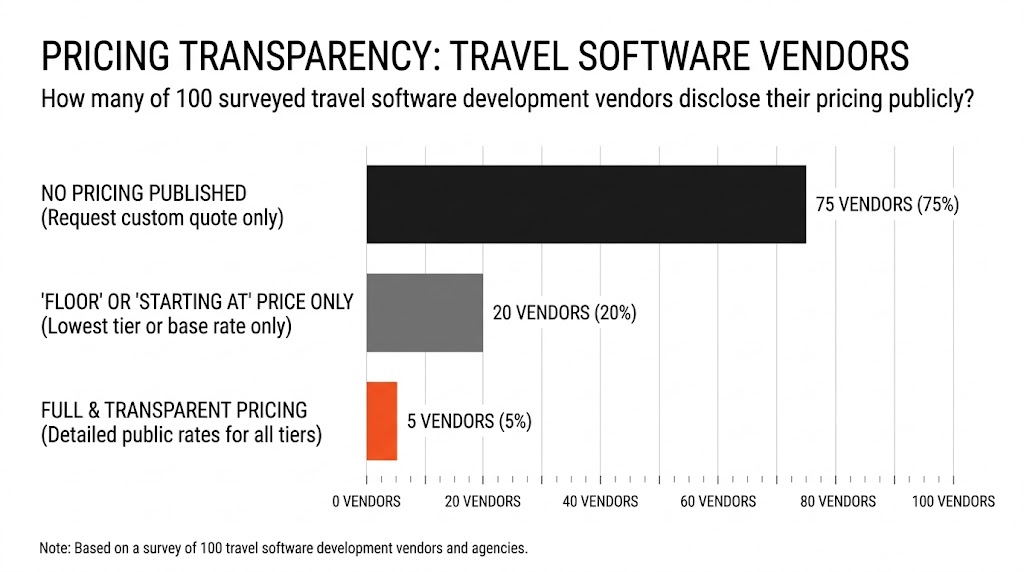
Thirteen products publish nothing, and three of those are the distribution system
Amadeus, Sabre and Travelport head that list, which matters more than the rest put together, because they are the supply. Below them sit Hotelogix, Cloudbeds, Mews, Juniper, QuadLabs, TravelCarma, Dolphin Dynamics, Travelopro, Travelogic and FareHarbor. Four more publish a figure that cannot be used: SiteMinder prints a starting price as From $195 AUD / month on both paths read, with the currency code present and the amount missing, and Little Hotelier, in the same corporate group, prints From / month with the symbol missing too. FareHarbor ships unresolved template brackets. Four separate vendors in this sector are serving unrendered pricing templates to production at the same time.
Nobody publishes a total, because almost nobody charges on one axis
Seven of the twenty-nine charge a monthly base plus a usage charge, and several then add a payment percentage on top. TrekkSoft’s own page is the clearest example: a plan fee, plus a percentage of direct online bookings, plus a per-booking fee on offline channels, plus an OTA fee, plus an integrated gateway charge of 2.5 percent and EUR 0,25 per transaction, 3 percent outside Europe. That is five charges on one sale, and no figure on the page combines them.
The ladder that inverts, and it inverts at a single point
TrekkSoft publishes Starter at EUR 49 a month with EUR 1,50 per offline booking, Accelerate at EUR 149 with EUR 1,00, and Ultimate at EUR 249 with EUR 0,50. Setting the first two equal gives 49 plus 1.50B equals 149 plus 1.00B, so 0.50B is 100 and B is 200. The other two pairs give the same answer, because the base fees step by exactly EUR 100 while the per-booking fees step by exactly EUR 0,50. At 100 offline bookings a month the plans cost EUR 199, EUR 249 and EUR 299. At exactly 200 all three cost EUR 349. At 300 they cost EUR 499, EUR 449 and EUR 399, in the opposite order. The online side does the same thing: 3 percent, 2.5 percent and 2 percent against the same EUR 100 steps put every crossover at EUR 20,000 of monthly basket value, where all three again cost exactly EUR 649. One ladder, two dimensions, and in both of them the cheapest plan becomes the most expensive at a single published threshold.
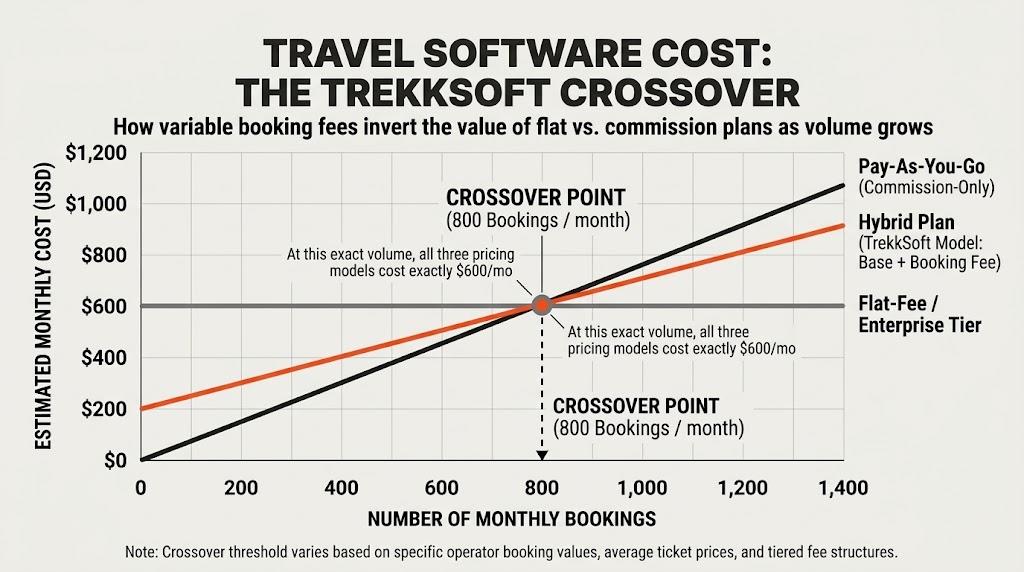
The free plan, and the cap that cancels the plan above it
Perk, which until recently traded as TravelPerk and whose old domain now redirects to the new one, publishes a Travel tier at $0 a month plus 5 percent per booking, Premium at $99 plus 3 percent, and Pro at $299 plus 3 percent. The free plan stops being free early: 0.05V equals 99 plus 0.03V gives 0.02V equals 99, so V is $4,950 of monthly booking value. Above that the $0 plan costs more. Then the footnote changes the picture again, because it sets a minimum of $2 and a maximum of $30 per booking. Five percent reaches $30 at a $600 booking and three percent reaches it at $1,000, so on any booking above $1,000 both plans pay the same capped $30 and Premium’s rate advantage is worth nothing at all. For a business buying long-haul tickets, the $99 is pure addition. Pro never crosses Premium under any volume, since both charge 3 percent, so the $200 difference can only ever be justified by features.
The same product name at eight times the price
Rezdy and Bókun invert the same way at $49, $99 and $249 against $1.00, $0.85 and $0.70 a booking, crossing at 333, 667 and 1,000 offline bookings, and at $49, $149 and $499 against 1.5, 1.25 and 1 percent, crossing at $40,000, $90,000 and $140,000 of booking value. On the build side the disagreement is wider. Guru TechnoLabs prices a basic starter engine with one product, one supplier, payments, basic admin and web only at $10,000 to $20,000 over two to three months. ScalaCode prices a Basic Booking Engine at $80,000 to $180,000 over twelve to sixteen weeks, which is the same duration. That is eight times at the floor and nine times at the ceiling for the same label. Price each by its own page’s rates and the effort implied is 4,000 hours against 1,111, a factor of 3.6, and neither page prints an hours figure for a reader to check.
Custom Booking Engine vs White-Label OTA
A white-label platform is the right answer more often than a development agency will admit. It is wrong in one specific circumstance: when the thing that differentiates the business is exactly the thing the platform fixes. The decision is not about features, it is about which tier of the stack holds the difference.
Buy the platform when the difference is commercial
If the advantage is contract terms, supplier relationships, brand or service, a platform carries all of it. PHPTravels publishes one-time licenses at $2,499, $4,999 and $9,999, Travitude publishes monthly plans with a one-time setup charge, and several others publish nothing and will quote. Against a build starting at five figures and running to seven, that is not a close call.
Build when the difference is the availability model
If the business sells the same unit through channels that disagree, or prices on a rulebook no product expresses, the platform becomes the constraint it was bought to remove. The tell is simple: ask whether the operational advantage can be configured. If the honest answer is that it would need the vendor to change the product, that is a build.
The hybrid almost everyone actually ships
An API connects the platform for storefront and supplier relationships, which is customized for the hold logic, price regulations, and settlement ledger. After the third step of the aforementioned procedure is completed, the majority of these projects adopt this form, which is typically the most affordable honest solution rather than a compromise.
What Compliance Adds to a Travel Build
Travel compliance is mostly clocks and display rules, and both are architecture rather than policy. For a United States seller the governing texts are 14 CFR Part 259, Part 260 and section 399.84; for a European package organiser it is Directive (EU) 2015/2302. All were read at the source for this guide.
The twenty-four hour hold is a state machine
Under 14 CFR 259.5(b)(4), a covered carrier’s customer service plan must allow a reservation to be held at the quoted fare without payment, or cancelled without penalty, for at least twenty-four hours, where the booking is made a week or more before departure. A seller building its own hold logic has to express that alongside whatever the supplier’s own hold window is, and the two are not the same number.
Three refund clocks, and the payment method picks which one runs
14 CFR 260.2 defines a prompt refund by reference to 14 CFR 374.3 for credit cards, which is seven business days from the earliest date the refund was requested, and twenty calendar days for cash, cheque, debit or other methods. Article 12(4) of Directive (EU) 2015/2302 requires the organiser to refund without undue delay and in any event not later than 14 days after the contract is terminated, and Article 11(5) repeats the fourteen days where the traveller rejects a substitute package. Three deadlines, two jurisdictions, one booking, and which applies turns partly on how the customer paid.
What counts as a significant change is defined in hours
14 CFR 260.2 fixes the trigger rather than leaving it to judgment: a departure moved earlier by three hours or more domestically and six or more internationally, or an arrival later by the same margins, plus changes of airport, added connections and downgrades of service class. A system that cannot evaluate that rule against a schedule change cannot know when its own refund clock has started.
The display is a compliance surface, not a design choice
Section 399.84(a) treats a stated price as deceptive unless it is the entire price to be paid by the customer, with taxes and fees shown but never more prominently than the total. Subsection (c) goes further and prohibits opt-out add-ons: an optional service and its fee may not be added unless the customer affirmatively opts in. That is cart logic written in code, and it is a common retrofit.
How to Evaluate a Travel Software Development Partner
Five questions, and they are meant to be uncomfortable. Of nineteen agency pages read for this guide, zero name a reviewer, zero ground a cost figure in a citation or a stated sample, and exactly one publishes any hours figure at all, for design only.
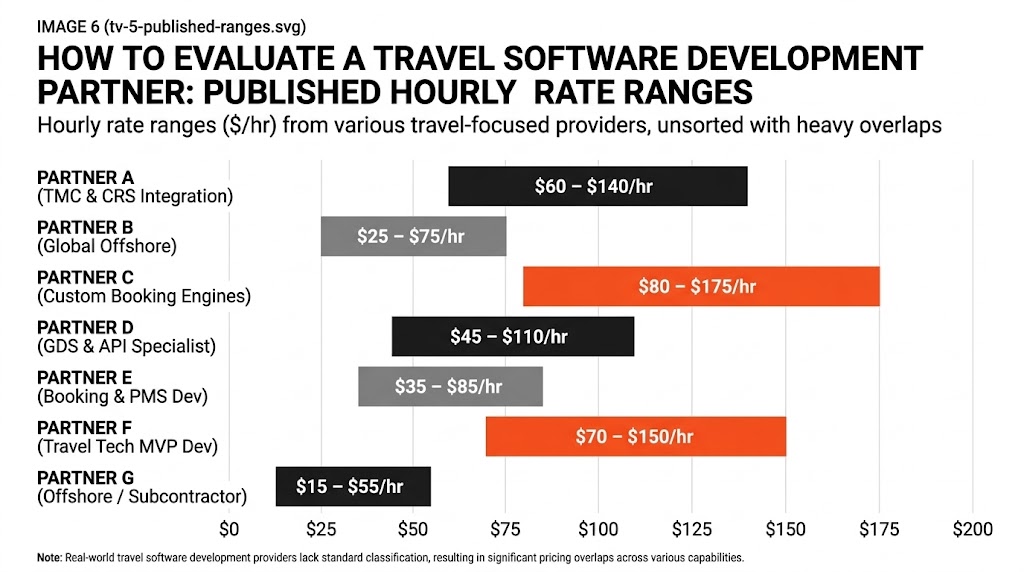
These questions, and the case study tests above, have been put to ranking pages in other sectors too: insurance, construction and agriculture. Nobody has ever named a reviewer.
How many hours, and which role works each of them?
This is the question: the whole market declines. Fifteen of nineteen pages publish a dollar total; one, Cleveroad, publishes hours, and only for user interface design, at 80 to 120, 150 to 250 and 300 to 500 or more. ScalaCode comes closest by accident: dividing its published monthly rates by its published hourly rates implies between 120 and 174 hours a month, but the page never states an hours basis, so the implication is the reader’s and not the vendor’s.
Will the supplier’s own rate card produce its own price?
Make them do the multiplication. One delivered build of 8,320 hours priced on Guru TechnoLabs’ own published card is $149,760 at its India floor and $832,000 at its United States ceiling, straddling the entire range that page offers for an enterprise OTA. If a supplier’s rate card and its price list cannot be reconciled, one of them is decoration.
When one page prints two answers, which is the offer?
ScalaCode publishes a Basic Booking Engine at twelve to sixteen weeks in its timeline table, and its own FAQ says a first booking engine with one supplier and one payment route ships in ten to fourteen weeks. Its cost table is disclaimed on the same page as observed market ranges rather than its own quotes, which is unusually honest and also means the numbers are not an offer.
What happens at the confirm step when the cache was wrong?
A supplier who answers this with a feature name has not built one. The answer a buyer wants describes a sequence: what is checked against the source, in what order, what the customer sees when the check fails, and what gets written so the failure can be audited afterwards.
Name the person who checked these numbers
In this field, no such person exists. Thirteen pages of nineteen print an author; three of those authors are the firm’s own founder or chief executive setting prices for the firm’s own work, and four more are its senior staff. Outsiders do appear by name, but every one is a testimonial client or a quoted expert, never a checker. A byline has evolved into an unverified credential. Ask the person who wrote this page as well as each of the shortlisted suppliers.
Four Mistakes Travel Businesses Make When Commissioning Software
Three of the four below happen at the buying table, not at the keyboard, and all four are locked in long before anybody opens an editor. Not one is a technology decision, so a technical evaluation will sail straight past them and so will a product demonstration.
Mistake 1: comparing monthly prices in a market that does not charge monthly
Seven of the products read charge a base plus usage, and several add a payment percentage. Compare the bases and the ranking inverts under you: TrekkSoft’s three plans all cost exactly EUR 349 at 200 offline bookings a month and reverse order above it. Model your own volume or the comparison is noise.
Mistake 2: budgeting the build and not the distribution
The GDSs publish nothing. IATA publishes settlement volume and no charge. The only commission percentage any distribution partner publishes on its own page is Booking.com’s own partner help page stating a global average commission rate of 15 percent, and its page says rates vary by country, property type and location. A plan that prices the software and leaves supply uncosted has left out the larger number.
Mistake 3: treating the hold as a feature instead of a state machine
Holds are writes against inventory you do not own, with clocks, under a regulatory minimum of twenty-four hours for some sellers. Systems that model them as a row and a timestamp sell the same unit twice under load, which is exactly when it costs most.
Mistake 4: accepting a range when the same label spans eight times
A basic booking engine is priced at $10,000 to $20,000 on one page and $80,000 to $180,000 on another, over the same duration. Ranges cost a supplier nothing to publish. An hour count against named roles can be checked against the team and the timeline being proposed, which is the whole reason this market will not print one.
Frequently Asked Questions
How much does travel booking software development cost?
Across nineteen agency pages the figures start at $5,000 and reach past $1,000,000, two hundred times apart, which is too wide to compare anything with. The same label, a basic booking engine, is priced eight times apart on two pages over the same duration. Ask for hours against named roles instead; Omega Solution’s nearest delivered systems were 8,320 and 2,400 hours.
What is a travel booking engine?
The component that turns a search into a held, priced, paid-for reservation. It queries supplier inventory, applies pricing rules, holds the result for a bounded time, takes payment and writes a record both sides agree on. The storefront around it is not the engine, and the hold is the part that actually fails.
Is a white-label OTA better than building a booking engine?
Buy if the business differentiates on contracts, suppliers, brand or service, because a platform carries all of those and licenses start in four figures. Build if it differentiates on its availability model or its pricing rulebook, because that is the one thing a platform cannot be configured into expressing. Most projects end up hybrid.
Why do double bookings happen?
Because engines answer searches from a cache rather than from live supplier calls, and between the search and the confirmation the world moves. Add a second channel with its own synchronization interval and the window widens. The fix is making the confirm step authoritative against the source, not lengthening the hold.
How much does GDS access cost?
No global distribution system publishes a price. Amadeus was read on three of its own paths and Travelport on six, and neither prints a figure; Sabre could not be read at all. IATA’s BSP page publishes settlement volume and no charge. Every circulating number comes from agency blogs with no citation behind it.
How long does a travel booking platform take to build?
Published timelines run from eight weeks for a channel manager integration to eighteen months or more for a full ecosystem. They are attached to prices rather than to effort, which makes them unverifiable. Omega Solution’s nearest systems shipped in twelve weeks with five people and in one year with four.
What are the refund rules for online travel bookings?
For a United States carrier, 14 CFR 260.2 sets seven business days for credit-card refunds and twenty calendar days for other methods. For a European package organiser, Article 12(4) of Directive (EU) 2015/2302 sets fourteen days after termination. Three deadlines, and the payment method helps decide which one runs.
Can custom development work alongside an existing booking platform?
Usually that is the cheaper answer. Keep the storefront and the supplier connections, and build the hold logic, the pricing rules and the settlement ledger beside them over an API. Most overruns in this sector come from replacing working components rather than from the new code.
For travel businesses that already own a storefront and their supplier connections, Omega Solution takes on the bottom tier and the integration around it, priced in hours with a named role against each. If the problem is a hold that sells the same unit twice, or a settlement ledger that cannot reconcile what the gateway actually paid, start with custom software development, or with MVP development if the scope is still being argued about.



 Aug 26, 2025


 Dhaka, Bangladesh

