

Education Software Development
 By Ashiqur Rahman
Education software development is worth paying for at the point where fee money, attendance records and a regulator’s retrieval deadline all have to agree with each other. Omega Solution shipped an AI-driven enrollment platform now used by more than fifty South African TVET colleges in twenty-two weeks with a team of four. That is 3,520 hours, and no page competing for this subject publishes an hours figure above 1,500.
Start here and the page moves outward in rings. Scope first, then the packaged market and what its price lists hide, then the plain definition of a school management system. After that comes Omega Solution’s own side of the work, the build process, and the one delivered education project with its duration and team size taken from the page the client reads. The financial aspects are as follows: where fee collection discreetly ceases, what an attendance and fee module actually does, how much this software costs in Bangladesh, and when an LMS and school ERP cease to overlap. It ends with compliance, five supplier inquiries, and four expensive errors.
What Education Software Development Covers
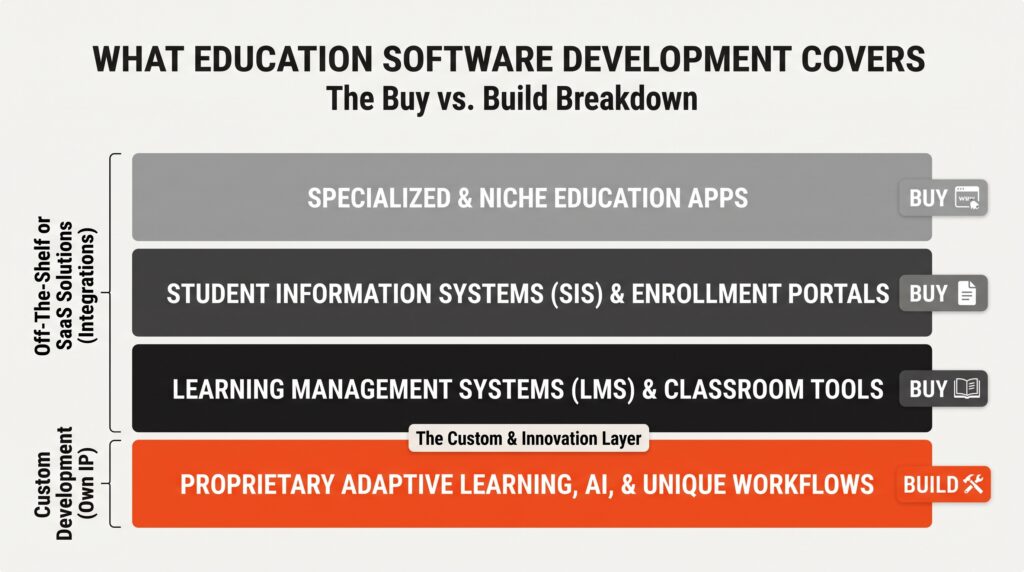
Education software development builds what a school, college or training provider cannot buy off a shelf: the fee logic its finance office actually applies, the records a regulator can demand inside a deadline, and the links between admissions, timetable and payment rail. Packaged products cover the rest, and most cover it competently.
Four tiers sit inside this category. Products already own three of them outright, and the money a buyer spends on development is nearly always spent on the fourth.
| Tier | What lives there | Verdict |
|---|---|---|
| Teaching and course delivery | Course content, assignments, grading, discussion, certificates, SCORM and xAPI | Buy. Moodle, Canvas and the commercial LMS vendors own this tier and own it well |
| Administration and records | Admissions, enrollment, timetabling, attendance, staff records, report cards | Buy. QuickSchools, Fedena, DreamClass, Classter and most of the Bangladeshi vendors sit here |
| Money in and money out | Fee heads, invoices, discounts, receipts, payroll, ledgers, bank reconciliation | Buy with eyes open. Classe365 sells its Fee & Invoicing module as a $75 a month add-on to a $100 a month core, and several Bangladeshi vendors leave the payment gateway priced at nothing at all |
| The joins, and the proofs | Which identifier a student carries across all three tiers, which fee rule applies to which cohort, which record satisfies which rule, and who is allowed to see it | Build. No product knows one institution’s fee exceptions, its own regulator, or the system it is replacing |
Omega Solution operates in the fourth tier and connects to the other three. The twenty-five agency pages reviewed for this guide agree on very little: their published education build costs range from $5,000 to $1,000,000, a two hundredfold spread, and six of them publish an hours figure. The retargeted head term for this subject, education software development, is held entirely by agency service pages.
Buy the first three tiers, and say so out loud
An institution that needs a gradebook needs an LMS, not a development contract. A supplier that will not say this is selling, not advising. What does not come off a shelf is the behavior at the seams. A student who enrolls, pays in installments, transfers campus mid-term and then requests their own records has just crossed all four tiers, and every product boundary they crossed is a place where a number can quietly stop matching.
The three patterns that justify a build
They recur. First, a fee structure with real exceptions in it: sibling discounts, scholarship offsets, partial-term joiners, a board fee collected on behalf of someone else. Second, a records obligation with a clock attached, which means retrieval has to be designed rather than hoped for. Third, a system already in place that cannot be abandoned, so the new work has to read and write what the old one holds.
Where Omega Solution’s own work actually sits
There is no Omega school product. No LMS, no student portal sold by the seat, nothing on a shelf. What is on offer is fourth-tier work plus integration upward, quoted as a count of hours with the role behind each one, and it is the same custom software development practice described elsewhere on this site. One education project has been delivered, it is described further down with its own published duration and team, and its own published budget band does not survive contact with its own published duration.
What School Management Software Publishes, and What It Leaves Out
School management software is the packaged administration tier, sold as a subscription or a license. Any comparison has to start from an awkward fact about this market: of twenty products read on their own sites, four print a figure with no billing period attached to it, and four print no figure at all.
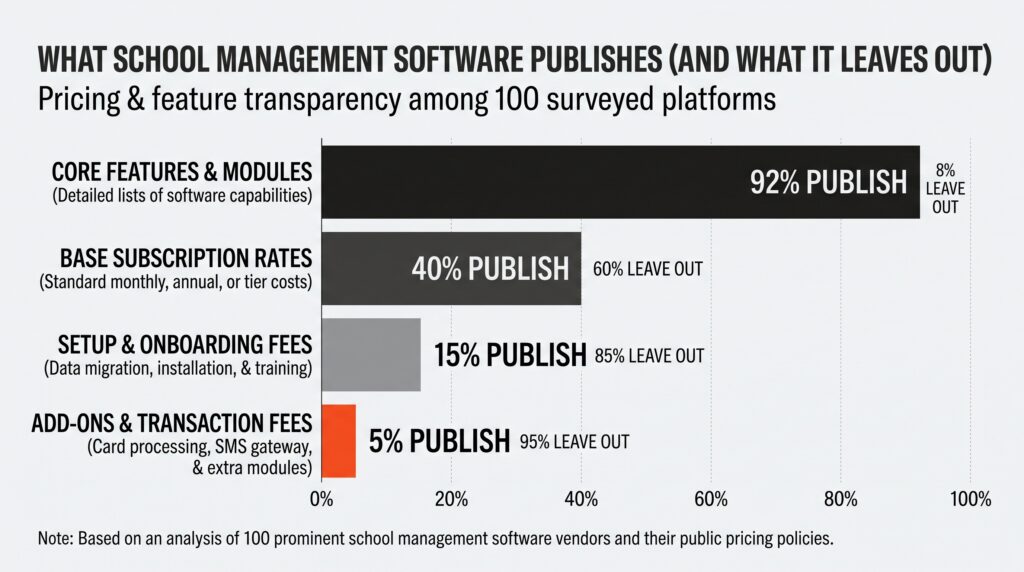
Four products publish no price on any path
Blackbaud, Rediker and Vidyalaya were each read on two paths and none of the three printed a figure. Blackbaud’s tuition management pricing page serves a quote form and one offer, six months of Financial Edge NXT free for new customers with conditions applied but not stated; its general pricing page says pricing is customized to the organization. Rediker has no pricing, plans or quote page anywhere in its navigation, only Request Information, Get Started and See a Demo. The fourth is smartschoolmanager.com, which is the most peculiar of the group. Three approaches were examined, all of which guarantee a lifetime license with no monthly fees or other expenses, and none of them specify a price. A price assertion that has no price attached.
Four publish a figure and never say what period it covers
Edufy publishes a student-range table running from ৳2000 to ৳40000 and never states whether those are monthly, annual or one-time; a Monthly and Yearly toggle renders on both its homepage and its pricing page, and no yearly value appears on either. Zaman IT publishes ৳ 50,000, ৳ 100,000 and ৳ 150,000 with the identical eight module groups listed under all three, no student limits and no billing period. Acquaint’s only figure is one FAQ line saying the basic price starts from 50,000 BDT. The bdstall listing prints ৳30,000 and is simultaneously marked Sold Out and Currently unavailable, with no seller, on a listing seven years old, and it still ranked for the Bangladesh price query when this guide was researched.
The price that renders on only one path, and what the comparison is worth
Pathshalasoft’s homepage carries no amount at all. Its FAQ says there is a one-time installation fee and a monthly support fee based on student numbers, and stops. The figures live on its services page: installation of BDT 5000 on Basic and BDT 10,000 on Standard, both with a monthly per-student charge of 10 BDT, and a Customizable tier whose installation reads 20,000 with no currency symbol or code printed anywhere near it. A buyer who reads the homepage concludes the vendor publishes nothing. This is the single best argument for reading every vendor on more than one path, and it is why this guide does.
Not much, taken at face value, because the structures are not comparable. GegoK12 publishes a core product at zero dollars forever under an MIT license and charges for hosting, modules and support. eSkooly publishes a free forever cloud tier. QuickSchools charges $0.99, $1.49 and $2.99 per student per month with a floor of thirty students billed. Fedena charges $999, $1399 and $1699 a year with unlimited users. Those are four different businesses wearing the same category label, and a per-student rate and a flat annual license cross over at a student count a buyer has to work out for themselves.
What Is a School Management System
A school management system records who is enrolled, what they owe, whether they attended and what they achieved, in one place, so the finance office, the registrar and the teacher read the same row. It is also called an SIS or a school ERP. It is not a learning platform, and that difference matters once fee money is involved.
What the system has to hold
Four record sets, and they are not equally hard. A student record with an identifier that never changes even when the name, the class or the campus does. A fee ledger that can express what is owed, what was paid, by whom, against which head, and what remains. An attendance record with a timestamp and an author. An academic record that can be reissued years later. The first and the second are where custom work concentrates, because both carry exceptions that a product’s data model may simply refuse.
Where the definition gets slippery
Vendors describe the same software as a school management system, a student information system, a school ERP and a campus management platform, and the pages that rank for the plain definition query are vendor blogs explaining why their own product is the answer. One of the nine results for the term when this guide was researched was a university cyberlaw wiki page, and another was a machine-generated category index. The term is weakly defended, which is a reason to answer it clearly and not a reason to write another product pitch.
One question: How many locations record the fact that a student pays half of their term’s fees in cash at the office and the remaining amount online six weeks later, and which is authoritative? There is just one solution in a true system. Three modules make up the collection, and the reconciliation takes place in an unowned spreadsheet.
Why the open-source answer is worth a serious look
GegoK12 publishes its core as free forever under an MIT license with unlimited students, staff and parent accounts, twenty-six modules and no time limit, and charges $49 a month or $490 a year for managed hosting. Its annual price is exactly ten times its monthly one, which is $588 over twelve months against $490, a saving of $98 or 16.67 percent. Moodle and Canvas occupy the equivalent position in the teaching tier. For an institution whose problem is the fourth tier rather than the first three, starting from a free core and paying for integration is often the cheaper honest answer, and a development supplier should be willing to say so.
Why Schools and Training Providers Commission Custom Software in 2026
Three reasons recur, and none is a missing feature. Fee money arrives through rails whose costs nobody published. Records now carry statutory deadlines with retrieval attached. And the products bought in a hurry during remote teaching are now three systems that do not talk to each other.
The collection rail has become a cost center
A school that moves fee collection online acquires a per-transaction cost that is usually invisible during procurement, because the software vendor does not quote it and the gateway may not publish it. The arithmetic further down this page shows the result: at the lowest per-student software rate published in Bangladesh, the fee on a single modest payment can exceed a whole month of that student’s software license. Nobody is hiding this. It simply sits in two different documents, one of which does not exist.
Records now come with a clock
Under the Family Educational Rights and Privacy Act, a United States educational agency or institution must comply with a parent’s or eligible student’s request to inspect and review records within a reasonable period, and 34 CFR § 99.10(b) fixes the outer bound as “but not more than 45 days after it has received the request”. Separately, § 99.32(a)(1) requires the institution to “maintain a record of each request for access to and each disclosure” of personally identifiable information from a student’s education records. A disclosure log is not a reporting feature. It is a design decision taken at the start or retrofitted expensively later.
Three systems that were bought in a hurry
The common shape in 2026 is an LMS chosen for teaching, an administration product chosen for records and a spreadsheet doing the fee work, with a person in the middle. Custom work is rarely a fourth system. It is the identifier, the sync and the single authoritative fee ledger that lets the existing three stay.
An institution running campuses in two countries is subject to two sets of record rules and two sets of payment rails, and the product’s single fee model and single consent model will not stretch. This is the case where the fourth tier stops being optional, because the thing that differs between the campuses is exactly the thing no vendor can configure.
What Omega Solution Builds for Schools and Training Providers
Four areas of work, all of them fourth-tier or integration, and all of them costed as hours against named roles rather than as a package. Omega Solution does not sell a school product, so nothing below is a license and nothing below has a seat price.
Enrollment and admissions flows
The delivered education project is an enrollment platform, which is where this capability is evidenced rather than asserted. Admissions is a funnel with eligibility rules, document capture, verification steps and a handover into the student record, and it is the part of an institution most likely to be running on forms and email.
Fee ledgers, exceptions and reconciliation
One authoritative record of what is owed and what was paid, able to express sibling discounts, scholarships, partial-term joiners, installment plans and fees collected on a third party’s behalf. Plus the reconciliation back to the gateway’s settlement file, which is the step that turns a payment report into an accounting entry.
There are mechanical reasons why attendance fails, such as the building’s lack of a network, a device shared by six teachers, or a correction made the next day without an author being identified. Offline capture, dispute settlement, and an audit trail that details who made what changes and when are the tasks.
Integration and migration into what already exists
Reading and writing the LMS, the accounting package and the payment rail, and moving historical records in without losing the identifier. Migration is where education projects overrun, because the old data is always worse than the sample suggested. Institutions that already have an internal team and need capacity rather than a project can read software team augmentation instead.
How Omega Solution Runs an Education Build
Five stages run in this order, with a decision gate at the third. The point of the sequence is that the expensive commitments come after the cheap discoveries, and the gate exists so that an institution can be told to buy a product instead of commissioning one.
Stage 1: read the fee rules and the records obligation
Before any architecture, two documents get written: every fee head with every exception that actually applies, and the list of record obligations with their deadlines and who can demand them. Both come from the institution’s own policies and the rules themselves, not from a feature list.
Stage 2: map what already exists, including the spreadsheets
An inventory of every system holding student, fee or attendance data, including the ones nobody owns. The identifier question gets answered here: what does a student carry today, and does it survive a transfer.
Stage 3: decide what not to build
This is the gate, and it is the part of an IT consultation that saves the most money. Each of the four tiers is examined against what products already do, and anything the first three tiers cover is bought. What survives this stage is the build scope, and it is deliberately smaller than what arrived in the brief. An institution that leaves this stage with a smaller project than it expected has had a good day.
Stage 4: build the ledger and the identifier first
The fee ledger and the student identifier come before interfaces, because every later decision depends on them and both are expensive to change once records exist. Two-week iterations, with the reconciliation path exercised against real settlement data rather than a fixture.
Stage 5: migrate, prove retrieval, then hand over
Historical data in, with a reconciliation report. Then the retrieval test: pick a student at random, produce their record and their disclosure log, and time it. Handover includes the runbook for that test, because the obligation outlives the project.
Case Study: X (NDA), an Enrollment Platform Delivered in 22 Weeks
This is the first project in this pillar series that sits genuinely inside its stated sector. X (NDA) is an AI-driven enrollment platform for South African TVET students, and its own project page publishes a duration, a team composition and a project size band. One of those three cannot be reconciled with the other two.
The published facts, and the hours derived from them
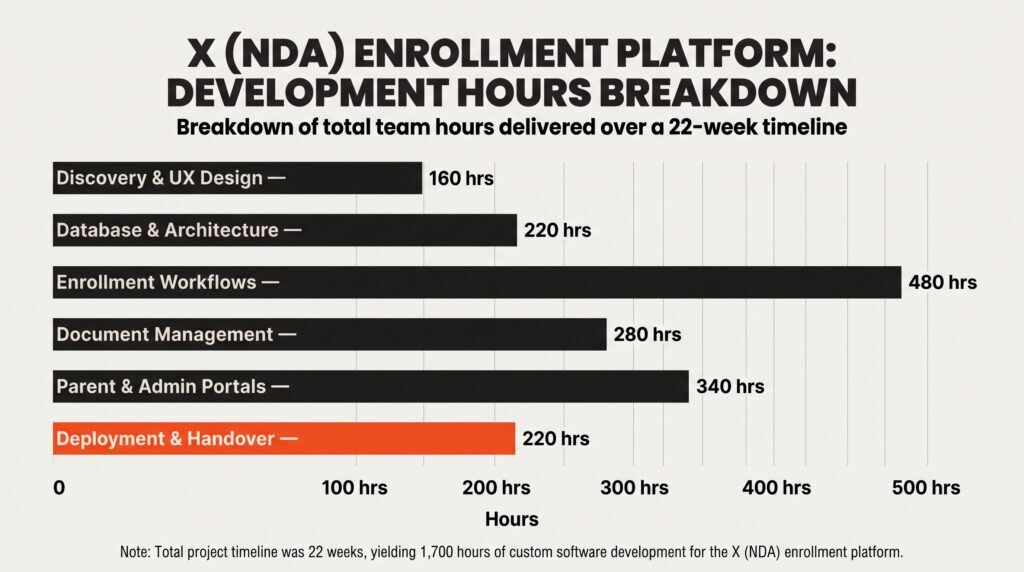
Four facts, taken from the page rather than from a sales deck. Industry recorded as Education. Launch date 2025. Country South Africa. Time taken, twenty-two weeks. The team is listed as four people: front-end and back-end development, DevOps, and project management. The reach claim is more than fifty South African TVET colleges. The testimonial is attributed to X (NDA) as an organization, with no individual named and no title.
The page publishes a duration and a team size but not an hour count, so here is the derivation. Twenty-two weeks times four people times forty hours a week gives 3,520 hours. That is the figure a buyer should compare against anything else they are quoted, and it is worth holding against the competitive set: of twenty-five agency pages read for this guide, six publish an education-scoped hours figure, and the largest of them is 1,500 hours. 3,520 divided by 1,500 is 2.35, so the delivered project ran roughly two and a third times the largest effort figure any ranking page is willing to print.
The budget band on the page does not survive the arithmetic
The project page records the project size as $0-10k. Against 3,520 derived hours, the top of that band implies an hourly figure of $10,000 divided by 3,520, which is $2.84 an hour. The lowest hourly rate published anywhere in the twenty-five agency pages read for this guide is $10 an hour, in Peerbits’ regional table for India. At that rate, 3,520 hours would be 3,520 times $10, or $35,200, which is 3.52 times the top of Omega Solution’s own published band. At Cleveroad’s published Asia floor of $20 an hour, the same hours come to $70,400, or 7.04 times. One of the three published facts is wrong, and the band is the most likely candidate. It is listed as a live defect at the end of this page.
How it scores on the five tests this guide applies to everyone
The same five tests are applied to every case study on this site and to every competitor’s, and they do not change between industries. Named client: pass, X (NDA). Published project cost or budget: pass, and it is the only case study in this series that publishes one at all, though the figure is the one being disputed above. Published timeline: pass, twenty-two weeks. Named person with a title: fail, the testimonial names no individual. Stated baseline for an outcome figure: fail, because more than fifty colleges is a current count with nothing behind it. Three of five, which is the best score in the series so far and still means two of the five things a buyer most needs are absent.
Why Fee Collection and Reporting Break Down
Fee collection rarely breaks because of a bug. It breaks because the money arrives through four channels into three systems, and only one of them is the system of record. Reporting then breaks a month later, when the finance office and the registrar produce two different numbers for the same term and neither can show where the other went wrong.
Nobody owns the reconciliation
Cash at the counter, a bank transfer, a mobile wallet and a card payment through a gateway produce four different records with four different identifiers and four different arrival times. Somebody has to decide which of them is authoritative for a given student on a given day. When that decision is not designed, it gets made repeatedly by whoever is closest to the problem, differently each time.
Partial payments are modelled as a boolean
The commonest data-model failure in this category is a paid flag where an amount belongs. A student who has paid 60 percent of a term is neither paid nor unpaid, and once the schema has committed to the flag, every report built on it inherits the lie. Installments, late fees and refunds are the same problem in three costumes.
An attendance mark fixed the following morning, a fee waiver applied by hand, a receipt reissued because the first one printed wrong: each is legitimate, and each needs a who and a when attached to it. A system without an audit trail cannot answer the only question that matters during a dispute, which is who decided this.
The gateway’s fee is never in the ledger
The gateway deducts its charge before settlement, so the amount that lands is smaller than the amount the student paid. If the software records the student’s figure and the bank records the settled figure, the two will not agree, and the gap is exactly the transaction fee. The next section prices that gap, and in Bangladesh it is larger than the software.
Student Attendance and Fee Collection Modules
An attendance and fee collection module has to do four things a feature list rarely mentions: work without a network, express a partial payment as an amount, attribute every correction to a person, and reconcile against what the rail actually settled. Most products handle the fourth badly, because the rail’s charges live elsewhere.
What the attendance side has to survive
No signal in the building, so capture is local and syncs later. A device shared between teachers, so the author of a mark is a person and not a device. A correction window, because the next-morning fix is normal and pretending otherwise just pushes it into a paper register. And a conflict rule for the case where the same session is marked twice from two devices.
What the fee side has to express
Fee heads, so that a tuition payment and an examination fee collected on a board’s behalf are not the same money. Amounts rather than flags. Exceptions as first-class objects: sibling discount, scholarship offset, partial-term joiner, hardship waiver. And a settlement reconciliation that ties each receipt to a line in the rail’s own settlement file.
Where the vendors put the price of this module
Classe365 prices its Fee & Invoicing module at $75 a month against a core plan of $100 a month for one to a hundred students, so the module that collects the money costs 75 percent of the system that records it. Its tiers from 101 students upward print no price at all, and its embedded quote tool displays $0. Edufy marks Payment Gateway as carrying a charge and never names the amount, which means a Bangladeshi school literally cannot price the single function it most needs before it signs.
One plan is published by SSLCommerz. The pricing card prints “Basic,” “৳ 25,500,” Non-Refundable, and a Transaction Fees heading that reads 2.5% per successful transaction (3.5% for AMEX). It also notes that this is Applicable for all standard payment channels – Visa, Mastercard, bKash, Nagad, Rocket, and more. Finally, there is a One-Time Setup Fee heading whose sole body text explains what the fee entails. The ৳ 25,500 is never explicitly stated on the card. It is the largest single publicised number a Bangladeshi school encounters while collecting fees online, and its location just above the setup-fee header is the sole way to recognise it.
School Management Software Price in Bangladesh
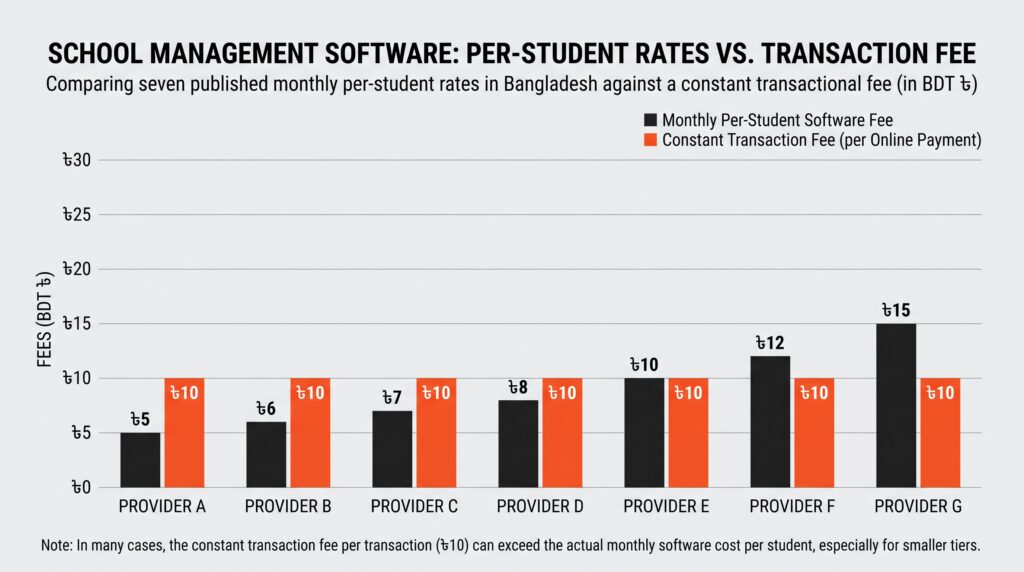
Nine Bangladeshi vendors were read on their own pages. Published figures run from ৳2000 to ৳ 150,000, a seventy-five-fold spread, and five of the nine publish a monthly per-student rate between 5 and 20 taka. That rate is the useful number, because it is the one the payment rail can be compared against, and the comparison is not close.
The per-student rates, as published
Diana EIMS, sold by DianaHost, publishes a per-head schedule of 12 taka per student for 0-200 students, 10 taka per student for 200-500, 8 taka per student for 500-1000 and 5 taka per student for the band it labels 1000+ Employees in a table of student counts. Smart Software BD publishes 10, 8, 7, 6, 5 and 5 TK per student across six bands on a flat server and installation charge of 10,000 TK. Orange Soft BD publishes 10TK for its single-branch package and 20TK for its two, three and four branch packages, which is the only schedule in the set that rises with size. Pathshalasoft publishes 10 BDT per student on both its Basic and Standard tiers.
The break-even payment, solved
SSLCommerz publishes 2.5 percent per successful transaction and publishes no fixed component and no minimum fee, so the charge on a payment is simply 2.5 percent of it. Setting the fee equal to one student’s monthly software cost gives a break-even payment of the rate divided by 0.025, which is the rate times forty. At 5 taka a student a month, the break-even single payment is ৳200. At 8 taka it is ৳320, at 10 taka ৳400 and at 12 taka ৳480. Every one of those sits below a realistic Bangladeshi monthly school fee, which means that for a school on any of the four cheapest published rates, receiving one month’s fee costs more than running the software that recorded it for that student for that month.
On a ৳500 payment the charge is 0.025 times 500, or ৳12.50. Against the 5 taka rate, that is 2.5 times the software. Against the 12 taka rate it still exceeds it, by fifty paisa. On a ৳2,000 monthly fee, the charge is ৳50, which is ten times the 5 taka rate. On a single ৳12,000 annual or term payment, the charge is ৳300, while a full twelve months of that student’s software at 5 taka a month is 5 times 12, or ৳60. One transaction’s fee equals five years of that student’s license. Every figure here is 2.5 percent of a payment size, worked out by Omega Solution from the rate SSLCommerz publishes.
Diana EIMS prices its one-time license backwards
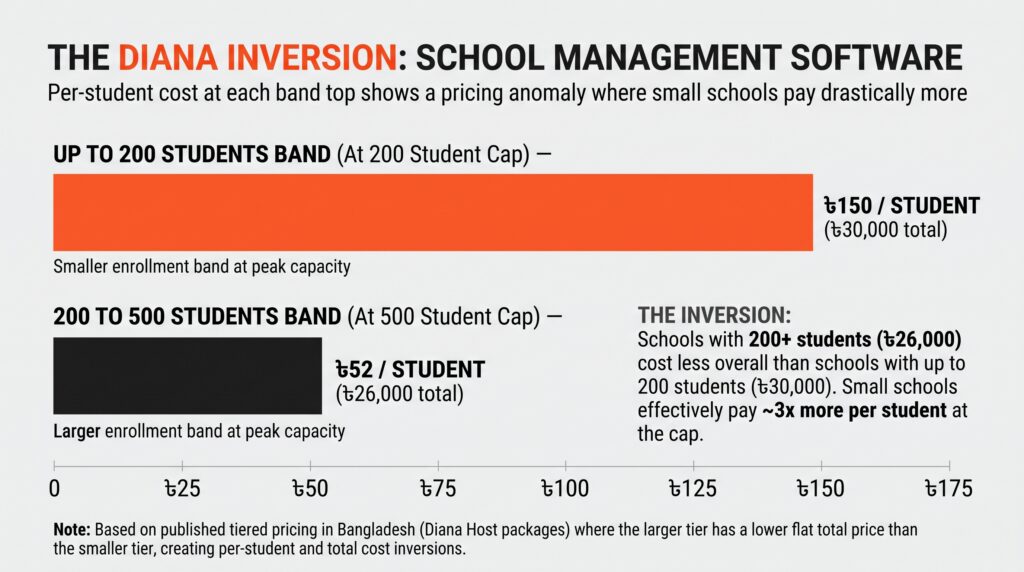
The same page publishes a second schedule, headed Probable Pricing Details, for a single institute: 30,000/= at 0-200 students falling to 20,000/= at 1000 and above. A 150-student school pays 30,000/=, and a 1,200-student school pays 20,000/=, so the smaller institution pays 10,000/= more for the same product. Per student at the band tops that is 30,000 divided by 200, or 150/= a head, against 20,000 divided by 1,000, or 20/= a head, a factor of 7.5 with the small school on the wrong side. The page also prints “All prices are excluding 5% Govt. VAT” and “Yearly Support Cost is 20% of Software Price.” without saying which of its two schedules that percentage applies to, and on the per-head route no software price is printed for it to apply to. Its bands overlap at 200 and at 500, so a school with exactly 200 students has two published prices.
Which rails publish a rate, and which do not
This is the structural finding, and it is uncomfortable. SSLCommerz publishes 2.5 percent. bKash publishes no merchant or gateway rate on its own site across five paths read for this guide, including its own payment gateway terms page, which states no rate and does not refer the reader to a separate schedule either, offering only a customer-care number; its developer documentation is disallowed to automated readers, so this guide makes no claim about what it contains. Nagad publishes no merchant rate on any reachable path, and most of its English site returned server errors during this check. Stripe publishes 2.9 percent plus 30 cents for domestic cards, plus 1.5 percent for international and 1 percent where currency conversion is required. PayPal publishes 3.49 percent plus a fixed fee of 0.49 USD for US dollar receipts, plus an additional 1.50 percent on international commercial transactions. The two rails that carry most Bangladeshi school fee payments publish nothing; the two that a Bangladeshi school largely cannot use for domestic taka publish complete rate cards.
The same test applied to the international vendors
QuickSchools publishes $0.99 per student per month on its cheapest plan. Stripe’s 30 cent fixed component alone, before any percentage is applied, is 0.30 divided by 0.99, or 30.30 percent of that student’s entire monthly software fee. PayPal’s 0.49 USD fixed component is 49.49 percent of it. Solving 0.029 times the payment plus 0.30 equals 0.99 puts the Stripe break-even at $23.79; solving 0.0349 times the payment plus 0.49 equals 0.99 puts the PayPal break-even at $14.33. The pattern is not a Bangladeshi quirk. It is what happens when software is priced per student per month and money is priced per transaction.
School ERP vs LMS
A school ERP holds who is enrolled, what they owe and whether they attended. An LMS holds what they were taught and how they did. The overlap is the gradebook, and that is the whole of it. Most procurement arguments in this category are really arguments about which of the two owns the student identifier.
Where the two genuinely overlap
Grades, and nothing else of substance. The LMS computes them from coursework; the ERP needs them for transcripts and progression. One of the two has to be authoritative and the other has to receive, and the direction of that sync is a decision worth taking deliberately rather than discovering after both systems have been populated.
Why the LMS usually loses the identifier argument
Fee money, statutory records and admissions all live on the ERP side, and all three outlive any particular course. An identifier that is minted by the teaching platform tends to break when a student takes a year out, transfers campus, or enrolls on a second program. The ERP side is the duller system and the better home for the key.
What neither of them does
Neither system reconciles a payment against a settlement file. Neither maintains a disclosure log of who looked at a student’s record and why. Neither expresses a fee exception that the institution invented last year. Those are fourth-tier problems, which is why a school that owns a good LMS and a good ERP can still have a genuine development project in front of it.
Choose the teaching platform on teaching grounds and the administration platform on records and fee grounds, independently, then budget for the join. Buyers who try to settle both with one purchase generally end up with a product that is strong on one side and tolerable on the other, and then pay for the join anyway.
What Compliance Adds to an Education Build
Compliance here is mostly two obligations, one with a clock and one with a log, plus a widely repeated exception that does not appear in the rule text at all. The governing texts for a United States institution are 34 CFR Part 99 and 16 CFR Part 312, and both were read at the eCFR rather than summarized.
The forty-five-day clock, and where it is written
34 CFR § 99.10(b) requires an educational agency or institution to comply with a request for access to education records within a reasonable period of time, but not more than 45 days after it has received the request. That is a retrieval requirement, which makes it an architectural one. A system that can answer it in an afternoon and a system that needs a week of manual assembly both technically comply, but only one of them does so repeatably.
The disclosure log is a requirement, not a feature
34 CFR § 99.32(a)(1) requires the institution to maintain a record of each request for access to and each disclosure of personally identifiable information from a student’s education records. Subparagraphs (a)(3)(i) and (a)(3)(ii) require that record to name the parties who requested or received the information and their legitimate interests in it. A development team that learns of this after the data model is settled will be retrofitting an audit table across every read path on the system.
What the school official exception actually requires
Under 34 CFR § 99.31(a)(1)(i)(B), an outside party treated as a school official must be one that is under the direct control of the agency or institution with respect to the use and maintenance of education records; and that is subject to the requirements of § 99.33(a) governing the use and redisclosure of personally identifiable information from education records. Both clauses are contractual obligations on the vendor, not configuration settings. A supplier who cannot describe how they satisfy the direct-control clause has not read it.
The school consent pathway is not in Part 312
Vendors routinely describe a mechanism by which a school consents on a parent’s behalf under the Children’s Online Privacy Protection Rule. The text of 16 CFR Part 312, read at the eCFR on 12 October 2026, does not contain the words school, educational or education anywhere, and the exceptions to prior parental consent at § 312.5(c)(1) through (9) do not include one. The part’s source note reads 78 FR 4008, Jan. 17, 2013, as amended at 90 FR 16977, Apr. 22, 2025. Whatever the operational practice, a build should not rest a consent design on a provision that is not in the rule.
Section 312.10 permits an operator to retain a child’s personal information only as long as is reasonably necessary to fulfill the specific purposes for which it was collected, states that it may not be retained indefinitely, and requires a written retention policy covering the purposes, the business need and a deletion timeframe, which must appear in the online notice required by § 312.4(d). A deletion timeframe is a scheduled job and a data map. It is cheap at design time and expensive afterwards.
How to Evaluate an Education Software Development Partner
Five questions, deliberately awkward. They exist to establish whether a supplier prices from its own delivery history or from a range it copied. Of twenty-five agency pages read for this guide, not one names a reviewer, and not one grounds a published cost figure in a stated sample of its own finished projects.
The same five questions, and the same five case study tests, were applied to the insurance, construction and agriculture pillars. The reviewer question came back the same way every time.
How many hours, from which roles, across how many weeks?
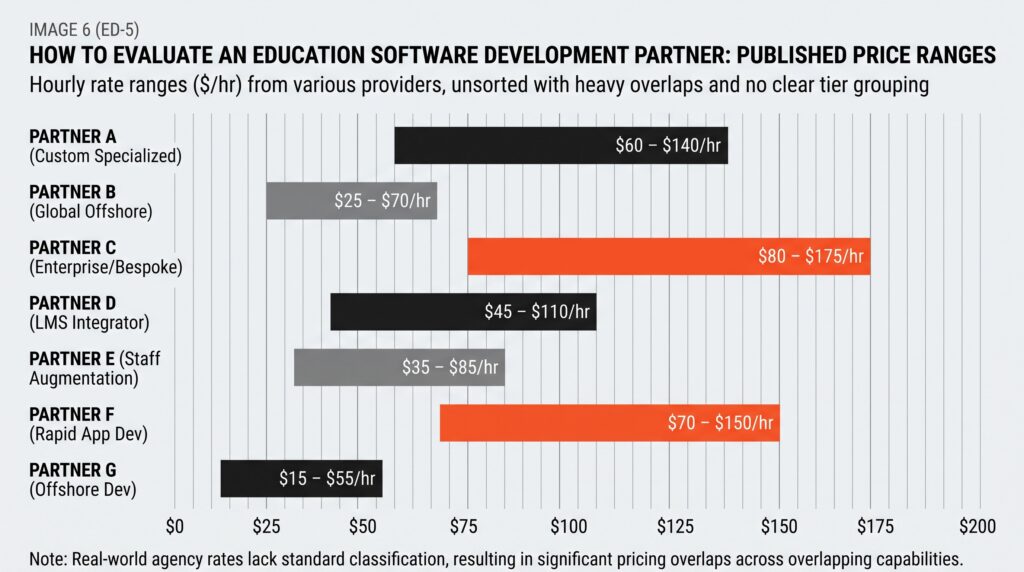
Ask for the number, not the range. Six of twenty-five pages publish an education-scoped hours figure, and they disagree sharply: Belitsoft prints a 580-hour table for a simple cross-platform app, Appinventiv prints 900 hours for its EdTech category, ProCoders prints 800 to 1,200 for an MVP, Cleveroad itemizes between 1,344 and 1,455 depending on platform, and Riseapps prints 1,500. The largest is 2.59 times the smallest for work described in similar terms. A supplier who will give an hour count has given you something you can check.
Does the supplier’s own arithmetic close?
Three of the twenty-five publish a method, which is hours times a rate, and that is exactly what makes them checkable. Cleveroad states that its estimates use $50 an hour, then prices an admin panel at $4,000 to $6,000 and attributes it to about 100 hours at $80 an hour; 100 times $80 is $8,000, which is $2,000 above its own ceiling, while 100 times its own stated $50 would be $5,000 and would fit. Appinventiv prints 900 hours for EdTech against a published range of $60,000 to $225,000 and a worked example of $40 an hour times 2,500 hours; 900 times $40 is $36,000, which is $24,000 below its own floor, and reaching $60,000 across 900 hours needs $66.67 an hour, a figure that appears as the floor of none of the twelve regions in its own rate table. Riseapps is the one whose multiplication closes: 1,500 hours at $50 gives exactly the $75,000 it publishes.
Will the supplier multiply its own published numbers?
Belitsoft is the case worth knowing about. It publishes a clean hours table totalling 580 and publishes hourly rates of $150 to $250 in the USA and $35 to $50 in Eastern Europe, and never multiplies them. The arithmetic it declines to print runs from 580 times $35, or $20,300, to 580 times $250, or $145,000, a spread of 7.14 times across its own two published configurations. A supplier holding both halves of a sum should be willing to do the sum in front of the buyer.
Which of the supplier’s own prices should a buyer believe?
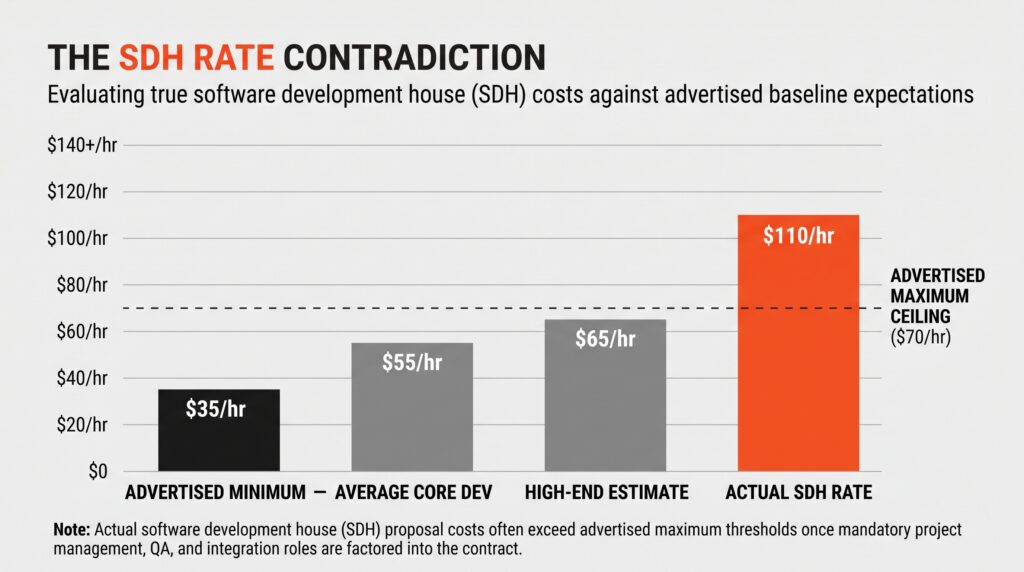
SDH Global publishes an education price ladder starting at $35,000 for an online learning portal over 8 to 12 weeks, $60,000 for a corporate training LMS and $90,000 for an AI-driven education system. Its education blog states that the minimum cost of developing an educational application for one platform starts at $135,000. That minimum is $100,000 above the entry price on its own quoting page, a factor of 3.86, and $45,000 above the most expensive package on that same ladder. Matellio’s complexity table is the other kind of failure: it prices Simple eLearning Apps at $40,000 to $100,000, Basic eLearning App at $125,000 to $450,000 and Advanced eLearning App at $50,000 to $1,000,000, so the basic floor sits $75,000 above the advanced floor and $25,000 above the simple ceiling.
Who reviewed this page, and what are their credentials?
Nobody, across the whole field. Seventeen of twenty-five pages name an author, and in two cases that author is the agency’s own co-founder pricing the agency’s own services: Aristek’s cost page is bylined to its co-founder and CCO, and Appinventiv’s education cost page to its director and co-founder. One page names an editor with no title given. One carries two Reviewed by fields with no name in either, both linking to a placeholder anchor. The byline has become an authority signal with nothing standing behind it, and asking who checked the numbers is a fair question to put to any supplier, including this one.
Four Mistakes Schools Make When Commissioning Software
The expensive mistakes in this sector are made before the first line of code is written, and three of the four happen during procurement rather than during delivery. None of them is a technology choice, which is why none of them is caught by a technical evaluation or a product demo.
Mistake 1: pricing the software and forgetting the rail
A school that compares 5 taka per student against 12 taka per student is optimizing the smaller number. At 2.5 percent with no fixed component and no minimum, the charge on a single ৳2,000 fee payment is ৳50, which is ten times the cheaper of those two rates. Price the collection and the software together or the comparison is meaningless.
Mistake 2: letting the teaching platform mint the student identifier
It is the natural choice because the LMS is the system people see every day, and it is the wrong one. Fee records, statutory records and admissions all outlive any course enrollment. Moving an identifier later means touching every system that ever stored it.
Mistake 3: treating the forty-five-day clock as a reporting question
Retrieval inside a deadline, with a disclosure log attached, is a design property. Institutions that discover § 99.10(b) and § 99.32(a) after go-live do not get a report built; they get an audit table added to every read path on a live system, which is the most expensive shape this work can take.
Mistake 4: accepting a range instead of an hour count
A field whose published education costs span $5,000 to $1,000,000 cannot be compared on ranges, and a range costs a supplier nothing to publish. A count of hours with a role beside each one can be checked against the duration and the team being proposed, which is the whole reason most pages will not print one.
Frequently Asked Questions
How much does education software development cost?
Published ranges across twenty-five agency pages run from $5,000 for a basic institutional website to $1,000,000 for an advanced platform, a two hundred-fold spread that makes them useless for comparison. Ask instead how many hours, and which role each of them works in. Omega Solution’s delivered enrollment platform took twenty-two weeks with a team of four, which is 3,520 hours.
What is the difference between a school ERP and an LMS?
A school ERP holds enrollment, fees, attendance and statutory records. An LMS holds course content, assignments and grades. The only real overlap is the gradebook, and the decision that matters is which of the two owns the student identifier. Fee money and statutory records outlive any course, so the ERP side usually should.
How much does school management software cost in Bangladesh?
Nine vendors read on their own pages publish figures from ৳2000 to ৳ 150,000. Five publish a monthly per-student rate between 5 and 20 taka, which is the comparable number. Four publish a figure without saying what period it covers, and one promises a lifetime license while publishing no price on any of three paths.
Is it cheaper to buy school management software or build it?
Buy the teaching, administration and finance tiers; they are mature and competitively priced, and two vendors publish a free core. Build the fee exceptions, the student identifier and the statutory records layer, because no product knows one institution’s rules. A supplier unwilling to tell you which parts to buy is selling rather than advising.
Why do transaction fees matter when comparing school software?
Because they can exceed the software. SSLCommerz publishes 2.5 percent with no fixed component and no published minimum, so a payment of the per-student monthly rate times forty breaks even. At 5 taka a student, that is ৳200, below any realistic monthly fee, meaning the charge to receive the money exceeds the cost of recording it.
What does FERPA require from a school management system?
Two things that are architectural rather than optional. Access to education records within a reasonable period and not more than forty-five days after the request, under 34 CFR § 99.10(b). And a maintained record of each request for access and each disclosure, naming the parties and their legitimate interests, under § 99.32(a).
How long does it take to build a custom school management system?
With four personnel, Omega Solution’s enrollment platform was shipped in twenty-two weeks. Published education timeframes range from eight weeks for a learning portal to eighteen months for an enterprise platform throughout the ranking sites. The majority of these durations are linked to a price rather than an effort figure, making them difficult to verify.
Can a custom build work alongside an existing LMS?
Usually that is the cheaper answer. If an institution already runs Moodle, Canvas or a commercial LMS it should keep it, and the development work becomes the fee ledger, the identifier and the sync. Most education overruns come from migration rather than from the new code, so leaving a working system in place reduces risk.
Omega Solution builds the fourth tier and the joins, costed as hours against named roles, for institutions that already own their teaching and administration platforms. If the problem is a fee ledger that cannot express the exceptions your finance office actually applies, or a records obligation with a deadline attached, start with custom software development or, if the scope is still being settled, with MVP development and a discovery stage that ends in a smaller project than it began with.


 Aug 26, 2025


 Dhaka, Bangladesh

