

How to Choose the Right Custom Software Development Partner in 2026
 By Ashiqur Rahman
Choose Your Custom Software Development Partner
Choosing a custom software development partner is no longer just about technology; it is a strategic decision that can shape your business for years. In 2026, companies worldwide are moving away from generic software and adopting custom, AI-powered solutions that grow with their business. According to Statista, the global custom software development market is expected to reach $66 billion in 2026, showing a clear demand for tailored, secure, and intelligent platforms.
Many businesses still choose partners by comparing rates or portfolios and hoping for the best. This approach is risky. A poor choice can slow projects, create security risks, and produce software that limits growth. The right partner acts like an extension of your business, guiding decisions, turning business logic into working systems, and supporting ongoing innovation.
Why Custom Software Development Matters?
Custom software is now a necessity, not a luxury. Off-the-shelf tools may handle basic needs, but as businesses grow, these platforms often fail to integrate workflows, automate tasks, or support emerging technologies like AI. Studies show that over 90% of enterprise software projects in 2026 include AI features, such as predictive analytics, workflow automation, or personalized experiences.
Generic software often forces workarounds, manual spreadsheets, disconnected tools, and slow reporting, which increase errors and reduce efficiency. Custom software consolidates processes into systems that are flexible, scalable, and efficient. Companies that invest in tailored solutions gain a competitive edge because their software adapts to their business, not the other way around.
Key Trends Driving Custom Software in 2026
AI-Driven Development
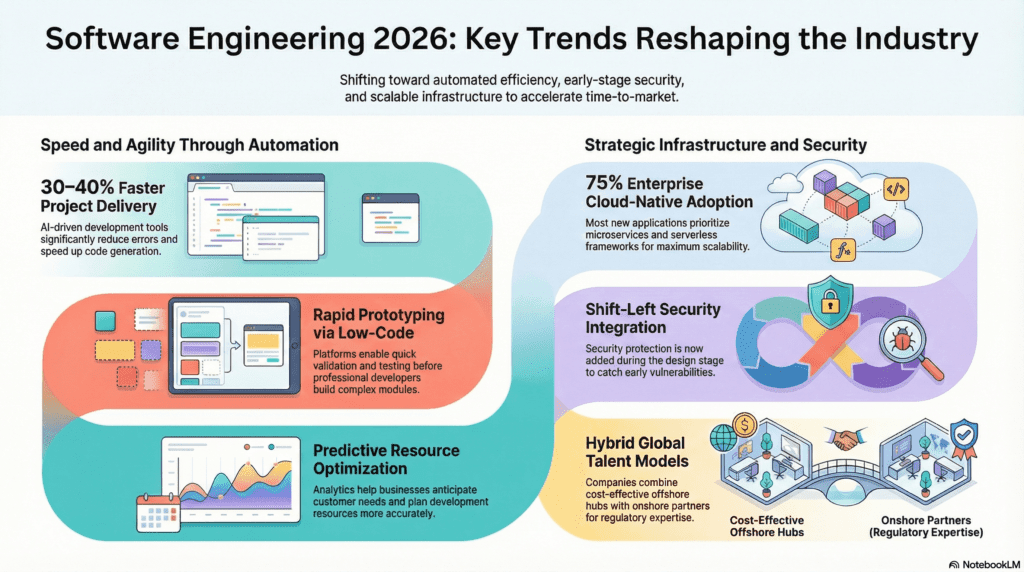
AI is changing software development. Tools like automated code generation and intelligent testing speed up projects and reduce errors. Companies using AI report 30–40% faster delivery and fewer defects. Predictive analytics helps businesses anticipate customer needs, optimize resources, and plan more accurately.
Low-Code and No-Code Acceleration
Low-code and no-code platforms let businesses prototype and launch solutions quickly. While they are great for early testing, complex modules still need professional developers. Using both approaches allows faster iterations, shorter time-to-market, and better validation before full development.
Shift-Left Security
Security is no longer an afterthought. Shift-left security adds protection at the design stage, catching vulnerabilities early. Industries like finance, healthcare, and government are adopting this to follow regulations and avoid costly breaches.
Cloud-Native Architecture
Cloud-native systems use microservices, containers, and serverless frameworks to provide flexibility, resilience, and scalability. Surveys show that 75% of enterprise projects in 2026 prioritize cloud-native solutions for new applications.
Offshore vs. Onshore Development
Global talent allows businesses to balance cost, quality, and expertise. Offshore hubs like Vietnam, India, and Latin America are cost-effective, while onshore partners offer regulatory familiarity and faster communication. Many companies now use hybrid models to combine the advantages of both.
How to Evaluate a Custom Software Development Partner
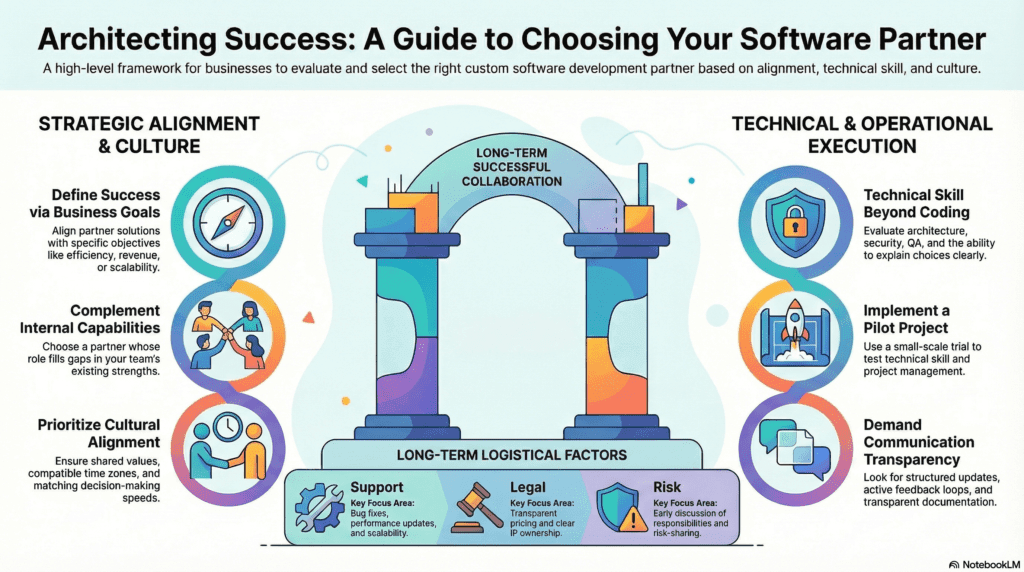
Choosing the right partner requires careful evaluation. Focus on business alignment, technical skill, and culture, not just cost. When evaluating the Top Software Development Companies, it is crucial to check verified directories to ensure reliability.
Start With Clear Business Goals
Begin with a clear understanding of success. Are you improving efficiency, enabling new revenue streams, or supporting a scalable business model? Clear goals help partners propose solutions that fit both short-term and long-term needs.
Assess Your Internal Capabilities
Know your team’s strengths. If your staff manages project management, testing, or support, the partner’s role should complement these efforts. This reduces friction and ensures smoother project execution.
Examine Technical Expertise
Technical skill goes beyond coding. Check architecture, security, QA, compliance, and code quality. Review past projects, documentation, and client feedback. Good partners explain technical choices in plain language and align solutions with your operations.
Prioritize Communication and Project Management
Poor communication is a main cause of failure. Partners should provide structured updates, transparent documentation, and active feedback loops. Clear communication keeps everyone aligned and prevents misunderstandings.
Focus on Cultural Alignment
Shared values improve collaboration. Consider time zones, work style, and decision-making speed. The right partner should feel like an extension of your team, not an external vendor.
Conduct Pilot Projects
Start with a small pilot to test technical skill, project management, and cultural fit. Pilots reduce risk, build trust, and provide evidence of capability before committing fully.
Plan for Maintenance and Support
Custom software is never truly finished. Discuss support models upfront, including bug fixes, performance updates, and scalability. Good partners plan for long-term maintenance from the start.
Evaluate Pricing, Ownership, and Risk
Transparent pricing and clear intellectual property ownership are essential. Discuss responsibilities and risk-sharing early. Clear agreements show maturity and reliability.
Top Global Custom Software Development Partners in 2026
| Company | HQ Location | Key Strength | Price Point | Ideal Use Case |
|---|---|---|---|---|
| ScienceSoft | Texas, USA | Regulated industries, compliance, system integration | $50–99/hr | Healthcare, finance, enterprise projects |
| KIMEI Global | Vietnam | Cost-effective offshore development, AI, UI/UX, cloud-native | <$25/hr | Startups, SMEs, budget-focused projects |
| Simform | Florida, USA | Cloud-native, AI/ML solutions, fast prototyping | $25–49/hr | Scalable architecture projects, mid-sized businesses |
| Toptal | California, USA | Elite talent (top 3% globally) | $100–149/hr | Niche, high-complexity projects |
| Intellectsoft | Florida, USA | Enterprise digital transformation | $50–99/hr | Large-scale enterprise implementations |
| BairesDev | California, USA | Nearshore top 1% talent | $50–99/hr | Mid-to-large enterprises needing flexible teams |
| Omega Solution | Bangladesh & USA | Full-cycle custom software, AI-powered solutions, ERP/CRM/HRM | Competitive | Startups to enterprises needing end-to-end development |
| Naked Development | California, USA | Rapid MVP development for startups | $25,000+ min | Early-stage startups and MVP launches |
| ELEKS | Estonia | Data science, analytics, EU compliance | $50–99/hr | Enterprise-grade analytics and compliance-heavy projects |
| DockYard | Boston, USA | High-end UX/UI, niche stacks (Elixir, Rails) | $150–199/hr | Premium enterprise apps and specialized solutions |
Real-World Case Studies
Fintech Compliance Automation: A fintech company used a custom AI platform to automate compliance reporting. Manual work dropped by 70%, and reporting cycles went from days to hours.
Logistics Optimization: A logistics firm integrated fleet management, predictive maintenance, and inventory tracking. Delivery accuracy improved by 35%, and costs dropped 20%.
Health-Tech MVP Launch: A health-tech startup worked with an offshore team for rapid MVP deployment. Early market feedback led to a scalable enterprise architecture without redesign.
Avoiding Common Partner Selection Mistakes
Many projects fail due to rushed decisions. Common errors include:
- Focusing only on cost: Low rates may signal weak QA or technical skills.
- Ignoring communication style: Misalignment slows progress.
- Skipping technical review: Fragile systems increase long-term costs.
- Overlooking post-launch support: Lack of maintenance creates risks.
Competitive Advantage Through Custom Software
Custom software provides control, flexibility, and differentiation. Companies can respond faster, optimize processes, and protect intellectual property. Studies show organizations adopting custom solutions see 25–40% efficiency gains in the first year and higher customer satisfaction.
How Omega Solution Approaches Partnerships
Omega Solution treats each engagement as a strategic partnership, focusing on business context rather than just technical work. Projects begin with a deep understanding of workflows, bottlenecks, and goals. Communication is clear, and technical solutions are scalable, secure, and maintainable. Post-launch support ensures software continues to deliver value as business requirements evolve, providing a long-term, flexible, and reliable technology foundation.
FAQs
When should you choose custom software over off-the-shelf tools?
When workflows, integrations, or scalability are limited. Custom solutions reduce friction and support growth.
How can non-technical stakeholders evaluate a partner?
Look at past projects, QA practices, IP handling, and how clearly technical choices are explained.
Why is cultural alignment important?
Aligned values improve trust, responsiveness, and day-to-day collaboration.
How does ongoing maintenance impact software value?
Regular updates and scalability improvements protect investment and ensure long-term reliability.
What are common red flags in partner selection?
Vague pricing, poor communication, lack of testimonials, and unclear IP terms.


 Aug 26, 2025


 Dhaka, Bangladesh

