

Crypto Exchange Development Cost: What 1,800 Hours Buys
 By Ashiqur Rahman
The cheapest crypto exchange costs $5,000 and the dearest says $1,240,000, a factor of 248 for the same nominal product. Six of the ten publish regional hourly rate tables on the same page as their totals, and not one multiplies the two together.
This guide does that multiplication first, because it is the only step that turns a range into a number you can check. It then separates what fintech software actually contains, prices crypto wallet infrastructure from the vendors who publish rates, works through the white-label against custom break-even that nine pages discuss and none computes, and sets the compliance cost beside the build cost, where it sometimes turns out to be larger. It ends with one of Omega Solution’s own builds, hours and team published, judged on the five points every case study in the census was judged on.
Why the same exchange is priced at $5,000 and at $1.24 million
Omega Solution read the ten-page ranking for crypto exchange development cost on 27 September 2026. Dappfort prices an ads-based exchange from $5,000. Innowise prices a centralised exchange at $420,000 to $1,240,000 and up. Head-to-head on a plain CEX, Dev Technosys says $15,000 to $30,000, where Innowise says $420,000 and up, which is 28 to 41 times apart.
Both pages ranked on the same query on the same day. Because neither specifies what its number buys in terms of hours, persons, or weeks, neither is lying in any way that can be proven. The numbers cannot be incorrect and are not comparable without them.
Five of the ten pages have $30,000 as a band border, although none of the five sources do. Advanced is set at $30,000 and higher by Dev Technosys. Hashcodex opens its range at $30,000. Suffescom starts a basic DEX at $30,000. Appinventiv’s app-only band runs $30,000 to $300,000. The same $30,000 anchored six of seven pages on a completely unrelated SERP, logistics software, which Omega Solution audited three days earlier. A number that recurs across industries without a source is not a market rate. It is a convention.
The arithmetic nobody on the SERP performs
Six of the ten pages publish regional hourly rates. Suffescom lists India at $20 to $80 an hour. Appinventiv lists India and Asia at $20 to $80. Troniex lists South Asia at $20 to $50. Innowise lists the US at $150 to $250.
Put them to use now. Dev Technosys charges between $15,000 and $30,000 for a full centralized exchange that includes a trading engine, wallet, KYC, admin panel, and mobile app. $30,000 may purchase 1,500 hours at the lowest South Asian rate that its own SERP neighbours publish, which is $20 per hour. For a regulated venue that holds client assets, that is less than nine person-weeks.
One page in ten does the multiplication. Purrweb states roughly 1,560 to 2,220 dev-hours and prices them at $90 to $100 per hour in Eastern Europe, reaching $156,000 to $222,000, and notes that a custom MVP of roughly 1,800 hours lands near $270k at US rates. That is the only derivation on the SERP, and it is worth more than the nine ranges around it, because it can be argued with.

Omega Solution built a crypto exchange CRM and wallet management platform for a Bulgarian operator in nine weeks with a team of five: one front-end developer, two back-end developers, one DevOps engineer and one project manager. At a 40-hour week, that is 45 person-weeks, or 1,800 hours, and it is the number this section is built on.
Compare that to the SERP’s sole independently calculated hours figure. For a custom exchange MVP, Purrweb offers a range of 1,560 to 2,220 hours. It has 1,800 hours of Omega’s genuine delivery. Two unrelated organizations, one measuring and one estimating, fall into the same category.
What that scope covered: client deposits, withdrawals and exchanges; admin-set transaction fees; KYC document upload with staff verification; a ticketing system; role-based access control; transaction and KYC alerts; and an audit trail. It is the account, compliance and custody layer around an exchange rather than a matching engine, which matters for the comparison below.
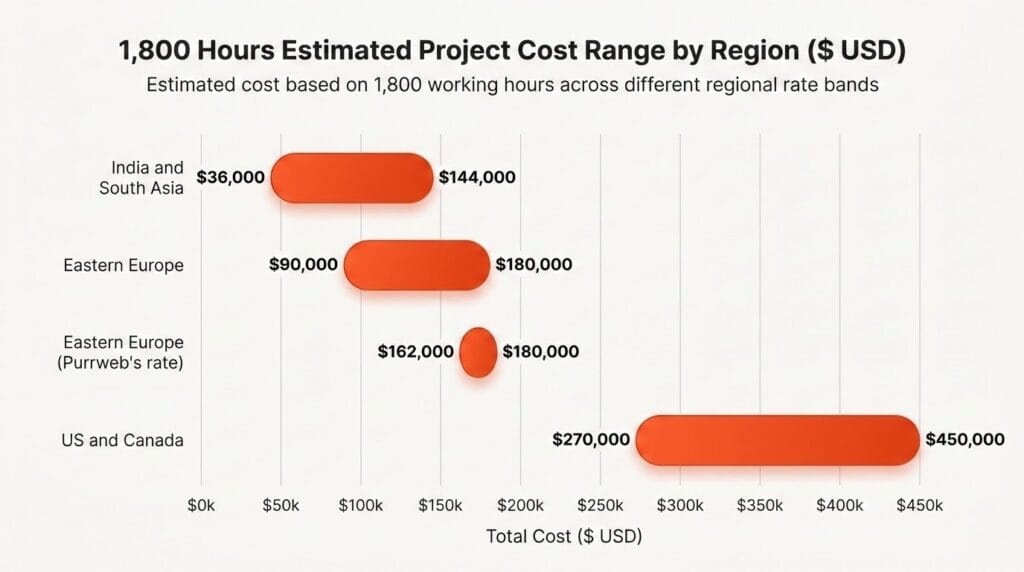
Now price those 1,800 hours at the rates the ranking pages publish:
| Region | Hourly rate published | Published by | 1,800 hours costs |
|---|---|---|---|
| India and South Asia | 20–80 | Suffescom, Appinventiv | 36,000–144,000 |
| Eastern Europe | 50–100 | Innowise | 90,000–180,000 |
| Eastern Europe (Purrweb’s own rate) | 90–100 | Purrweb | 162,000–180,000 |
| US and Canada | 150–250 | Innowise | 270,000–450,000 |
The floor of that table is $36,000, and Dev Technosys prices an entire exchange at $15,000 to $30,000. Its complete product costs less than the lowest possible price of the hours Omega spent on the CRM and wallet layer alone, before any matching engine, liquidity, or market data. The two pages are not disagreeing about price. One of them is not describing the same thing.
What this page will not claim. Omega Solution does not publish the fee for that project. Those fields came off twelve case studies earlier this month, once it was clear the stored values worked out to hourly rates nobody charges. Nothing has replaced them yet. Instead, the buyer can check the scope, team, and hours against any pricing they choose.
What fintech software actually includes
Fintech software is not one build. It is four layers bought from different vendors, each billing on its own unit, with the joins left for the buyer to pay for. Of the nine pages ranking for the definition, three are university careers blogs and one dates to 2021, so the term has drifted from anyone commissioning a system.
The division that matters commercially, with the unit each layer bills on:
| Layer | What it does | Usual billing unit |
|---|---|---|
| Ledger and accounts | Balances, double-entry, reconciliation, statements | Built, or per account per month |
| Wallet and custody | Key management, signing, hot and cold storage | Per monthly active wallet, or per signature |
| Identity and screening | KYC, AML, sanctions, ongoing monitoring | Per verification, per screened name |
| Movement | Card rails, bank transfers, on and off ramps | Percentage plus fixed fee per transaction |
The billing units have much more influence over the bill than the feature list. The sections below illustrate two instances where the difference is a multiple rather than a margin: a platform charging per monthly active wallet and one charging per signature generate entirely different bills for the identical goods.
Omega Solution’s ledger-layer work sits closer to the accounting software pillar. This page stays on wallet, identity and exchange.
Which wallet vendors print a rate, and which make you ask
Omega Solution checked eleven wallet and custody vendors on 27 September 2026. The newer wallet-infrastructure companies print per-unit rates and the institutional custodians do not. Web3Auth, Magic, Privy and Turnkey publish tiers with allowances and overage rates. BitGo, Copper, Anchorage and Cobo send every request to a contact form.
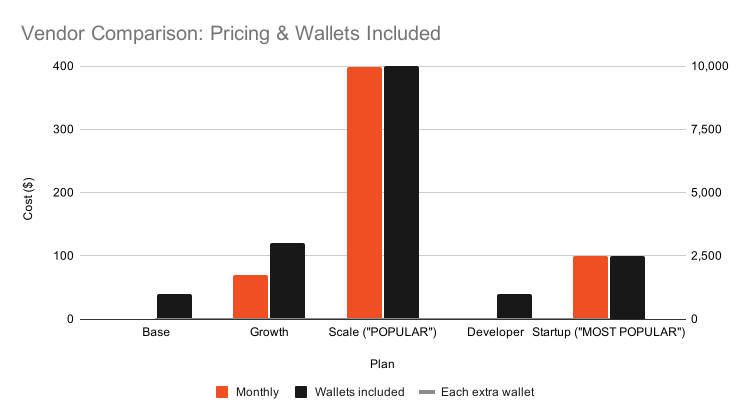
What the publishers show, per monthly active wallet:
| Vendor | Plan | Monthly | Wallets included | Each extra wallet |
|---|---|---|---|---|
| Web3Auth | Base | Free | 1,000 | $0.050 |
| Web3Auth | Growth | $69 | 3,000 | $0.045 |
| Web3Auth | Scale (“POPULAR”) | $399 | 10,000 | $0.040 |
| Magic | Developer | Free | 1,000 | $0.045 |
| Magic | Startup (“MOST POPULAR”) | $99 | 2,500 | $0.040 |
With the exception of tokenisation, which is quoted as 3–30bps on AUC, Fireblocks offers a single entry figure that starts at $36,000 annually and leaves Pro, Enterprise, and every add-on as bespoke. Any institutional custodian can only publish that much.
Two vendors, one formula
Reduce Web3Auth’s Scale plan and Magic’s Startup plan to cost functions of monthly active wallets M:
- Web3Auth Scale: 399 + 0.040(M − 10,000) = 0.040M − 1
- Magic Startup: 99 + 0.040(M − 2,500) = 0.040M − 1
They are the same function. At 13,000 wallets both cost exactly $519. At 20,000 both cost exactly $799. A founder comparing a $399 plan against a $99 plan sees a fourfold headline difference that does not exist at any volume above either allowance. Neither vendor mentions it, and there is no reason either would.
The wallet plans that cost more than the plan below them
Three published pricing structures in this market invert the usual logic, and all three are computable from the vendors’ own rate cards. In each case, a plan marketed as the upgrade is the more expensive choice across a wide band of real usage.
Web3Auth: the free plan overtakes the $69 plan at 2,380 wallets
Base is free to 1,000 wallets, then $0.050 each. Growth is a flat $69 to 3,000 wallets.
Set them equal: 0.050 × (M − 1,000) = 69, so M − 1,000 = 1,380, and M = 2,380.
Check it: at 2,380 wallets, Base costs 0.05 × 1,380 = $69.00, and Growth costs $69.00. At 3,000 wallets, still inside Growth’s flat fee, Base costs $100.00 against Growth’s $69.00. The free plan is 45% more expensive than the paid one.
Web3Auth: the plan marked POPULAR is the wrong choice below 13,000 wallets
Growth is 69 + 0.045(M − 3,000). Scale is 399 + 0.040(M − 10,000). Setting them equal gives 0.045M − 66 = 0.040M − 1, so 0.005M = 65 and M = 13,000. Both cost $519.00 there.
The revealing point is 10,000 wallets, exactly where Scale’s allowance begins: Growth costs $384.00, and Scale costs $399.00. At the volume Scale is designed for, Scale is still the dearer option. It carries the POPULAR label anyway.
Magic: the free plan beats the “MOST POPULAR” plan to 8,800 wallets
Developer is 0.045 × (M − 1,000). Startup is 99 + 0.040(M − 2,500), which reduces to 0.040M − 1. Setting them equal gives 0.005M = 44, so M = 8,800, where both cost $351.00.
| Monthly active wallets | Developer (free plan) | Startup ($99 plan) | Cheaper |
|---|---|---|---|
| 2,500 | $67.50 | $99.00 | Developer |
| 5,000 | $180.00 | $199.00 | Developer |
| 8,800 | $351.00 | $351.00 | tie |
| 10,000 | $405.00 | $399.00 | Startup |
The plan Magic labels MOST POPULAR is worse than Magic’s own free plan for every customer below 8,800 monthly active wallets, which is 8.8 times the free tier’s allowance.
Why this keeps happening. In all three cases, the overage rate falls as the tier rises, from 5 cents to 4.5 to 4. Because the per-unit rate improves while the base fee jumps, the cheaper plan’s cost line stays below the dearer plan’s line well past the point where the dearer plan’s allowance begins. The structure is not a trick, but nothing on either pricing page tells you where the crossing is, and the crossing is the only number that matters.
What to do with this. Before signing, write your vendor’s plans out as base fee plus rate times volume, set two of them equal, and solve. It is one line of algebra, and it is the difference between choosing a plan and being assigned one.
What identity checks and money movement cost per transaction
The build is one-time, and the rails are permanent, so a quote covering only the build tells a founder little. Stripe publishes 2.9% plus 30 cents for domestic cards and 0.8% for ACH Direct Debit, capped at $5.00. Adyen publishes $0.13 plus interchange plus 0.60% on Visa and Mastercard. Neither appears on any ranking cost page.
At size, the caps are more important than the percentages. Stripe’s ACH cost is essentially stable over $625 per transaction, with a 0.8% cap at $5.00. GBP bank transfers are 0.5% capped at $5.00, and SEPA Direct Debit is 0.8% plus 30 cents capped at $6.00. Rail costs on large transfers will be significantly overstated by a model that applies the % without the cap, whereas small transfers will be understated by a model that ignores the percentage below the cap.
Adyen publishes its schedule with an explicit qualifier worth quoting before anyone builds a spreadsheet on it: The fees outlined above are indicative; please get in touch to discuss pricing options. Checkout.com publishes no rate at all, offering tailored pricing behind a contact form.
Exchange fee schedules, where they are published
For anyone modelling revenue rather than cost, Kraken and Binance publish complete spot fee schedules, and Coinbase does not.
Kraken’s schedule runs from 0.40% maker and 0.80% taker at the entry tier down to 0.00% maker and 0.10% taker above $10 million in 30-day volume, and it qualifies tiers on the better of volume or assets on platform. Binance runs from 0.100% maker and taker at the regular tier to 0.011% and 0.023% at VIP 9, with a 25% discount for paying fees in BNB.
Coinbase publishes no table. Its own help page states that to see the structure, a user must sign in to their Coinbase.com account and see the Coinbase Advanced fees page, and that Tiers update hourly based on trading volume. A competitor’s published schedule is a planning input. A gated one is not, and a business model built on assumed Coinbase parity is built on an assumption.
Identity verification is priced per check, and the definition of a check varies
Sumsub, Persona and Veriff publish per-verification pricing; Entrust, which now owns Onfido, routes to “Talk to an Identity Expert”. The number that moves a budget is not the headline per-check price but what counts as a check. A re-run after a failed capture, a document plus a liveness test, and an ongoing sanctions re-screen may each bill separately, and the per-check figure quoted in a sales conversation is usually the first of those.
Therefore, the practical challenge for a scoping document is not how much you charge for each verification, but rather what events result in a chargeable verification and how many are anticipated for each authorized user. Whatever the actual re-check rate is, a KYC line based on one check per user will be inaccurate.
White label or custom, and the break-even nobody computes
All nine pages ranking for white label crypto exchange vs custom are published by a party that sells one or both options. Zero are independent. Five take a side, and not one of the five discloses that it sells the side it recommends. Three disclose, and all three are vendors that sell both, which makes disclosure free.
The business model makes all of the recommendations. White-label is recommended for every page that sells exclusively white-label. Custom is recommended on any page that sells solely custom. Every page that offers both refuses to make a decision.
A disclosure before the method. Omega Solution sells custom development, so what follows is a way to compute the answer rather than the answer itself.
Five of the nine publish no dollar figures at all, on a decision that is purely economic. Zero of nine compute a break-even, which is the only question the query asks. Here is how to compute yours.
White-label costs a setup fee plus a monthly license, and often a share of revenue. Custom costs hours times rate, once, plus maintenance. The crossing point in months N is:
N = (custom build cost − white-label setup) ÷ (monthly license + monthly revenue share)
Worked with published figures rather than invented ones: B2Broker publishes B2TRADER starting from $2,500 / mo. CISIN, the one page on that SERP pricing both sides, publishes white-label setup at $30,000 to $80,000. Take Omega’s measured 1,800 hours at an Eastern European $90, which is $162,000, against a $30,000 setup and $2,500 a month:
N = (162,000 − 30,000) ÷ 2,500 = 52.8 months, a little over four years.
Change one input and the answer moves a long way. At South Asian rates, the same 1,800 hours is $36,000, and N = (36,000 − 30,000) ÷ 2,500 = 2.4 months. At B2Broker’s own higher published tier of $6,000 a month with an Eastern European build, N = 132,000 ÷ 6,000 = 22 months.
Which is why nobody publishes it. The answer is not a fact about the two options. It is a fact about your build rate and your license tier, and it swings from ten weeks to four years across published inputs. Any page that tells you white-label or custom wins without asking your rate is selling one of them.
One more term belongs in that division and is almost always left out: B2Broker states that A-book commissions offset all software subscriptions, meaning the license can fall to zero if you route order flow through the vendor. That is a real discount and also a lock-in, and it makes the monthly denominator a negotiation rather than a number.
What compliance costs, and when the license exceeds the build
Across the fifty-one pages Omega Solution audited, one prices regulatory licensing at all. Suffescom publishes US state money transmitter licenses at $50,000 to $200,000, against its own white-label MVP at $25,000 to $80,000. On its own figures, the license costs more than the software, and nine of the ten cost pages never mention licensing exists.
No central bank, statistics agency, or regulator discloses the cost of creating an exchange figure or the cost of obtaining a MiCA license. Each number that is in use for both originates from a company that offers the service. The clock, which is more helpful, is what regulators do publish.
The numbers that come from the regulation itself
MiCA is Regulation (EU) 2023/1114, and it has applied generally since 30 December 2024 under Article 149(2), with Titles III and IV running earlier from 30 June 2024 under Article 149(3). Article 59(1) is the operative sentence for anyone planning to serve EU users, and it has two limbs: A person shall not provide crypto-asset services, within the Union, unless that person is: (a) a legal person or other undertaking that has been authorised as a crypto-asset service provider in accordance with Article 63; or (b) a credit institution, central securities depository, investment firm, market operator, electronic money institution, UCITS management company, or an alternative investment fund manager that is allowed to provide crypto-asset services pursuant to Article 60.
Commercially speaking, limb (b) is often overlooked. A founder does not always require a new Article 63 permission if they already have an authorization for an investment firm or e-money institution under Article 60. Before scoping the compliance work, anyone purchasing or expanding on that premise should determine which limb applies.
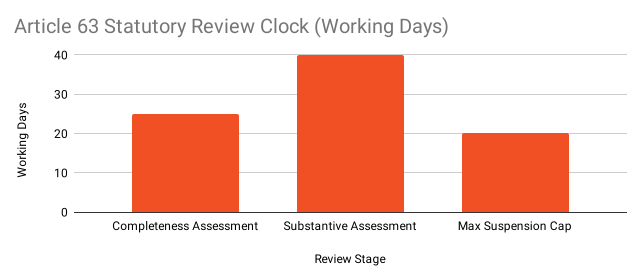
Article 63 sets a statutory clock, not an estimate. The competent authority has 25 working days to assess completeness and 40 working days for the substantive assessment, with any suspension capped at 20 working days. A founder can plan against that. Consultancy estimates of six to twelve months cannot be checked against anything.
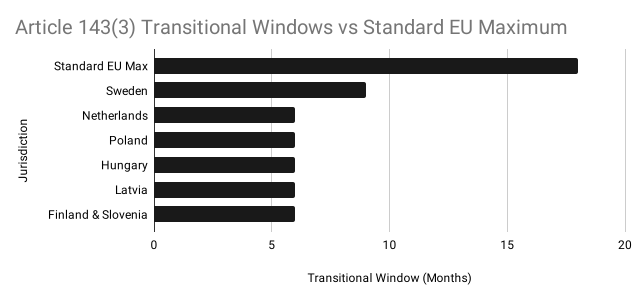
The transitional window is closed, and for many firms it closed earlier than the headline date. Article 143(3) is precise about this: providers operating lawfully before 30 December 2024 may continue to do so until 1 July 2026 or until they are granted or refused an authorisation pursuant to Article 63, whichever is sooner.
Read the last three words. A firm that applied and received a decision lost the transitional cover on the date of that decision, not on 1 July. Refusal ends it just as finally as approval. None of the pages this section corrects mentions that.
Member states could also shorten the window, and several did. On ESMA’s own list, Latvia, Hungary, the Netherlands, Poland, Slovenia and Finland ran six months and Sweden ran nine. ESMA attaches a caveat to that list worth carrying across: the periods were communicated by national authorities and may not all have been transposed into national law. Any page still advising founders that they can operate under a national regime into 2026 is describing a window that has shut.
As of 1 September 2026 the EBA’s own figures were 39 e-money tokens issued and zero asset-referenced tokens authorized. Content describing authorized ARTs under MiCA is describing something that has not happened.
The threshold that does not exist
This is the most common factual error in agency writing on the subject, and it is checkable in one sentence.
The EU travel rule for crypto is Regulation (EU) 2023/1113, on information accompanying transfers of funds and certain crypto-assets, OJ L 150/1 of 9 June 2023, in application since 30 December 2024. A great deal of published guidance states that it carries a €1,000 threshold for crypto. It does not. Recital 30 closes with this: In order to reflect those specific features, transfers of crypto-assets should be subject to the same requirements regardless of their amount and of whether they are domestic or cross-border transfers.
The €1,000 figure is real, and it lives elsewhere. It governs transfers of funds in Articles 5(2), 6(2) and 7(3), and it governs the ownership verification required on transfers to or from self-hosted addresses. Neither is a floor below which a crypto transfer escapes the traceability obligation.
Applying the funds threshold to crypto produces a compliance design that misses everything beneath it, which is the opposite of what the recital asks for. If a vendor’s scoping document contains a €1,000 crypto threshold, that vendor has taken the number from a summary rather than the regulation.
A fintech build with its hours and team published
Omega Solution scored the pages ranking for fintech case study on 27 September 2026 against the same five points used across this series. None publishes a project cost. None sets a baseline besides an outcome. The strongest reaches three of five, and one page-one result is a tag archive holding 175 words.
The tests, unchanged from earlier audits in this series: is the client named; is there an outcome with a number on both sides of it; is the team size or the duration on the page; is any budget figure published; and is there a byline, or a quote signed by someone with a job title.
Coinex Crypto
The build described earlier is a crypto exchange CRM and wallet management platform for a Bulgarian operator, launched in 2025. Nine weeks, five people, 1,800 hours. Laravel and React. The scope covered deposits, withdrawals and exchanges, admin-controlled fees, KYC document upload and staff verification, support ticketing, role-based access control and an audit trail.
The client quote is attributed to Asparuh Gavrailov, Chairman of the Board and co-organiser of Cyber Security Challenge Bulgaria.
That clears three of the five points. The client is named, the duration and headcount sit on the page, and the quote carries a real person and a title. It also publishes hours, which nothing on that SERP does.
The two failures. No outcome carries a number on either side of it, because the impact section is written in adjectives. And no fee is published, for the reason given further up this page.
One claim this page does not make. Omega Solution’s case study carousel currently advertises $40M, Crypto Exchange in 6 Months and a 1,120% Increase in Exchange Profit against a different project. The page those figures link to describes a five-week build by a team of three and publishes neither number. Until that is reconciled, the figures do not appear on this page, and a claim an agency cannot reconcile against its own project page is not evidence a buyer should accept from anyone, including Omega Solution.

How Omega Solution builds a fintech quote
Omega Solution quotes this work from three declared inputs: how many people, at what blended rate, over how many weeks. No other form can be checked by the person paying for it. Coinex is the worked example: five people, nine weeks, 1,800 hours, and whatever rate you want to apply.
Roles and headcount appear on the proposal ahead of any price. Five people over nine weeks is 1,800 hours. If a quote implies more hours than the stated team can work in the stated timeline, one of the three numbers is wrong, and it is worth finding out which before signing rather than after.
The construction and compliance are scoped independently. They have separate lines with their own estimations for KYC vendor expenses, screening, licensing, and audit. You cannot compare a build quote that silently contains them to another.
What is excluded is written down. Wallet infrastructure fees, KYC per-verification charges, hosting, market data and ongoing maintenance sit outside the build figure. The convention of quoting maintenance as a flat percentage of build cost appears unsourced on pages across two different industry SERPs, so Omega Solution quotes maintenance against a scope instead.
A personal note, not a company one. In this vertical, the license, not the software, is usually what decides whether a launch happens on time. If a development quote arrives without a compliance line, the vendor has either assumed someone else is handling it or has not thought about it, and both are worth an early question.
Frequently Asked Questions
How much does crypto exchange development cost?
Published ranges run from $5,000 to $1,240,000, which is a factor of 248 and therefore not an answer. A measurable one: Omega Solution’s exchange CRM and wallet platform took 1,800 hours, which costs $36,000 to $144,000 at published South Asian rates and $270,000 to $450,000 at published US rates. The only competitor that derives hours independently, Purrweb, puts a custom exchange MVP at 1,560 to 2,220 hours.
Why do crypto exchange cost estimates vary so much?
Because almost none of them state what the number buys. Six of ten ranking pages publish hourly rate tables alongside their totals, and none multiply the two, so the totals cannot be checked against the rates on the same page. Five of ten use $30,000 as a band boundary without sourcing it, and the same unsourced $30,000 anchors an unrelated industry’s cost SERP.
Is white label cheaper than a custom crypto exchange?
It depends on your build rate and license tier, and the honest answer is a division rather than a verdict. Break-even in months is the custom build cost minus white-label setup, divided by the monthly license plus revenue share. On published figures, that lands anywhere from 2.4 months to 52.8 months. No page ranking for that query computes it.
What does a crypto wallet infrastructure vendor charge?
Web3Auth publishes free, $69 and $399 tiers at 1,000, 3,000 and 10,000 monthly active wallets. Magic publishes free and $99 tiers at 1,000 and 2,500. Both charge per additional wallet at 4 to 5 cents. Institutional custodians publish almost nothing; Fireblocks states “Starting at $36,000 per year” and leaves the rest custom.
Does the EU travel rule have a €1,000 threshold for crypto?
No. Recital 30 of Regulation (EU) 2023/1113 states that “transfers of crypto-assets should be subject to the same requirements regardless of their amount and of whether they are domestic or cross-border transfers.” The €1,000 threshold sits in Articles 5(2), 6(2) and 7(3), where it governs transfers of funds, and separately on the self-hosted address ownership check. This is the most common factual error in published guidance on the subject.
How long does a MiCA license take?
Article 63 of Regulation (EU) 2023/1114 sets 25 working days for the competent authority to assess completeness and 40 working days for the substantive assessment, with any suspension capped at 20 working days. Those are statutory figures. Any month-count you see beyond them comes from a firm selling licensing services, not from a regulator.



 Aug 26, 2025


 Dhaka, Bangladesh

